Skip to Content
Merck

208523

Ruthenium(III) chloride

solid, Ru content 45-55%

Synonym(s):

Ruthenium trichloride

Sign In to View Organizational & Contract Pricing.

Select a Size


About This Item

Linear Formula:
RuCl3
CAS Number:
Molecular Weight:
207.43
NACRES:
NA.22
PubChem Substance ID:
UNSPSC Code:
12161600
EC Number:
233-167-5
MDL number:
Technical Service
Need help? Our team of experienced scientists is here for you.
Let Us Assist
Technical Service
Need help? Our team of experienced scientists is here for you.
Let Us Assist

Product Name

Ruthenium(III) chloride, Anhydrous, solid, Ru content 45-55%

InChI key

YBCAZPLXEGKKFM-UHFFFAOYSA-K

InChI

1S/3ClH.Ru/h3*1H;/q;;;+3/p-3

SMILES string

Cl[Ru](Cl)Cl

Quality Level

form

solid

reaction suitability

core: ruthenium, reagent type: catalyst
reaction type: Atom Transfer Radical Polymerization (ATRP)

density

3.11 g/mL at 25 °C (lit.)

Looking for similar products? Visit Product Comparison Guide

General description

Ruthenium(III) chloride is a chemical compound, that can be used as a mild Lewis acid catalyst for the acetalization of aldehydes, acetalization of alcohols, and conversion of ketoximes to amides. Additionally, it can also be used as a precursor to synthesize Ru nanoparticles.

Application

Ruthenium(III) chloride is used as a catalyst:

  • In the synthesis of β‐amino alcohols by nucleophilic opening of epoxides with anilines.
  • In the acetylation of varies of phenols, alcohols, thiols, and amines under mild conditions.
  • In the synthesis of α‐aminonitriles by mixing aldehydes, amines, and trimethylsilyl cyanides.

Other Notes
insoluble form

signalword

Danger

Hazard Classifications

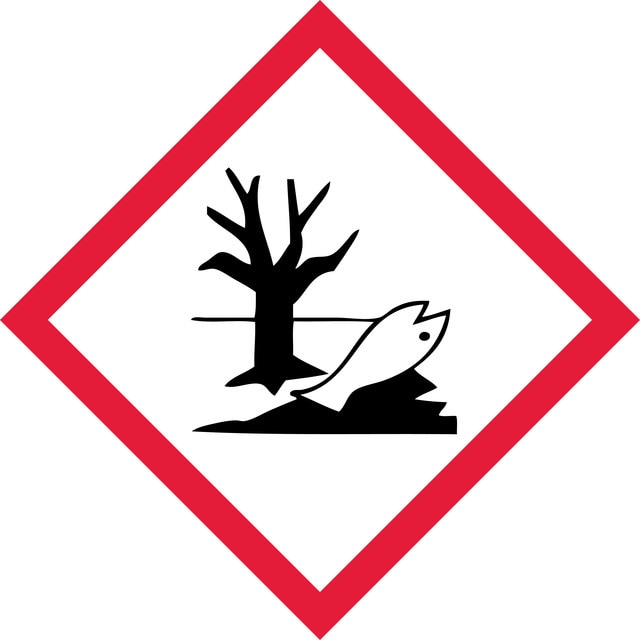
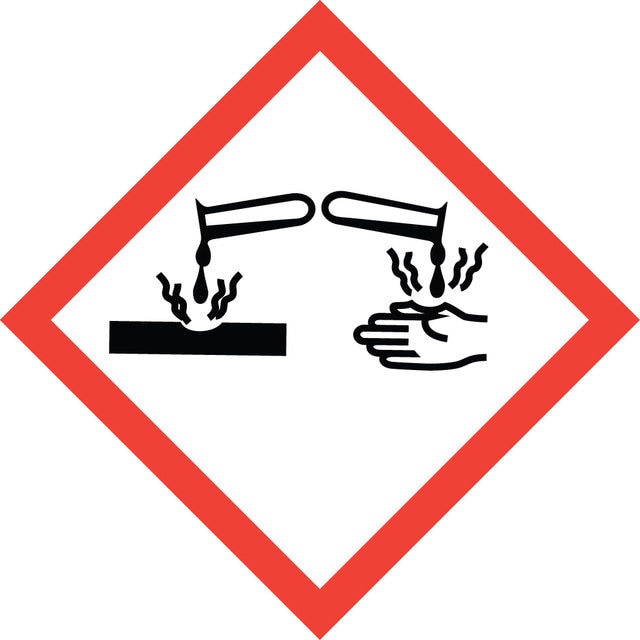
Acute Tox. 4 Oral - Aquatic Chronic 2 - Eye Dam. 1 - Skin Corr. 1B

Storage Class

8B - Non-combustible corrosive hazardous materials

wgk

WGK 3

flash_point_f

Not applicable

flash_point_c

Not applicable

ppe

Eyeshields, Faceshields, Gloves, type P3 (EN 143) respirator cartridges


Choose from one of the most recent versions:

Certificates of Analysis (COA)

Lot/Batch Number

Don't see the Right Version?

If you require a particular version, you can look up a specific certificate by the Lot or Batch number.

Already Own This Product?

Find documentation for the products that you have recently purchased in the Document Library.

Visit the Document Library

Patrik Västilä et al.
Chemistry (Weinheim an der Bergstrasse, Germany), 12(12), 3218-3225 (2006-01-28)
We studied the role of alkali cations in the [{RuCl2(p-cymene)}2]-pseudo-dipeptide-catalyzed enantioselective transfer hydrogenation of ketones with isopropanol. Lithium salts were shown to increase the enantioselectivity of the reaction when iPrONa or iPrOK was used as the base. Similar transfer-hydrogenation systems
Tetrahedron Letters, 48, 5131-5131 (2007)
Yoshihiko Yamamoto et al.
Organic & biomolecular chemistry, 3(9), 1768-1775 (2005-04-29)
In the presence of catalytic amounts of Cp*RuCl(cod), the partially intramolecular cyclotrimerizations of various C-alkynylglycosides and C-diynylglycosides proceeded at ambient temperature to afford C-arylglycosides.
Jong Seok Lee et al.
The Journal of organic chemistry, 72(15), 5820-5823 (2007-06-26)
Ruthenium-catalyzed site-specific C-H oxyfunctionalization of steroidal ethers with periodate or bromate as terminal oxidants in phosphate buffer provided the acid-sensitive C-16 hydroxy compounds in high yields. Phosphate buffer (pH 7.5) significantly inhibits formation of unwanted side products generated under more
Sébastien Perdriau et al.
ChemSusChem, 5(12), 2427-2434 (2012-10-13)
Cardanol, a constituent of cashew nutshell liquid (CNSL), was subjected to transfer hydrogenation catalyzed by RuCl(3) using isopropanol as a reductant. The side chain of cardanol, which is a mixture of a triene, a diene, and a monoene, was selectively

Our team of scientists has experience in all areas of research including Life Science, Material Science, Chemical Synthesis, Chromatography, Analytical and many others.

Contact Technical Service