Skip to Content
Merck

377996

Titanium(IV) isopropoxide

99.999% trace metals basis

Synonym(s):

TTIP, Tetraisopropyl orthotitanate

Sign In to View Organizational & Contract Pricing.

Select a Size


About This Item

Linear Formula:
Ti[OCH(CH3)2]4
CAS Number:
Molecular Weight:
284.22
UNSPSC Code:
12352107
NACRES:
NA.23
PubChem Substance ID:
EC Number:
208-909-6
Beilstein/REAXYS Number:
3679474
MDL number:
Technical Service
Need help? Our team of experienced scientists is here for you.
Let Us Assist
Technical Service
Need help? Our team of experienced scientists is here for you.
Let Us Assist

InChI key

VXUYXOFXAQZZMF-UHFFFAOYSA-N

InChI

1S/4C3H7O.Ti/c4*1-3(2)4;/h4*3H,1-2H3;/q4*-1;+4

SMILES string

CC(C)O[Ti](OC(C)C)(OC(C)C)OC(C)C

assay

99.999% trace metals basis

form

liquid

reaction suitability

core: titanium, reagent type: catalyst

refractive index

n20/D 1.464 (lit.)

bp

232 °C (lit.)

mp

14-17 °C (lit.)

density

0.96 g/mL at 20 °C (lit.)

Quality Level

Looking for similar products? Visit Product Comparison Guide

General description

Titanium(IV)isopropoxide is a high-purity, colorless to yellowish liquid with a pungentodor. It is a colorless to yellowish liquid with a pungent odor. This compoundis used in various applications such as producing high-quality titanium dioxidefilms on glass and in electronics to produce thin-film transistors. It is alsoused in the production of specialty polymers, ceramics, and in organicsynthesis.

Application

Novel metal oxide/phosphonate hybrids were formed from titanium(IV) isopropoxide in a two-step sol-gel process. Starting material for barium-strontium-titanate thin films. Used to make porous titanosilicates, potential ion-exchange materials for cleanup of radioactive wastes. Applied in the formation of a heterosupermolecule consisting of a TiO2 nanocrystallite-viologen electron acceptor complex whose light-induced electron transfer has been demonstrated.

pictograms

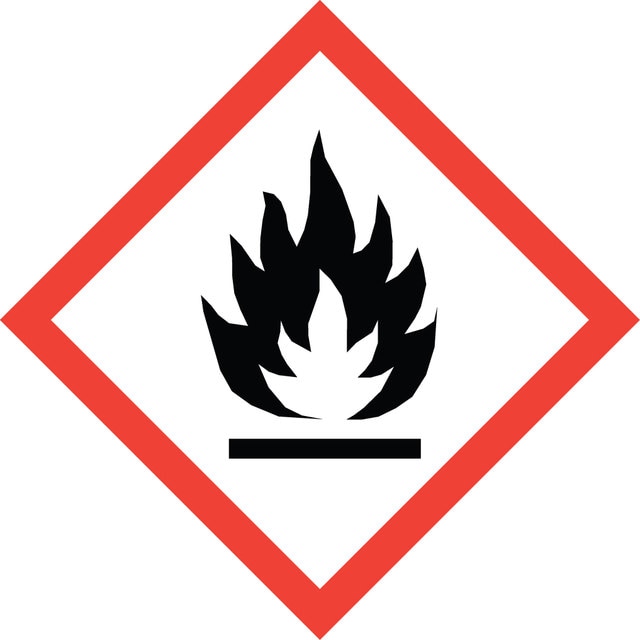
FlameExclamation mark

signalword

Warning

Hazard Classifications

Eye Irrit. 2 - Flam. Liq. 3 - STOT SE 3

target_organs

Central nervous system

Storage Class

3 - Flammable liquids

wgk

WGK 1

flash_point_f

105.8 °F - Pensky-Martens closed cup

flash_point_c

41 °C - Pensky-Martens closed cup

ppe

Eyeshields, Faceshields, Gloves, type ABEK (EN14387) respirator filter


Choose from one of the most recent versions:

Certificates of Analysis (COA)

Lot/Batch Number

Don't see the Right Version?

If you require a particular version, you can look up a specific certificate by the Lot or Batch number.

Already Own This Product?

Find documentation for the products that you have recently purchased in the Document Library.

Visit the Document Library

  1. Which document(s) contains shelf-life or expiration date information for a given product?

    If available for a given product, the recommended re-test date or the expiration date can be found on the Certificate of Analysis.

  2. How do I get lot-specific information or a Certificate of Analysis?

    The lot specific COA document can be found by entering the lot number above under the "Documents" section.

  3. Sometimes I receive Product 377996, Titanium (IV) isopropoxide as a solid and sometimes as a liquid. Which is correct?

    The melting point of this product is right around ambient temperature at 18-20°C. Depending on the transportation considerations, the product may arrive as either.

  4. Product 377996, Titanium (IV) isopropoxide is slightly yellow and it has always been colorless in the past.

    While many lots have passed as a colorless liquid, our specifications will also allow for a slightly yellow liquid (up to 25 APHA).

  5. Is Product 377996, Titanium (IV) isopropoxide packaged under an inert gas?

    Yes, we package this product under nitrogen. This product is considered air and moisture sensitive. The MSDS recommends handling and storing titanium (IV) isopropoxide under nitrogen.

  6. How do I find price and availability?

    There are several ways to find pricing and availability for our products. Once you log onto our website, you will find the price and availability displayed on the product detail page. You can contact any of our Customer Sales and Service offices to receive a quote.  USA customers:  1-800-325-3010 or view local office numbers.

  7. What is the Department of Transportation shipping information for this product?

    Transportation information can be found in Section 14 of the product's (M)SDS.To access the shipping information for this material, use the link on the product detail page for the product. 

  8. My question is not addressed here, how can I contact Technical Service for assistance?

    Ask a Scientist here.

Weihua Ning et al.
Advanced materials (Deerfield Beach, Fla.), 30(20), e1706246-e1706246 (2018-04-01)
Developing environmentally friendly perovskites has become important in solving the toxicity issue of lead-based perovskite solar cells. Here, the first double perovskite (Cs2 AgBiBr6 ) solar cells using the planar structure are demonstrated. The prepared Cs2 AgBiBr6 films are composed
Manas K Panda et al.
Dalton transactions (Cambridge, England : 2003), 39(9), 2428-2440 (2010-02-18)
Controlled oxidation of organic sulfides to sulfoxides under ambient conditions has been achieved by a series of titanium isopropoxide complexes that use environmentally benign H(2)O(2) as a primary oxidant. Specifically, the [N,N'-bis(2-oxo-3-R(1)-5-R(2)-phenylmethyl)-N,N'-bis(methylene-R(3))-ethylenediamine]Ti(O(i)Pr)(2) [R(1) = t-Bu, R(2) = Me, R(3) =
Laszlo Sipos et al.
Biomacromolecules, 6(5), 2570-2582 (2005-09-13)
A poly(styrene-b-isobutylene-b-styrene) (SIBS) triblock polymer is employed as the polymer drug carrier for the TAXUS Express2 Paclitaxel-Eluting Coronary Stent system (Boston Scientific Corp.). It has been shown that the release of paclitaxel (PTx) from SIBS can be modulated by modification
Alfred J Wooten et al.
Organic letters, 9(3), 381-384 (2007-01-26)
[reaction: see text] We report the catalytic asymmetric allylation of ketones under highly concentrated reaction conditions with a catalyst generated from titanium tetraisopropoxide and BINOL (1:2 ratio) in the presence of isopropanol. This catalyst promotes the addition of tetraallylstannane to
Henrique Antonio Mendonça Faria et al.
Materials science & engineering. C, Materials for biological applications, 56, 260-268 (2015-08-08)
The structural and electronic properties of titanium oxide nanotubes (TiO2) have attracted considerable attention for the development of therapeutic devices and imaging probes for nanomedicine. However, the fluorescence response of TiO2 has typically been within ultraviolet spectrum. In this study

Our team of scientists has experience in all areas of research including Life Science, Material Science, Chemical Synthesis, Chromatography, Analytical and many others.

Contact Technical Service