Sign In to View Organizational & Contract Pricing.
Select a Size
About This Item
Linear Formula:
Ba(OH)2
CAS Number:
Molecular Weight:
171.34
NACRES:
NA.23
PubChem Substance ID:
UNSPSC Code:
12352302
EC Number:
241-234-5
MDL number:
Assay:
~95%
Grade:
technical grade
Form:
powder
InChI key
RQPZNWPYLFFXCP-UHFFFAOYSA-L
InChI
1S/Ba.2H2O/h;2*1H2/q+2;;/p-2
SMILES string
O[Ba]O
grade
technical grade
assay
~95%
form
powder
reaction suitability
core: barium
mp
>300 °C (lit.)
density
2.2 g/mL at 25 °C (lit.)
Quality Level
Looking for similar products? Visit Product Comparison Guide
Related Categories
Application
Reagent used in wet chemical gel-to-crystallite conversion to form BaTiO3 at low temperatures.
signalword
Danger
hcodes
Hazard Classifications
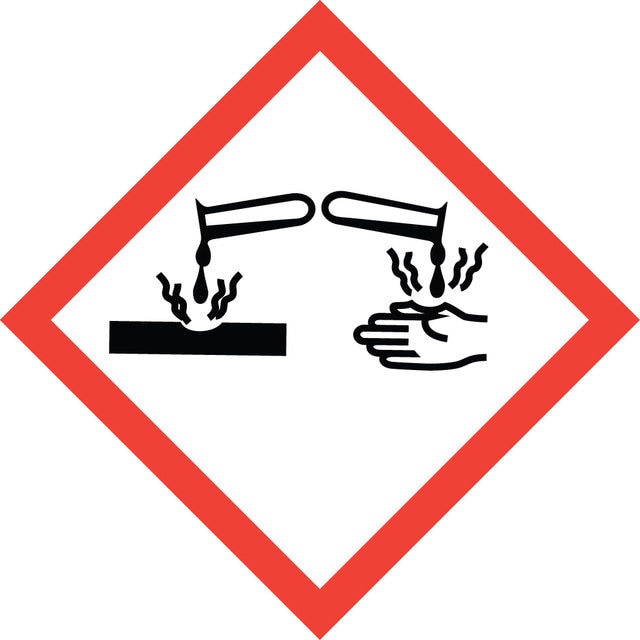
Acute Tox. 4 Inhalation - Acute Tox. 4 Oral - Eye Dam. 1 - Skin Corr. 1
Storage Class
8A - Combustible corrosive hazardous materials
wgk
WGK 1
flash_point_f
Not applicable
flash_point_c
Not applicable
ppe
Eyeshields, Faceshields, Gloves, type P3 (EN 143) respirator cartridges
Choose from one of the most recent versions:
Already Own This Product?
Find documentation for the products that you have recently purchased in the Document Library.
Kutty, T.R.N. Padmini, P.
Materials Chemistry and Physics, 39, 200-200 (1995)
M F Byford
The Biochemical journal, 280 ( Pt 1), 261-265 (1991-11-15)
The beta-elimination of phosphoserine residues by dilute alkali is catalysed by the presence of group II metal ions. The use of 0.1 M-Ba (OH)2 catalysed the rate of beta-elimination of phosphoserine by more than two orders of magnitude compared with
Spontaneous ignition, explosion, and fire with sevoflurane and barium hydroxide lime.
Junzheng Wu et al.
Anesthesiology, 101(2), 534-537 (2004-07-28)
Marshall B Dunning et al.
Anesthesiology, 106(1), 144-148 (2007-01-02)
Fires, explosions, and extreme heat production may occur when sevoflurane reacts with desiccated barium hydroxide lime. The identity of the flammable gas has not previously been published, although carbon monoxide, methanol, formaldehyde, and methyl formate have been identified in low
P J Baxter et al.
Anesthesiology, 89(4), 929-941 (1998-10-20)
Desflurane, enflurane and isoflurane can be degraded to carbon monoxide (CO) by carbon dioxide absorbents, whereas sevoflurane and halothane form negligible amounts of CO. Carbon monoxide formation is greater with drier absorbent, and with barium hydroxide, than with soda lime.
Our team of scientists has experience in all areas of research including Life Science, Material Science, Chemical Synthesis, Chromatography, Analytical and many others.
Contact Technical Service