
103004

2-Hexanone
reagent grade, 98%
Synonym(s):
Butyl methyl ketone
Sign In to View Organizational & Contract Pricing.
Select a Size
About This Item
Linear Formula:
CH3(CH2)3COCH3
CAS Number:
Molecular Weight:
100.16
UNSPSC Code:
12352115
NACRES:
NA.21
PubChem Substance ID:
EC Number:
209-731-1
Beilstein/REAXYS Number:
1737676
MDL number:
Assay:
98%
Grade:
reagent grade
Bp:
127 °C (lit.)
Vapor pressure:
10 mmHg ( 39 °C)
InChI key
QQZOPKMRPOGIEB-UHFFFAOYSA-N
InChI
1S/C6H12O/c1-3-4-5-6(2)7/h3-5H2,1-2H3
SMILES string
CCCCC(C)=O
grade
reagent grade
vapor pressure
10 mmHg ( 39 °C)
assay
98%
form
liquid
dilution
(for analytical testing)
refractive index
n20/D 1.401 (lit.)
bp
127 °C (lit.)
mp
−57 °C (lit.)
density
0.812 g/mL at 25 °C (lit.)
Quality Level
Looking for similar products? Visit Product Comparison Guide
Related Categories
General description
2-Hexanone can also be synthesized via Wacker oxidation of 1-hexene. It can be used as a solvent in paints, oils and waxes.
Application
Inhalation is suspected of causing peripheral neuropathy.
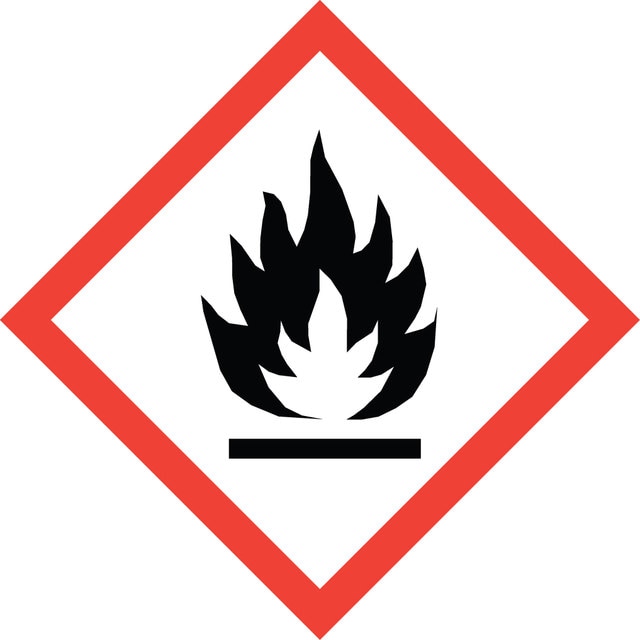


signalword
Danger
hcodes
Hazard Classifications
Flam. Liq. 3 - Repr. 2 - STOT RE 1 - STOT SE 3
target_organs
Central nervous system
Storage Class
3 - Flammable liquids
wgk
WGK 1
flash_point_f
73.4 °F - closed cup
flash_point_c
23 °C - closed cup
Choose from one of the most recent versions:
Already Own This Product?
Find documentation for the products that you have recently purchased in the Document Library.
"Wacker oxidation of 1-hexene in 1-n-butyl-3-methylimidazolium hexafluorophosphate ([bmim][PF6]), supercritical (SC) CO2, and SC CO2/[bmim][PF6] mixed solvent"
Hou Z, et al.
New. J. Chem., 26(09), 1246-1248 (2002)
Dikshith.S.S.T
Handbook of Chemicals and Safety (2016)
Peripheral neuropathy associated with inhalation of methyl-n-butyl ketone.
S Duckett et al.
Experientia, 30(11), 1283-1284 (1974-11-15)
Y Lolin
Human toxicology, 8(4), 293-300 (1989-07-01)
1. The main neurological disorders associated with chronic VSA are peripheral neuropathy, cerebellar disease, chronic encephalopathy and dementia. Apart from peripheral neuropathy, the clinical features are non-specific, evidence for solvent-related toxicity is in most cases circumstantial and there is no
J W Griffin
Neurobehavioral toxicology and teratology, 3(4), 437-444 (1981-01-01)
The neurotoxicity of hexacarbon solvents has become apparent only recently, but an extensive literature has already developed as a result of the clinical and epidemiological implications of the human disease, and the advantages of small animal models of hexacarbon neurotoxicity
Our team of scientists has experience in all areas of research including Life Science, Material Science, Chemical Synthesis, Chromatography, Analytical and many others.
Contact Technical Service