
Skip to Content
Merck

24127

tert-Butanol

≥99% (GC)

Synonym(s):

2-Methyl-2-propanol, tert-Butyl alcohol, Trimethyl carbinol

Sign In to View Organizational & Contract Pricing.

Select a Size


About This Item

Linear Formula:
(CH3)3COH
CAS Number:
Molecular Weight:
74.12
UNSPSC Code:
41116107
NACRES:
NA.21
PubChem Substance ID:
EC Number:
200-889-7
Beilstein/REAXYS Number:
906698
MDL number:
Technical Service
Need help? Our team of experienced scientists is here for you.
Let Us Assist
Technical Service
Need help? Our team of experienced scientists is here for you.
Let Us Assist

Product Name

tert-Butanol, ≥99% (GC)

InChI key

DKGAVHZHDRPRBM-UHFFFAOYSA-N

InChI

1S/C4H10O/c1-4(2,3)5/h5H,1-3H3

SMILES string

CC(C)(C)O

vapor density

2.5 (vs air)

vapor pressure

31 mmHg ( 20 °C)
44 mmHg ( 26 °C)

assay

≥99% (GC)

form

liquid

autoignition temp.

896 °F

expl. lim.

8 %

technique(s)

GC/GC: suitable

impurities

≤0.001% free acid (as C3H7COOH)
≤0.001% non-volatile matter
≤0.1% water (Karl Fischer)

refractive index

n20/D 1.387 (lit.)

pH

7 (20 °C)

bp

83 °C (lit.)

mp

23-26 °C (lit.)

density

0.775 g/mL at 25 °C (lit.)

Quality Level

Looking for similar products? Visit Product Comparison Guide

Application

tert-Butanol may be employed for the preparation of carbohydrate fatty acid esters. It may be employed as a reaction medium during the production of fatty acid methyl ester (FAME) from waste cooking palm oil (WCPO) by lipase-catalyzed reaction.

It can be used for the butylation of p-cresol in the presence of 12-tungstophosphoric acid supported on zirconia catalyst. 2-tert-Butyl-p-cresol (TBC), 2,6-di-tert-butyl-p-cresol (DTBC) and tert-butyl-p-tolyl ether (ether) are formed as butylation reaction products.

General description

tert-Butanol is a tertiary alcohol. Aqueous potassium peroxodisulfate undergoes photolysis in the presence of tert-butanol on irradiation with 254nm light at 20°C to afford hydrogen sulfate.

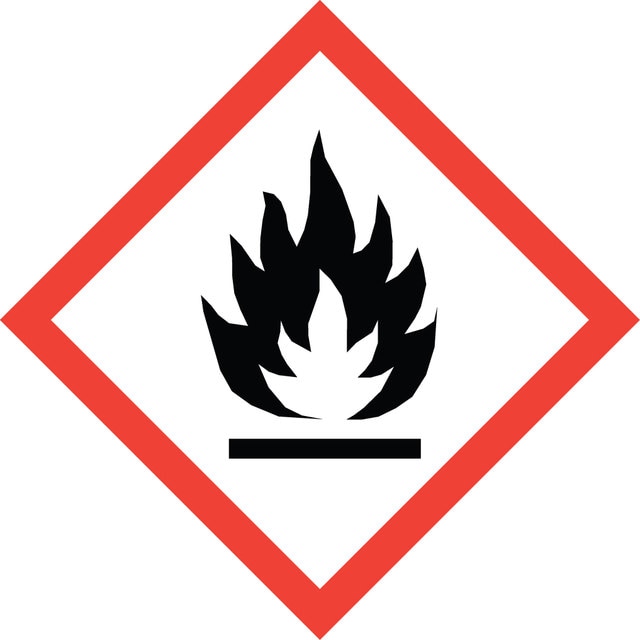
pictograms

FlameExclamation mark

signalword

Danger

Hazard Classifications

Acute Tox. 4 Inhalation - Eye Irrit. 2 - Flam. Liq. 2 - STOT SE 3

target_organs

Central nervous system, Respiratory system

Storage Class

3 - Flammable liquids

wgk

WGK 1

flash_point_f

59.0 °F - closed cup

flash_point_c

15 °C - closed cup


Choose from one of the most recent versions:

Certificates of Analysis (COA)

Lot/Batch Number

Don't see the Right Version?

If you require a particular version, you can look up a specific certificate by the Lot or Batch number.

Already Own This Product?

Find documentation for the products that you have recently purchased in the Document Library.

Visit the Document Library

Sebastian Björklund et al.
Scientific reports, 7(1), 9960-9960 (2017-09-01)
Mesoporous silica has received much attention due to its well-defined structural order, high surface area, and tunable pore diameter. To successfully employ mesoporous silica for nanotechnology applications it is important to consider how it is influenced by solvent molecules due
Lipase-catalysed synthesis of glucose fatty acid esters in tert-butanol.
Degn P, et al.
Biotechnology Letters, 21(4), 275-280 (1999)
Catalytic studies of lipase on FAME production from waste cooking palm oil in a tert-butanol system.
Halim SFA and Kamaruddin AH.
Process. Biochem., 43(12), 1436-1439 (2008)
Alkylation of p-cresol with tert-butanol catalyzed by heteropoly acid supported on zirconia catalyst.
Devassy BM, et al.
J. Mol. Catal. A: Chem., 210(1), 125-130 (2004)
Travis Marshall-Roth et al.
Nature communications, 11(1), 5283-5283 (2020-10-21)
Iron- and nitrogen-doped carbon (Fe-N-C) materials are leading candidates to replace platinum catalysts for the oxygen reduction reaction (ORR) in fuel cells; however, their active site structures remain poorly understood. A leading postulate is that the iron-containing active sites exist

Our team of scientists has experience in all areas of research including Life Science, Material Science, Chemical Synthesis, Chromatography, Analytical and many others.

Contact Technical Service