Skip to Content
Merck

M7891

N-Methyl-N-(trimethylsilyl)trifluoroacetamide

BioReagent, for silylations, LiChropur

Synonym(s):

N-Trimethylsilyl-N-methyl trifluoroacetamide, MSTFA

Sign In to View Organizational & Contract Pricing.

Select a Size


About This Item

Linear Formula:
CF3CON(CH3)Si(CH3)3
CAS Number:
Molecular Weight:
199.25
UNSPSC Code:
12352111
NACRES:
NA.25
PubChem Substance ID:
EC Number:
246-331-6
Beilstein/REAXYS Number:
1941550
MDL number:
Technical Service
Need help? Our team of experienced scientists is here for you.
Let Us Assist
Technical Service
Need help? Our team of experienced scientists is here for you.
Let Us Assist

Product Name

N-Methyl-N-(trimethylsilyl)trifluoroacetamide, BioReagent, for silylations, LiChropur

InChI

1S/C6H12F3NOSi/c1-10(12(2,3)4)5(11)6(7,8)9/h1-4H3

InChI key

MSPCIZMDDUQPGJ-UHFFFAOYSA-N

SMILES string

CN(C(=O)C(F)(F)F)[Si](C)(C)C

vapor density

>1 (vs air)

vapor pressure

8.8 mmHg ( 27 °C)

product line

BioReagent

form

liquid

quality

for silylations, LiChropur

reaction suitability

reaction type: Silylations
reagent type: derivatization reagent

technique(s)

gas chromatography (GC): suitable

refractive index

n20/D 1.38 (lit.)

bp

130-132 °C (lit.)

solubility

chloroform: soluble 0.1 mg/mL

density

1.07 g/mL at 25 °C (lit.)
1.075 g/mL at 25 °C (lit.)

storage temp.

2-8°C

Quality Level

Looking for similar products? Visit Product Comparison Guide

Application

N-Methyl-N-(trimethylsilyl)trifluoroacetamide can be used:
  • In the derivatization step of the metabolomics analysis using gas chromatography/mass spectrometry (GC/MS).
  • Derivatization reagent in gas chromatography with flame ionization detection (GC-FID) analysis.

General description

N-Methyl-N-(trimethylsilyl)trifluoroacetamide(MSTFA) is a BioReagent commonly used for silylation reactions in analyticalchemistry.

Packaging

Sealed ampules contain 1 ml. Gram sizes are in screw-cap bottles.

Legal Information

LiChropur is a trademark of Merck KGaA, Darmstadt, Germany

pictograms

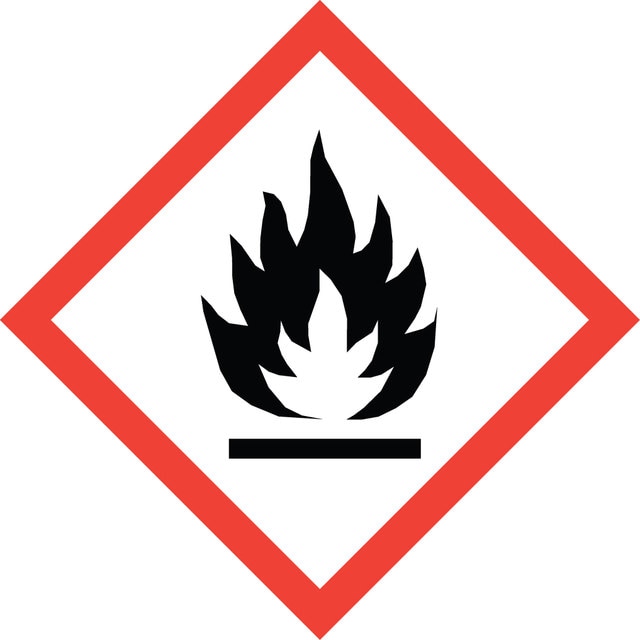
FlameExclamation mark

signalword

Warning

Hazard Classifications

Eye Irrit. 2 - Flam. Liq. 3 - Skin Irrit. 2 - STOT SE 3

target_organs

Respiratory system

Storage Class

3 - Flammable liquids

wgk

WGK 3

flash_point_f

77.0 °F - closed cup

flash_point_c

25 °C - closed cup

ppe

Eyeshields, Faceshields, Gloves, type ABEK (EN14387) respirator filter


Choose from one of the most recent versions:

Certificates of Analysis (COA)

Lot/Batch Number

Don't see the Right Version?

If you require a particular version, you can look up a specific certificate by the Lot or Batch number.

Already Own This Product?

Find documentation for the products that you have recently purchased in the Document Library.

Visit the Document Library

Iria González-Mariño et al.
Journal of chromatography. A, 1217(11), 1748-1760 (2010-02-13)
An alternative method for the sensitive determination of several drugs of abuse and some of their metabolites in surface and sewage water samples is proposed. Analytes are concentrated using a solid-phase extraction (SPE) sorbent, converted into the corresponding trimethylsilyl derivatives
Harin Kanani et al.
Journal of chromatography. B, Analytical technologies in the biomedical and life sciences, 871(2), 191-201 (2008-06-10)
Metabolomics being the most recently introduced "omic" analytical platform is currently at its development phase. For the metabolomics to be broadly deployed to biological and clinical research and practice, issues regarding data validation and reproducibility need to be resolved. Gas
Hee-Kyung Jeon et al.
Journal of chromatography. A, 1131(1-2), 192-202 (2006-08-08)
A novel method has been developed to simultaneously determine and quantify seven organic UV filters employing liquid (solid)-liquid extraction, derivatization with N-methyl-N-(trimethylsilyl) trifluoroacetamide (MSTFA) and gas chromatography with mass spectrometric detection in various environmental matrices. The UV filters determined were:
Stina K Lien et al.
Journal of chromatography. A, 1247, 118-124 (2012-06-15)
GC-MS analysis of silylated metabolites is a sensitive method that covers important metabolite groups such as sugars, amino acids and non-amino organic acids, and it has become one of the most important analytical methods for exploring the metabolome. Absolute quantitative
L Damasceno et al.
Journal of mass spectrometry : JMS, 35(11), 1285-1294 (2000-12-13)
An evaluation of derivatization procedures for the detection of beta(2)-agonists is presented. The study was performed with the beta(2)-agonists bambuterol, clenbuterol, fenoterol, formoterol, salbutamol, salmeterol and terbutaline. Different derivatizating agents were employed, aiming to obtain derivatives with high selectivity to

Our team of scientists has experience in all areas of research including Life Science, Material Science, Chemical Synthesis, Chromatography, Analytical and many others.

Contact Technical Service