Skip to Content
Merck

P9029

o-Phenylenediamine

peroxidase substrate, chromogenic, ≥98.0%, powder

Synonym(s):

1,2-Diaminobenzene, 1,2-Phenylenediamine, OPD

Sign In to View Organizational & Contract Pricing.

Select a Size


About This Item

Empirical Formula (Hill Notation):
C6H8N2
CAS Number:
Molecular Weight:
108.14
NACRES:
NA.83
PubChem Substance ID:
UNSPSC Code:
12352204
EC Number:
202-430-6
MDL number:
Beilstein/REAXYS Number:
606074
Technical Service
Need help? Our team of experienced scientists is here for you.
Let Us Assist
Technical Service
Need help? Our team of experienced scientists is here for you.
Let Us Assist

Product Name

o-Phenylenediamine, Peroxidase substrate, ≥98.0%, powder

InChI key

GEYOCULIXLDCMW-UHFFFAOYSA-N

InChI

1S/C6H8N2/c7-5-3-1-2-4-6(5)8/h1-4H,7-8H2

SMILES string

Nc1ccccc1N

vapor density

3.7 (vs air)

vapor pressure

0.01 mmHg ( 25 °C)

assay

≥98.0%

form

powder

color

white to off-white

bp

256-258 °C

mp

98-102 °C

solubility

ethanol: 50 mg/mL, clear, colorless to faintly yellow

fluorescence

λex 337 nm; λem 417 nm (Pyruvic acid derivative)

storage temp.

2-8°C

Quality Level

Looking for similar products? Visit Product Comparison Guide

Application

o-Phenylenediamine has been used in the microtiter?based assay for hyaluronan quantification. It has also been used in enzyme linked immunosorbent assay (ELISA) for color development.

Disclaimer

May darken in storage.

General description

o-Phenylenediamine (OPD) Free Base is a peroxidase substrate suitable for use in enzyme linked immunosorbent assay (ELISA) procedures. The substrate produces a soluble product that is orange-brown in color and can be read spectrophotometrically at 450 nm. The OPD reaction may be stopped with 3N HCl or 3M H2SO4 and read at 492 nm.

signalword

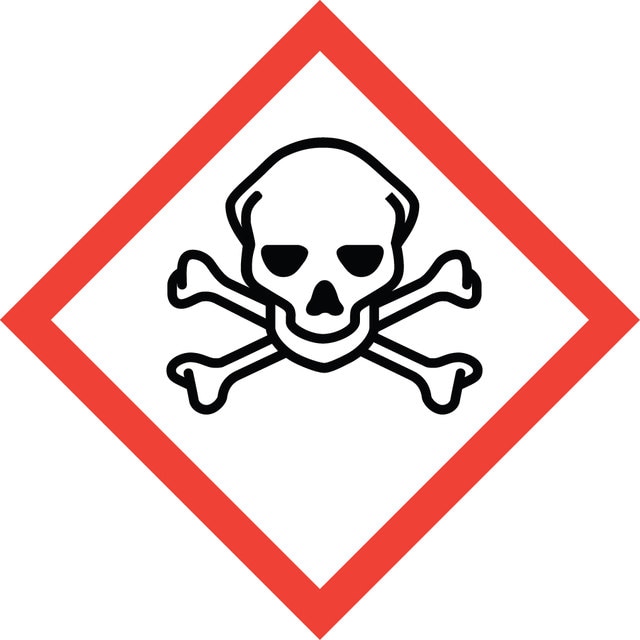
Danger

Hazard Classifications

Acute Tox. 3 Oral - Acute Tox. 4 Dermal - Acute Tox. 4 Inhalation - Aquatic Acute 1 - Aquatic Chronic 1 - Carc. 2 - Eye Irrit. 2 - Muta. 2 - Skin Sens. 1

Storage Class

6.1C - Combustible acute toxic Cat.3 / toxic compounds or compounds which causing chronic effects

wgk

WGK 3

flash_point_f

276.8 °F - closed cup

flash_point_c

136 °C - closed cup


Choose from one of the most recent versions:

Certificates of Analysis (COA)

Lot/Batch Number

Don't see the Right Version?

If you require a particular version, you can look up a specific certificate by the Lot or Batch number.

Already Own This Product?

Find documentation for the products that you have recently purchased in the Document Library.

Visit the Document Library

Kelsey E Noll et al.
Cell reports, 31(4), 107587-107587 (2020-04-30)
Host genetic factors play a fundamental role in regulating humoral immunity to viral infection, including influenza A virus (IAV). Here, we utilize the Collaborative Cross (CC), a mouse genetic reference population, to study genetic regulation of variation in antibody response
Bothrops asper envenoming in cattle: Clinical features and management using equine-derived whole IgG antivenom
C.Rodriguez, et al.
The Veterinary Journal, 207(, pages=), 160-163 (2016)
Expression of hyaluronan synthase 2 or hyaluronidase 1 differentially affect the growth rate of transplantable colon carcinoma cell tumors
Jacobson A, et al.
International Journal of Cancer. Journal International Du Cancer, 102(3), 212-219 (2002)
Patrick A Julien et al.
Beilstein journal of organic chemistry, 13, 2160-2168 (2017-11-09)
We provide the first in situ and real-time study of the effect of milling frequency on the course of a mechanochemical organic reaction conducted using a vibratory shaker (mixer) ball mill. The use of in situ Raman spectroscopy for real-time
Development of a chicken-derived antivenom against the taipan snake (Oxyuranus scutellatus) venom and comparison with an equine antivenom
Navarro D, et al.
Toxicon, 120(3), 1-8 (2016)

Our team of scientists has experience in all areas of research including Life Science, Material Science, Chemical Synthesis, Chromatography, Analytical and many others.

Contact Technical Service