
185434

1,1,2,2-Tetrachloroethane
reagent grade, ≥98%
Synonym(s):
Acetylene tetrachloride
Sign In to View Organizational & Contract Pricing.
Select a Size
Change View
About This Item
Linear Formula:
CHCl2CHCl2
CAS Number:
Molecular Weight:
167.85
NACRES:
NA.04
PubChem Substance ID:
eCl@ss:
39050126
UNSPSC Code:
12352101
EC Number:
201-197-8
MDL number:
Beilstein/REAXYS Number:
969206
Assay:
≥98%
Grade:
reagent grade
Bp:
147 °C (lit.)
Vapor pressure:
8 mmHg ( 20 °C)
grade
reagent grade
Quality Segment
vapor density
5.8 (vs air)
vapor pressure
8 mmHg ( 20 °C)
assay
≥98%
form
liquid
dilution
(for analytical testing)
refractive index
n20/D 1.494 (lit.)
bp
147 °C (lit.)
mp
−43 °C (lit.)
density
1.586 g/mL at 25 °C (lit.)
SMILES string
ClC(Cl)C(Cl)Cl
InChI
1S/C2H2Cl4/c3-1(4)2(5)6/h1-2H
InChI key
QPFMBZIOSGYJDE-UHFFFAOYSA-N
General description
1,1,2,2-Tetrachloroethane (TeCA) is a chlorine containing hydrocarbon solvent useful for dissolution of cellulose acetate, fat, waxes, greases, rubber and sulfur. It is widely used in the manufacturing of polymers. Among the chlorinated hydrocarbons, it has the highest solvent power.
Application
1,1,2,2-Tetrachloroethane may be employed as a solvent additive for 2,2′,7,7′-tetrakis-(N,N-di-p-methoxyphenyl-amine)9,9′spiro-bifluorene (Spiro-OMeTAD). Spiro-OMe TAD is a triarylamine-based organic p-type organic hole transport material (HTM) employed in solid-state dye-sensitized solar cells.
Still not finding the right product?
Explore all of our products under 1,1,2,2-Tetrachloroethane
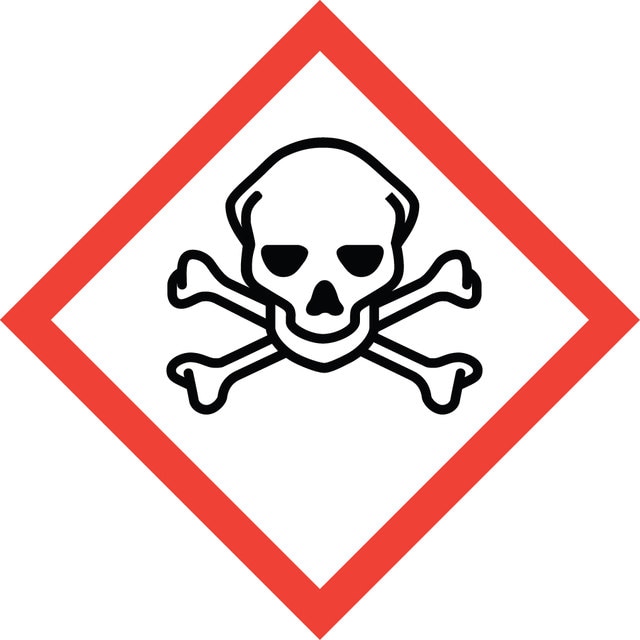
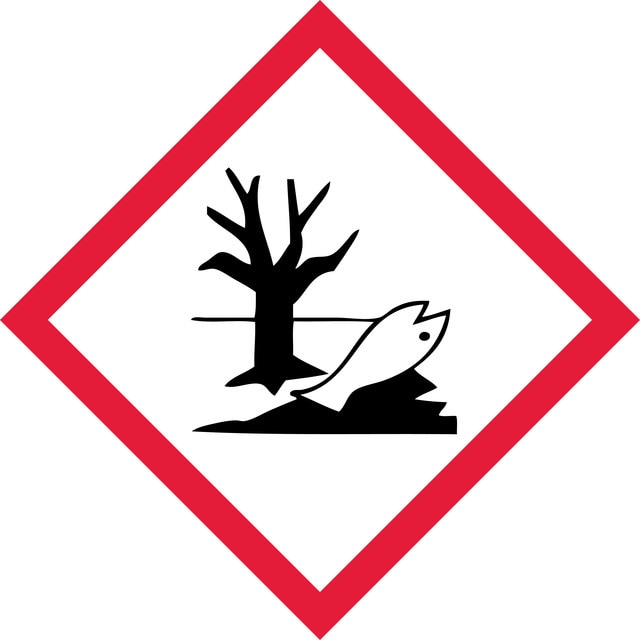
signalword
Danger
hcodes
Hazard Classifications
Acute Tox. 1 Dermal - Acute Tox. 2 Inhalation - Aquatic Chronic 2
Storage Class
6.1A - Combustible acute toxic Cat. 1 and 2 / very toxic hazardous materials
wgk
WGK 3
flash_point_f
Not applicable
flash_point_c
Not applicable
Choose from one of the most recent versions:
Already Own This Product?
Find documentation for the products that you have recently purchased in the Document Library.