Skip to Content
Merck

F1635

Formaldehyde solution

contains 10-15% methanol as stabilizer, 37 wt. % in H2O

Synonym(s):

Formalin

Sign In to View Organizational & Contract Pricing.

Select a Size


About This Item

Linear Formula:
HCHO
CAS Number:
Molecular Weight:
30.03
UNSPSC Code:
12352114
NACRES:
NA.21
PubChem Substance ID:
MDL number:
Beilstein/REAXYS Number:
1209228
Technique(s):
tissue processing: suitable
Bp:
97 °C
Vapor pressure:
52 mmHg ( 37 °C)
Technical Service
Need help? Our team of experienced scientists is here for you.
Let Us Assist
Technical Service
Need help? Our team of experienced scientists is here for you.
Let Us Assist

Product Name

Formaldehyde solution, contains 10-15% methanol as stabilizer, 37 wt. % in H2O

SMILES string

[H]C([H])=O

InChI key

WSFSSNUMVMOOMR-UHFFFAOYSA-N

InChI

1S/CH2O/c1-2/h1H2

vapor density

1.03 (vs air)

vapor pressure

52 mmHg ( 37 °C)

form

liquid

autoignition temp.

572 °F

contains

10-15% methanol as stabilizer

concentration

37 wt. % in H2O
37-38%

technique(s)

tissue processing: suitable

impurities

≤0.03% free acid (as HCOOH)

color

APHA: ≤10

pH

2.8-4.0

bp

97 °C

mp

-15 °C

density

1.09 g/mL at 25 °C (lit.)

Quality Level

Looking for similar products? Visit Product Comparison Guide

Application

Formaldehyde solution has been used to prepare formaldehyde fixation/permeabilization solution that is employed to fix tissue samples.

Biochem/physiol Actions

Induces tumors in the nasal epithelium of rats, and is suspected to be a human carcinogen. Potent mutagen.

General description

This product is 37wt% solution of formaldehyde in water. It contains 10-15% methanol as stabilizer.

signalword

Danger

Hazard Classifications

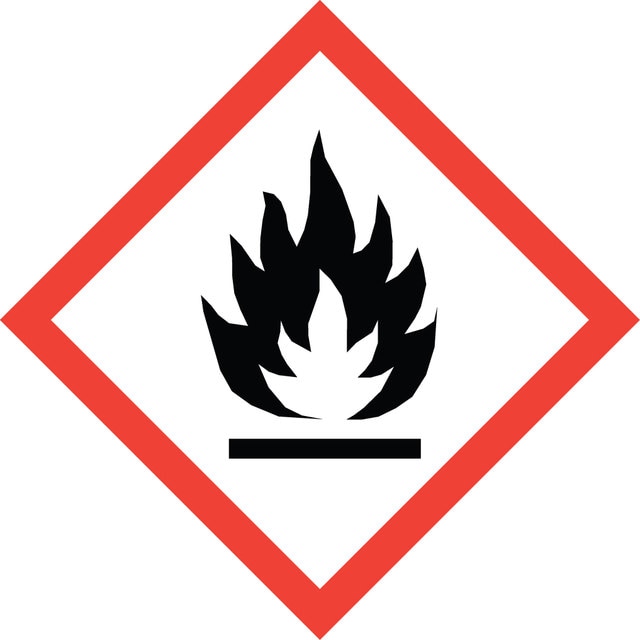
Acute Tox. 2 Inhalation - Acute Tox. 3 Dermal - Acute Tox. 3 Oral - Carc. 1B - Eye Dam. 1 - Flam. Liq. 3 - Muta. 2 - Skin Corr. 1B - Skin Sens. 1 - STOT SE 1 - STOT SE 3

target_organs

Eyes,Central nervous system, Respiratory system

Storage Class

3 - Flammable liquids

wgk

WGK 3

flash_point_f

133.0 °F - closed cup

flash_point_c

56.11 °C - closed cup


Choose from one of the most recent versions:

Certificates of Analysis (COA)

Lot/Batch Number

Don't see the Right Version?

If you require a particular version, you can look up a specific certificate by the Lot or Batch number.

Already Own This Product?

Find documentation for the products that you have recently purchased in the Document Library.

Visit the Document Library

Christopher Bruhn et al.
Genomics, proteomics & bioinformatics, 12(6), 255-265 (2014-12-03)
Cell cycle progression is coordinated with metabolism, signaling and other complex cellular functions. The investigation of cellular processes in a cell cycle stage-dependent manner is often the subject of modern molecular and cell biological research. Cell cycle synchronization and immunostaining
Omer Barkai et al.
Pain, 160(6), 1281-1296 (2019-04-02)
Endogenous inflammatory mediators contribute to the pathogenesis of pain by acting on nociceptors, specialized sensory neurons that detect noxious stimuli. Here, we describe a new factor mediating inflammatory pain. We show that platelet-derived growth factor (PDGF)-BB applied in vitro causes
Cindy S Ma et al.
The Journal of experimental medicine, 205(7), 1551-1557 (2008-07-02)
Hyper-immunoglobulin E syndrome (HIES) is a primary immune deficiency characterized by abnormal and devastating susceptibility to a narrow spectrum of infections, most commonly Staphylococcus aureus and Candida albicans. Recent investigations have identified mutations in STAT3 in the majority of HIES
G R Moore et al.
Neurology, 55(10), 1506-1510 (2000-11-30)
To determine the pathologic basis of areas not exhibiting signal of the short-T2 component of the T2 relaxation distribution in MS, as studied in formalin-fixed brain. A myelin-specific MRI signal would be of great importance in assessing demyelination in patients
Richard Brad Jones et al.
PLoS pathogens, 10(8), e1004287-e1004287 (2014-08-15)
Resting memory CD4+ T-cells harboring latent HIV proviruses represent a critical barrier to viral eradication. Histone deacetylase inhibitors (HDACis), such as suberanilohydroxamic acid (SAHA), romidepsin, and panobinostat have been shown to induce HIV expression in these resting cells. Recently, it

Related Content

Product Information Sheet

Our team of scientists has experience in all areas of research including Life Science, Material Science, Chemical Synthesis, Chromatography, Analytical and many others.

Contact Technical Service