
441090

2,2′-Azobis(2-methylpropionitrile)
98%
Synonym(s):
α,α′-Azoisobutyronitrile, AIBN, Azobisisobutyronitrile, Free radical initiator
Sign In to View Organizational & Contract Pricing.
Select a Size
Change View
About This Item
Linear Formula:
(CH3)2C(CN)N=NC(CH3)2CN
CAS Number:
Molecular Weight:
164.21
UNSPSC Code:
12162002
NACRES:
NA.23
PubChem Substance ID:
EC Number:
201-132-3
Beilstein/REAXYS Number:
1708400
MDL number:
Quality Level
assay
98%
form
powder
mp
102-104 °C (dec.) (lit.)
storage temp.
2-8°C
SMILES string
CC(C)(\N=N\C(C)(C)C#N)C#N
InChI
1S/C8H12N4/c1-7(2,5-9)11-12-8(3,4)6-10/h1-4H3/b12-11+
InChI key
OZAIFHULBGXAKX-VAWYXSNFSA-N
Application
2,2′-Azobis(2-methylpropionitrile) can be used as an initiator in the preparation of:
- Polystyrene by soap-free emulsion polymerization.
- Molecularly imprinted polymer(MIP) using 1-vinyl imidazole. MIP can be used to quantify acid violet 19 dye in river water samples.
Preparation Note
Warning: these products are subject to the Explosives Act and must be transported refrigerated - additional costs for transport will apply.
Still not finding the right product?
Explore all of our products under 2,2′-Azobis(2-methylpropionitrile)
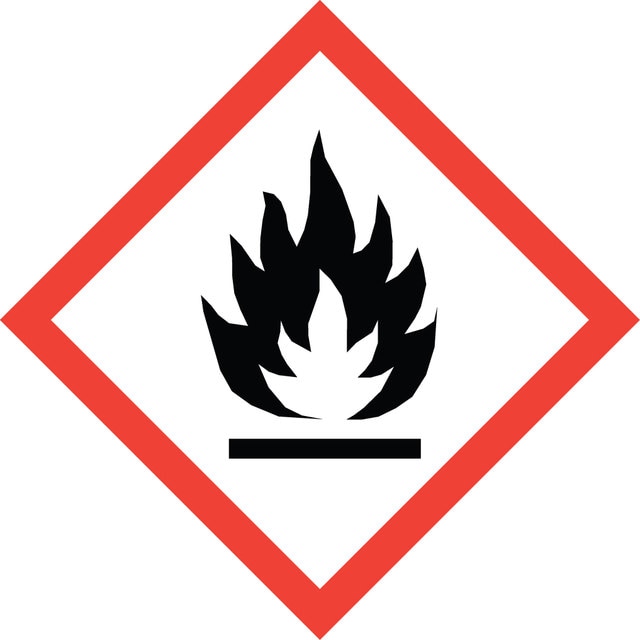

signalword
Danger
hcodes
Hazard Classifications
Acute Tox. 4 Inhalation - Acute Tox. 4 Oral - Aquatic Chronic 3 - Self-react. C
supp_hazards
Storage Class
4.1A - Other explosive hazardous materials
wgk
WGK 2
flash_point_f
122.0 °F
flash_point_c
50 °C
ppe
dust mask type N95 (US), Eyeshields, Faceshields, Gloves, type P3 (EN 143) respirator cartridges
Choose from one of the most recent versions:
Already Own This Product?
Find documentation for the products that you have recently purchased in the Document Library.
Tetrahedron Letters, 48, 5585-5585 (2007)
Lianghui Liu et al.
Organic letters, 14(22), 5692-5695 (2012-10-31)
In the presence of a catalytic amount of radical initiator AIBN, primary amines are oxidatively coupled to imines and tertiary amines are cyanated to α-aminonitriles. These "metal-free" aerobic oxidative coupling reactions may find applications in a wide range of "green"
Bor-Shiunn Lee et al.
Journal of endodontics, 37(2), 246-249 (2011-01-18)
We have developed new urethane acrylate-based root canal sealers using polycarbonate (PC) as polyol and 2,2-azobis(2-methyl)butyronitrile (AMBN) as a thermal initiator. The purpose of this study was to compare the properties among a group of seven sealers: (1) polybutyleneadipate (PBA)