Skip to Content
Merck

45997

Methyl acetate

analytical standard

Sign In to View Organizational & Contract Pricing.

Select a Size

Change View

About This Item

Linear Formula:
CH3COOCH3
CAS Number:
Molecular Weight:
74.08
UNSPSC Code:
85151701
NACRES:
NA.24
PubChem Substance ID:
EC Number:
201-185-2
Beilstein/REAXYS Number:
1736662
MDL number:
Technical Service
Need help? Our team of experienced scientists is here for you.
Let Us Assist


grade

analytical standard

Quality Level

vapor density

2.55 (vs air)

vapor pressure

165 mmHg ( 20 °C)

assay

≥99.9% (GC)

autoignition temp.

936 °F

shelf life

limited shelf life, expiry date on the label

expl. lim.

16 %

technique(s)

HPLC: suitable, gas chromatography (GC): suitable

refractive index

n20/D 1.361 (lit.), n20/D 1.362

bp

57-58 °C (lit.)

mp

−98 °C (lit.)

density

0.934 g/mL at 25 °C

application(s)

cleaning products
cosmetics
environmental
flavors and fragrances
food and beverages
personal care

format

neat

SMILES string

COC(C)=O

InChI

1S/C3H6O2/c1-3(4)5-2/h1-2H3

InChI key

KXKVLQRXCPHEJC-UHFFFAOYSA-N

General description

Methyl acetate is an acetate ester, classified as a volatile organic compound (VOC). It is used as a solvent for many resins and oils.

Application

The analytical standard can also be used as follows:

  • Quantitative analysis of seven volatile organic compounds (VOCs) in paint coating samples by dynamic headspace-gas chromatography-mass spectrometry (D-HS-GC-MS)
  • Detection of 88 VOCs in breath samples of lung cancer patients using solid-phase microextraction (SPME) combined with GC-MS
  • Development of a thermal desorption-gas chromatography-mass spectrometry (TDS-GC/MS) based method for the identification of very volatile organic compounds (VVOCs) in indoor air samples

Other Notes

Refer to the product′s Certificate of Analysis for more information on a suitable instrument technique. Contact Technical Service for further support.


Still not finding the right product?

Explore all of our products under Methyl acetate
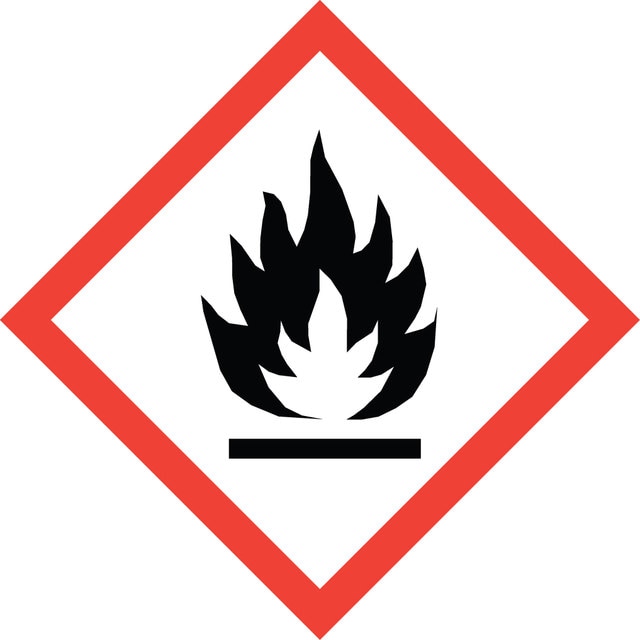

pictograms

FlameExclamation mark

signalword

Danger

Hazard Classifications

Eye Irrit. 2 - Flam. Liq. 2 - STOT SE 3

target_organs

Central nervous system

supp_hazards

Storage Class

3 - Flammable liquids

wgk

WGK 1

flash_point_f

8.6 °F - closed cup

flash_point_c

-13 °C - closed cup

ppe

Eyeshields, Faceshields, Gloves


Choose from one of the most recent versions:

Certificates of Analysis (COA)

Lot/Batch Number

It looks like we've run into a problem, but you can still download Certificates of Analysis from our Documents section.

If you need assistance, please contact Customer Support

Already Own This Product?

Find documentation for the products that you have recently purchased in the Document Library.

Visit the Document Library


DeLu Tyler Yin et al.
Chemistry (Weinheim an der Bergstrasse, Germany), 18(26), 8130-8139 (2012-05-24)
Several serine hydrolases catalyze a promiscuous reaction: perhydrolysis of carboxylic acids to form peroxycarboxylic acids. The working hypothesis is that perhydrolases are more selective than esterases for hydrogen peroxide over water. In this study, we tested this hypothesis, and focused
M L Senent et al.
The Journal of chemical physics, 138(4), 044319-044319 (2013-02-08)
Highly correlated ab initio calculations (CCSD(T)) are used to compute gas phase spectroscopic parameters of three isotopologues of the methyl acetate (CH(3)COOCH(3), CD(3)COOCH(3), and CH(3)COOCD(3)), searching to help experimental assignments and astrophysical detections. The molecule shows two conformers cis and
Marco Candelaresi et al.
The journal of physical chemistry. A, 113(46), 12783-12790 (2009-10-02)
The solvation dynamics of methyl acetate in heavy water are analyzed by means of two-dimensional infrared spectroscopy, in conjunction with Car-Parrinello molecular dynamics simulations. The C horizontal lineO stretching infrared band of methyl acetate in water splits into a doublet
