
T4885

Trichloroacetic acid
≥99.0% (titration), powder or crystals
Synonym(s):
TCA
Select a Size
About This Item
Product Name
Trichloroacetic acid, ≥99.0% (titration)
Quality Level
vapor density
<1 (vs air)
vapor pressure
1 mmHg ( 51 °C)
assay
≥99.0% (titration)
form
powder or crystals
refractive index
n20/D 1.62 (lit.)
pH
1 (at 25 °C, 81,7 g/L)
bp
196 °C (lit.)
mp
54-58 °C (lit.)
solubility
H2O: 1 g/10 mL
density
1.62 g/mL at 25 °C (lit.)
functional group
carboxylic acid, chloro
storage temp.
2-8°C
SMILES string
OC(=O)C(Cl)(Cl)Cl
InChI
1S/C2HCl3O2/c3-2(4,5)1(6)7/h(H,6,7)
InChI key
YNJBWRMUSHSURL-UHFFFAOYSA-N
Application
- β-enaminones via condensation reaction of 1,3-dicarbonyl compounds and amines.
- 6-amino-3-methyl-1,4-diphenyl-1,4-dihydropyrano[2,3-c]pyrazole-5-carbonitrile derivatives via four-component condensation reaction of ethyl acetoacetate, phenylhydrazine, malononitrile, and aromatic aldehydes.
- Tetrahydrobenzo[a]xanthen-11-ones by three-component reaction of aldehydes, 2-naphthol and dimedone.
Still not finding the right product?
Explore all of our products under Trichloroacetic acid
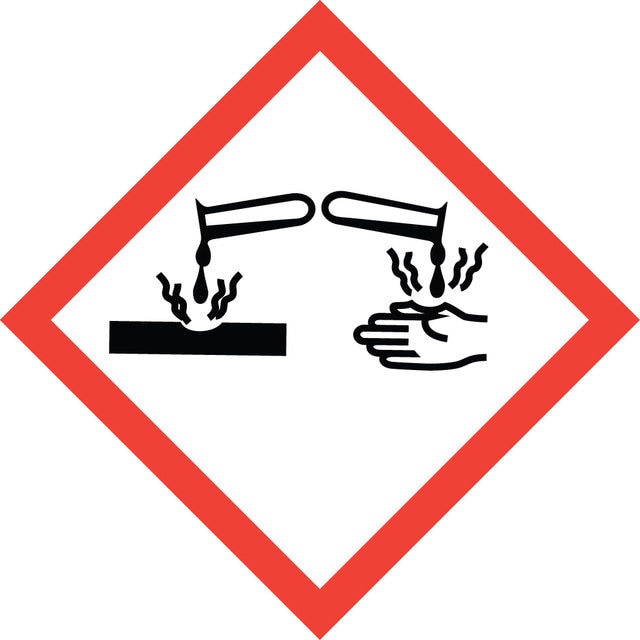
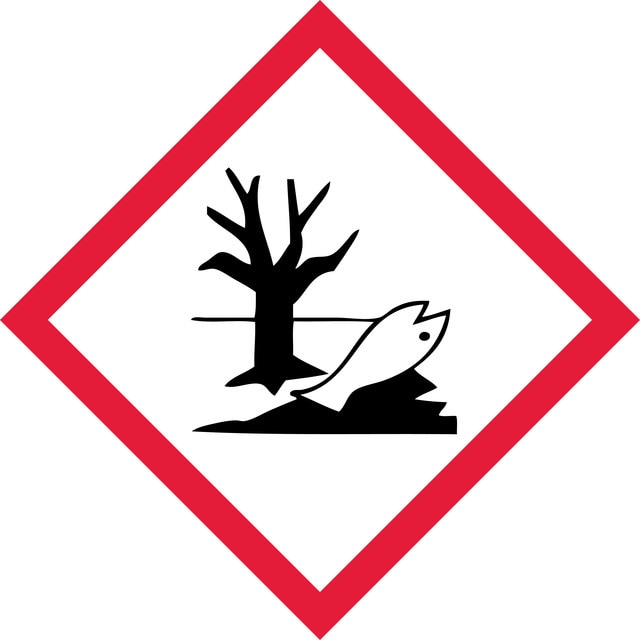
signalword
Danger
hcodes
Hazard Classifications
Aquatic Acute 1 - Aquatic Chronic 1 - Eye Dam. 1 - Skin Corr. 1A
wgk
WGK 2
flash_point_f
>235.4 °F - closed cup
flash_point_c
> 113 °C - closed cup
ppe
Eyeshields, Faceshields, Gloves, type P3 (EN 143) respirator cartridges
Storage Class
8A - Combustible corrosive hazardous materials
Choose from one of the most recent versions:
Already Own This Product?
Find documentation for the products that you have recently purchased in the Document Library.