Saltar al contenido
Merck

11590

4,4′-Azobis(4-cyanovaleric acid)

≥98.0% (T)

Sinónimos:

4,4′-Azobis(4-cyanopentanoic acid), ABCVA, ACVA

Iniciar sesión para ver los precios por organización y contrato.

Seleccione un Tamaño


Acerca de este artículo

Fórmula lineal:
HOCOCH2CH2C(CH3)(CN)N=NC(CH3)(CN)CH2CH2COOH
Número CAS:
Peso molecular:
280.28
UNSPSC Code:
12352100
NACRES:
NA.22
PubChem Substance ID:
EC Number:
220-135-0
Beilstein/REAXYS Number:
1729856
MDL number:
Assay:
≥98.0% (T)
Form:
solid
Servicio técnico
¿Necesita ayuda? Nuestro equipo de científicos experimentados está aquí para ayudarle.
Permítanos ayudarle
Servicio técnico
¿Necesita ayuda? Nuestro equipo de científicos experimentados está aquí para ayudarle.
Permítanos ayudarle

InChI key

VFXXTYGQYWRHJP-FOCLMDBBSA-N

InChI

1S/C12H16N4O4/c1-11(7-13,5-3-9(17)18)15-16-12(2,8-14)6-4-10(19)20/h3-6H2,1-2H3,(H,17,18)(H,19,20)/b16-15+

SMILES string

CC(CCC(O)=O)(\N=N\C(C)(CCC(O)=O)C#N)C#N

assay

≥98.0% (T)

form

solid

impurities

≤1% water

mp

118-125 °C (dec.) (lit.)

functional group

azo, carboxylic acid, nitrile

storage temp.

2-8°C

Quality Level

Application

4,4′-Azobis(4-cyanovaleric acid) has been used in the preparation of polystyrene particles by polymerizing styrene in ethyl alcohol.

Biochem/physiol Actions

4,4′-azobis(4-cyanovaleric acid) is an azo-initiator that induces lipid peroxidation of sunflower oil.

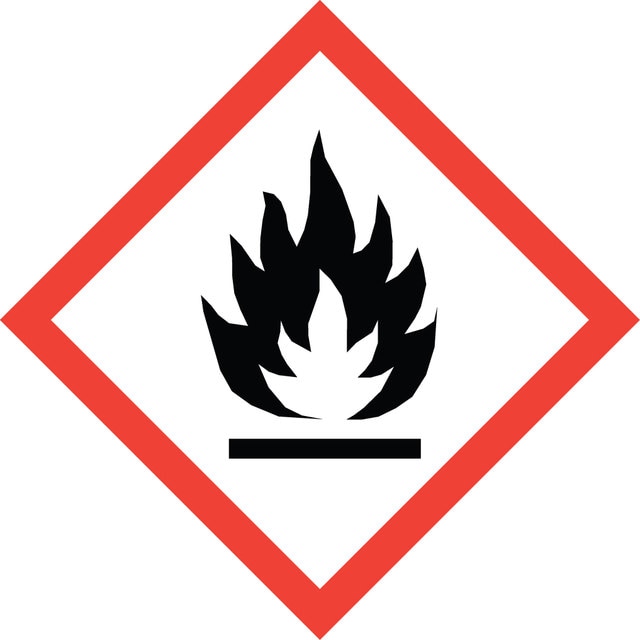
pictograms

Flame

signalword

Danger

hcodes

Hazard Classifications

Self-react. D

Clase de almacenamiento

5.2 - Organic peroxides and self-reacting hazardous materials

wgk

WGK 2

flash_point_f

Not applicable

flash_point_c

Not applicable

ppe

Eyeshields, Gloves, type P3 (EN 143) respirator cartridges


Elija entre una de las versiones más recientes:

Certificados de análisis (COA)

Lot/Batch Number

¿No ve la versión correcta?

Si necesita una versión concreta, puede buscar un certificado específico por el número de lote.

¿Ya tiene este producto?

Encuentre la documentación para los productos que ha comprado recientemente en la Biblioteca de documentos.

Visite la Librería de documentos

Ray Chang et al.
Polymers, 10(10) (2019-04-10)
Temperature stimulus, easy modulation in comparison to other environmental stimuli, makes thermo-responsive nanocarriers popular in the applications of controlled drug release for cancer therapy. In this study, photosensitive sodium copper chlorophyllin (SCC) was incorporated into thermo-responsive polymeric nanogels consisted of
Uniform polymer particles by dispersion polymerization in alcohol.
Journal of Polymer Science Part A: Polymer Chemistry, 24(11), 2995-3007 (1986)
Maraíssa S Franco et al.
Journal of chromatography. A, 1597, 149-158 (2019-03-30)
This paper addresses the evaluation of a new amphiphilic nanoparticle supported on silica and its application as sorbent in on-line solid phase extraction. The investigated sorbent material is a copolymer composed by [2- (Acryloyloxy) ethyl] trimethylammonium chloride (block A) and
A Zaidi et al.
Free radical biology & medicine, 27(7-8), 810-821 (1999-10-09)
The regulation of free intracellular calcium [Ca2+]i is altered in neurons from the aged brain, possibly due to reductions in the activity of Ca2+ transporters. The plasma membrane Ca(2+)-ATPase (PMCA) plays a critical role in Ca2+ homeostasis, and its kinetic
J A Tripp et al.
Journal of combinatorial chemistry, 3(2), 216-223 (2001-04-13)
Polyethylene encased porous poly(chloromethylstyrene-co-divinylbenzene) disks have been prepared by polymerization in a cylindrical glass mold and cut to a disk format. Following attachment of a free radical azo initiator 4,4'-azobis(4-cyanovaleric acid) to available functionalities at the surface of the pores

Nuestro equipo de científicos tiene experiencia en todas las áreas de investigación: Ciencias de la vida, Ciencia de los materiales, Síntesis química, Cromatografía, Analítica y muchas otras.

Póngase en contacto con el Servicio técnico