Saltar al contenido
Merck

146455

Isovaleraldehyde

97%

Sinónimos:

3-Methylbutanal, 3-Methylbutyraldehyde, NSC 404119

Iniciar sesión para ver los precios por organización y contrato.

Seleccione un Tamaño


Acerca de este artículo

Fórmula lineal:
(CH3)2CHCH2CHO
Número CAS:
Peso molecular:
86.13
UNSPSC Code:
12352100
NACRES:
NA.22
PubChem Substance ID:
EC Number:
209-691-5
Beilstein/REAXYS Number:
773692
MDL number:
Assay:
97%
Form:
liquid
Servicio técnico
¿Necesita ayuda? Nuestro equipo de científicos experimentados está aquí para ayudarle.
Permítanos ayudarle
Servicio técnico
¿Necesita ayuda? Nuestro equipo de científicos experimentados está aquí para ayudarle.
Permítanos ayudarle

InChI key

YGHRJJRRZDOVPD-UHFFFAOYSA-N

InChI

1S/C5H10O/c1-5(2)3-4-6/h4-5H,3H2,1-2H3

SMILES string

[H]C(=O)CC(C)C

vapor density

2.96 (vs air)

vapor pressure

30 mmHg ( 20 °C)

assay

97%

form

liquid

autoignition temp.

464 °F

Quality Level

refractive index

n20/D 1.388 (lit.)

bp

90 °C (lit.)

solubility

alcohol: miscible, diethyl ether: miscible, water: slightly soluble

density

0.803 g/mL at 25 °C (lit.)

functional group

aldehyde

organoleptic

pungent

storage temp.

2-8°C

¿Está buscando productos similares? Visita Guía de comparación de productos

General description

Isovaleraldehyde is a short-chain aldehyde that can be produced by oxidizing isoamyl alcohol.

Isovaleraldehyde is an attractant and its interaction with zoospores of the fungus Phytophthora palmivora has been studied by binding techniques.

Application

Isovaleraldehyde was used as standard to evaluate the quality of olive oils by headspace solid-phase microextraction-gas chromatography using flame ionization detection and multivariate analysis. It was used as internal standard in determination of wine aroma carbonyl compounds with 5-8 carbon atoms.

signalword

Danger

Hazard Classifications

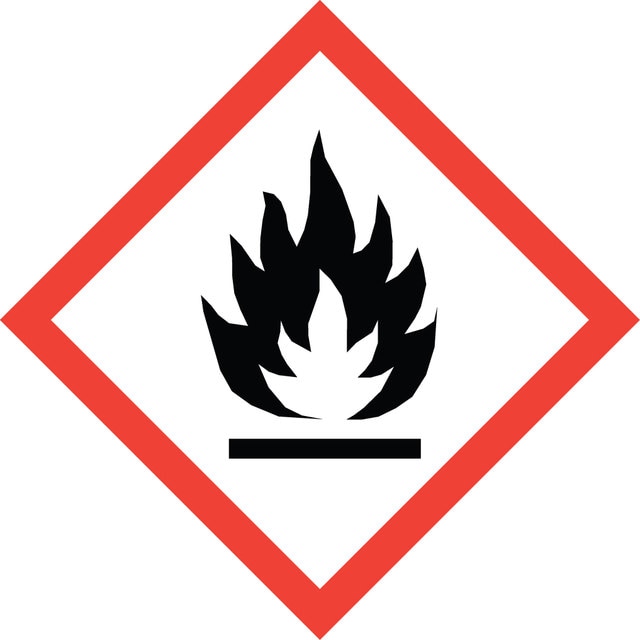
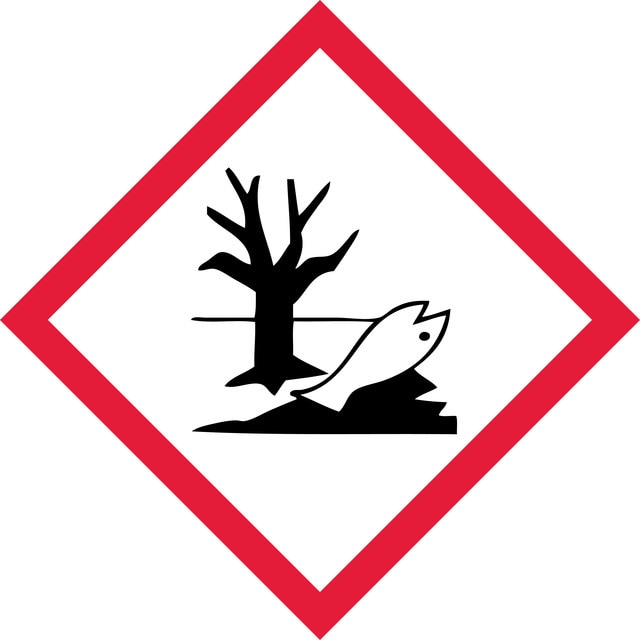
Aquatic Chronic 2 - Eye Irrit. 2 - Flam. Liq. 2 - Skin Sens. 1 - STOT SE 3

target_organs

Respiratory system

Clase de almacenamiento

3 - Flammable liquids

wgk

WGK 2

flash_point_f

32.9 °F - closed cup

flash_point_c

0.5 °C - closed cup

ppe

Eyeshields, Faceshields, Gloves, type ABEK (EN14387) respirator filter


Elija entre una de las versiones más recientes:

Certificados de análisis (COA)

Lot/Batch Number

¿No ve la versión correcta?

Si necesita una versión concreta, puede buscar un certificado específico por el número de lote.

¿Ya tiene este producto?

Encuentre la documentación para los productos que ha comprado recientemente en la Biblioteca de documentos.

Visite la Librería de documentos

J N Cameron et al.
Journal of cell science, 49, 273-281 (1981-06-01)
The interaction of isovaleraldehyde, an attractant, with zoospores of the fungus Phytophthora palmivora was investigated by using binding techniques. The amount of isovaleraldehyde bound diminished with time, an effect that may be related to sensory adaptation. In addition to non-specific
Analysis for wine C5-C8 aldehydes through the determination of their O-(2, 3, 4, 5, 6-pentafluorobenzyl) oximes formed directly in the solid phase extraction cartridge.
Cullere L, et al.
Analytica Chimica Acta, 524(1), 201-206 (2004)
B A Smit et al.
Applied microbiology and biotechnology, 64(3), 396-402 (2003-11-19)
Various microorganisms, belonging to the genera Lactococcus, Lactobacillus, Streptococcus, Leuconostoc, Bifidobacterium, Propionibacterium, Brevibacterium, Corynebacterium and Arthrobacter, used in dairy fermentations such as cheese making, were analysed for their potential to convert leucine into flavour components, most notably 3-methylbutanal. A large
Benoit Berlioz et al.
Journal of agricultural and food chemistry, 54(26), 10092-10101 (2006-12-21)
Headspace solid-phase microextraction (HS-SPME) -gas chromatography using flame ionization detection and multivariate analysis were applied to the study of the specificity of protected designation of origin (PDO) virgin olive oils produced in a southern French region (Alpes-Maritimes) based on their
P Perpète et al.
Journal of agricultural and food chemistry, 48(6), 2384-2386 (2000-07-11)
A medium containing labeled leucine-d(10) has been used to show that Saccharomyces cerevisiae was able to produce deuterated 3-methylbutanal in a cold contact fermentation. Whereas residual unreduced Strecker aldehydes bound to polyphenols were considered until now as the main defect

Nuestro equipo de científicos tiene experiencia en todas las áreas de investigación: Ciencias de la vida, Ciencia de los materiales, Síntesis química, Cromatografía, Analítica y muchas otras.

Póngase en contacto con el Servicio técnico