Saltar al contenido
Merck

240370

Valeric acid

≥99%

Sinónimos:

n-Valeric acid, Pentanoic acid

Iniciar sesión para ver los precios por organización y contrato.

Seleccione un Tamaño


Acerca de este artículo

Fórmula lineal:
CH3(CH2)3COOH
Número CAS:
Peso molecular:
102.13
UNSPSC Code:
12352100
NACRES:
NA.22
PubChem Substance ID:
EC Number:
203-677-2
Beilstein/REAXYS Number:
969454
MDL number:
Assay:
≥99%
Form:
liquid
Servicio técnico
¿Necesita ayuda? Nuestro equipo de científicos experimentados está aquí para ayudarle.
Permítanos ayudarle
Servicio técnico
¿Necesita ayuda? Nuestro equipo de científicos experimentados está aquí para ayudarle.
Permítanos ayudarle

InChI key

NQPDZGIKBAWPEJ-UHFFFAOYSA-N

InChI

1S/C5H10O2/c1-2-3-4-5(6)7/h2-4H2,1H3,(H,6,7)

SMILES string

CCCCC(O)=O

vapor density

3.5 (vs air)

vapor pressure

0.15 mmHg ( 20 °C)

assay

≥99%

form

liquid

autoignition temp.

707 °F

expl. lim.

7.6 %

Quality Level

bp

110-111 °C/10 mmHg (lit.), 185 °C (lit.)

mp

−20-−18 °C (lit.)

density

0.939 g/mL at 25 °C (lit.)

functional group

carboxylic acid

¿Está buscando productos similares? Visita Guía de comparación de productos

General description

Valeric acid (VA) also known as pentanoic acid, is a short-chain fatty acid used to synthesize valeric biofuels.

Application

Sex attractant of the sugar beet wireworm, Limonius californicus.

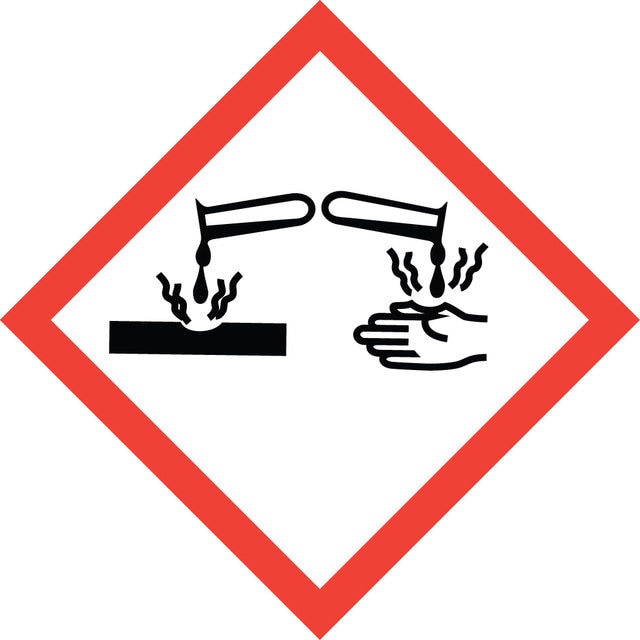
pictograms

Corrosion

signalword

Danger

hcodes

Hazard Classifications

Aquatic Chronic 3 - Eye Dam. 1 - Skin Corr. 1B

Clase de almacenamiento

8A - Combustible corrosive hazardous materials

wgk

WGK 1

flash_point_f

192.2 °F - closed cup

flash_point_c

89 °C - closed cup

ppe

Faceshields, Gloves, Goggles, type ABEK (EN14387) respirator filter


Elija entre una de las versiones más recientes:

Certificados de análisis (COA)

Lot/Batch Number

¿No ve la versión correcta?

Si necesita una versión concreta, puede buscar un certificado específico por el número de lote.

¿Ya tiene este producto?

Encuentre la documentación para los productos que ha comprado recientemente en la Biblioteca de documentos.

Visite la Librería de documentos

Chun-Chieh Lin et al.
eLife, 4 (2015-10-01)
Animals use olfactory cues for navigating complex environments. Food odors in particular provide crucial information regarding potential foraging sites. Many behaviors occur at food sites, yet how food odors regulate such behaviors at these sites is unclear. Using Drosophila melanogaster
D M Saunders et al.
The Australian & New Zealand journal of obstetrics & gynaecology, 18(3), 198-201 (1978-08-01)
The effect of oestradiol valerate on levels of blood cholesterol, triglycerides, free oestradiol and coagulation factors, as well as on urinary oestrogens and free cortisol was measured in 10 oöphorectomised women. Despite the very high urinary oestrogen levles obtained, there
M F Böttcher et al.
Clinical and experimental allergy : journal of the British Society for Allergy and Clinical Immunology, 30(11), 1590-1596 (2000-11-09)
The prevalence of allergic diseases has increased particularly over the past 30-40 years. A reduced microbial stimulation during infancy may result in a development of a disturbed balance between Th1- and Th2-like immunity. The gut flora is, quantitatively, the most
Martin Koller et al.
Macromolecular bioscience, 7(2), 218-226 (2007-02-14)
Three different microbial wild-type strains are compared with respect to their potential as industrial scale polyhydroxyalkanoate (PHA) producers from the feed stock whey lactose. The halophilic archaeon Haloferax mediterranei as well as two eubacterial strains (Pseudomonas hydrogenovora and Hydrogenophaga pseudoflava)
O Siddiqui et al.
Journal of pharmacokinetics and biopharmaceutics, 17(4), 405-424 (1989-08-01)
The permeation of triamcinolone, hydrocortisone, prednisolone, corticosterone, triamcinolone acetonide, testosterone, and betamethasone-17-valerate through excised human stratum corneum was quantified. The time course of permeation could be adequately described by a simple diffusion model suggesting that shunt transport may not be

Nuestro equipo de científicos tiene experiencia en todas las áreas de investigación: Ciencias de la vida, Ciencia de los materiales, Síntesis química, Cromatografía, Analítica y muchas otras.

Póngase en contacto con el Servicio técnico