Saltar al contenido
Merck

39391

N-(3-Dimethylaminopropyl)-N′-ethylcarbodiimide

≥97.0% (T), for peptide synthesis

Sinónimos:

N-Ethyl-N′-(3-dimethylaminopropyl)carbodiimide, EDC, WSC

Iniciar sesión para ver los precios por organización y contrato.

Seleccione un Tamaño


Acerca de este artículo

Fórmula empírica (notación de Hill):
C8H17N3
Número CAS:
Peso molecular:
155.24
NACRES:
NA.22
PubChem Substance ID:
UNSPSC Code:
12352116
EC Number:
217-579-2
MDL number:
Beilstein/REAXYS Number:
507429
Servicio técnico
¿Necesita ayuda? Nuestro equipo de científicos experimentados está aquí para ayudarle.
Permítanos ayudarle
Servicio técnico
¿Necesita ayuda? Nuestro equipo de científicos experimentados está aquí para ayudarle.
Permítanos ayudarle

Nombre del producto

N-(3-Dimethylaminopropyl)-N′-ethylcarbodiimide, ≥97.0% (T)

InChI key

LMDZBCPBFSXMTL-UHFFFAOYSA-N

InChI

1S/C8H17N3/c1-4-9-8-10-6-5-7-11(2)3/h4-7H2,1-3H3

SMILES string

CCN=C=NCCCN(C)C

assay

≥97.0% (T)

form

liquid

reaction suitability

reaction type: Coupling Reactions

refractive index

n20/D 1.461

density

0.877 g/mL at 20 °C (lit.)

application(s)

peptide synthesis

functional group

amine

storage temp.

−20°C

Quality Level

Application

N-(3-Dimethylaminopropyl)-N′-ethylcarbodiimide has been used for the surface functionalization of graphene quantum dots (GQDs) employed as sensing probes in Janus micromotors to detect enterobacterial contamination. It has also been used for the activation of folic acid, prior to its conjugation on silica nanoparticles.

General description

N-(3-Dimethylaminopropyl)-N′-ethylcarbodiimide is commonly used in combination with N-hydroxysuccinimide (NHS) in carbodiimide coupling reaction to activate carboxyl group for coupling with amines to form amides.

signalword

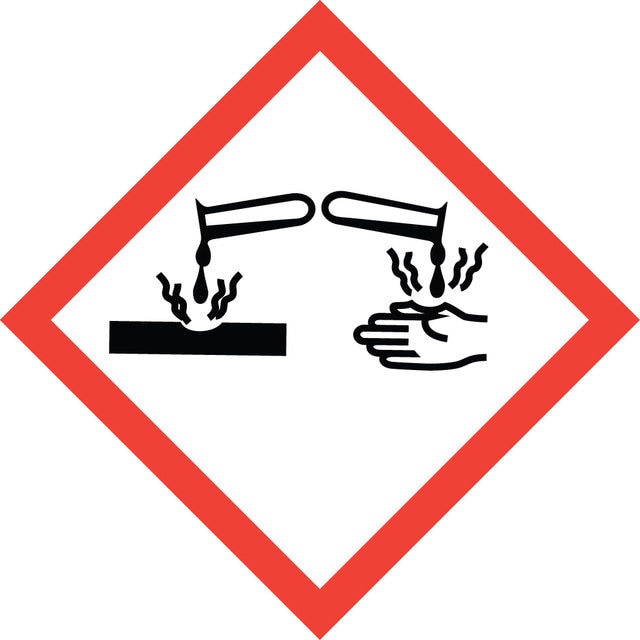
Danger

Hazard Classifications

Acute Tox. 3 Dermal - Acute Tox. 4 Oral - Aquatic Acute 1 - Aquatic Chronic 1 - Eye Dam. 1 - Skin Corr. 1A - Skin Sens. 1A - STOT RE 2 Oral

target_organs

Stomach,large intestine,lymph node

Clase de almacenamiento

6.1A - Combustible acute toxic Cat. 1 and 2 / very toxic hazardous materials

wgk

WGK 3

flash_point_f

Not applicable

flash_point_c

Not applicable

ppe

Faceshields, Gloves, Goggles, type ABEK (EN14387) respirator filter


Elija entre una de las versiones más recientes:

Certificados de análisis (COA)

Lot/Batch Number

¿No ve la versión correcta?

Si necesita una versión concreta, puede buscar un certificado específico por el número de lote.

¿Ya tiene este producto?

Encuentre la documentación para los productos que ha comprado recientemente en la Biblioteca de documentos.

Visite la Librería de documentos

SENSITIVE MONITORING OF ENTEROBACTERIAL CONTAMINATION OF FOOD USING SELF-PROPELLED JANUS MICROSENSORS
Pacheco M
Analytical Chemistry, 90(4), 2912-2917 (2018)
Anthony C Y Yau et al.
Scientific reports, 7(1), 14998-14998 (2017-11-10)
Mineral oils are extensively used in our daily life, in food, cosmetics, biomedicine, vaccines and in different industrial applications. However, exposure to these mineral oils has been associated with immune adjuvant effects and the development of autoimmune diseases. Here we
Ruogu Qi et al.
Nature communications, 8(1), 2166-2166 (2017-12-20)
Advanced-stage epithelial ovarian cancers are amongst the most difficult to treat tumors and have proven to be refractory to most cytotoxic, molecularly targeted, or immunotherapeutic approaches. Here, we report that nanoparticle-drug conjugates (NDCs) of monomethyl auristatin E (MMAE) significantly increase
Immobilization of laccase on polymer grafted polytetrafluoroethylene membranes for biosensor construction.
Tastan E
Talanta, 84(2), 524-530 (2011)
Michael J Taylor et al.
Journal of biomedical materials research. Part A, 107(10), 2195-2204 (2019-05-23)
Scaffolds composed of synthetic polymers such as poly(caprolactone) (PCL) are widely used for the support and repair of tissues in biomedicine. Pores are common features in scaffolds as they facilitate cell penetration. Various surface modifications can be performed to promote

Nuestro equipo de científicos tiene experiencia en todas las áreas de investigación: Ciencias de la vida, Ciencia de los materiales, Síntesis química, Cromatografía, Analítica y muchas otras.

Póngase en contacto con el Servicio técnico