Saltar al contenido
Merck

631868

1,4-Dioxane solution

suitable for NMR (reference standard), 5 mM in chloroform-d (99.8 atom % D), NMR tube size 3 mm × 8 in.

Iniciar sesión para ver los precios por organización y contrato.

Seleccione un Tamaño


Acerca de este artículo

Fórmula empírica (notación de Hill):
C4H8O2
Número CAS:
Peso molecular:
88.11
NACRES:
NA.24
PubChem Substance ID:
UNSPSC Code:
12142201
MDL number:
Servicio técnico
¿Necesita ayuda? Nuestro equipo de científicos experimentados está aquí para ayudarle.
Permítanos ayudarle
Servicio técnico
¿Necesita ayuda? Nuestro equipo de científicos experimentados está aquí para ayudarle.
Permítanos ayudarle

InChI

1S/C4H8O2/c1-2-6-4-3-5-1/h1-4H2

SMILES string

C1COCCO1

InChI key

RYHBNJHYFVUHQT-UHFFFAOYSA-N

grade

analytical standard

concentration

5 mM in chloroform-d (99.8 atom % D)

technique(s)

NMR: suitable

NMR tube size

3 mm × 8 in.

density

1.500 g/mL at 25 °C

suitability

suitable for NMR (reference standard)

format

single component solution

Quality Level

¿Está buscando productos similares? Visita Guía de comparación de productos

General description

This compound is listed in the SVHC (Substances of very high concern) candidate list of ECHA (European Chemicals Agency)

Preparation Note

3 mm O.D. tube contains 0.235 mL.
Each pack contains 10 tubes.

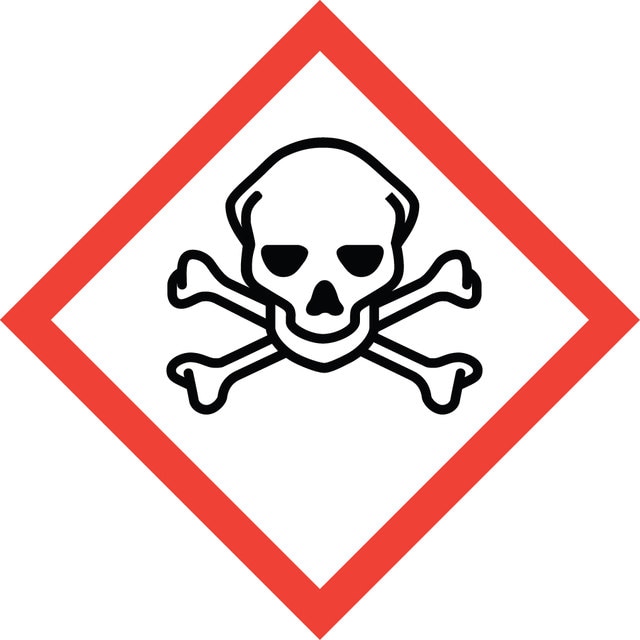
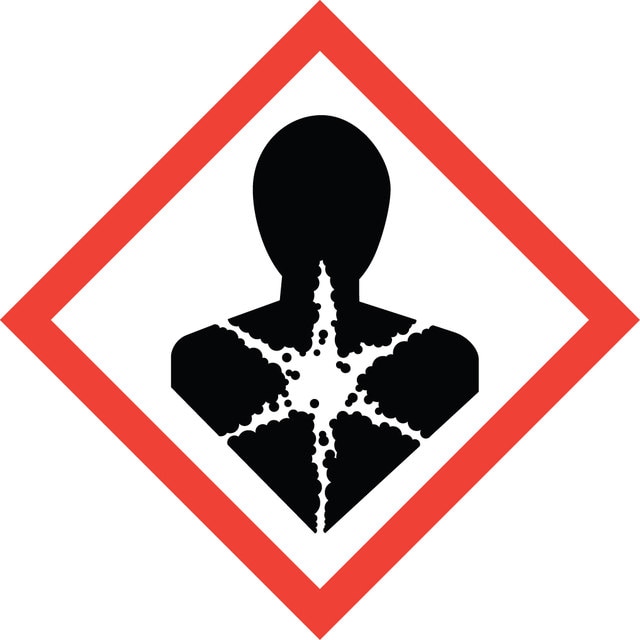
pictograms

Skull and crossbonesHealth hazard

signalword

Danger

Hazard Classifications

Acute Tox. 3 Inhalation - Acute Tox. 4 Oral - Carc. 2 - Eye Irrit. 2 - Repr. 2 - Skin Irrit. 2 - STOT RE 1 Oral - STOT SE 3

target_organs

Central nervous system, Liver,Kidney

Clase de almacenamiento

6.1C - Combustible acute toxic Cat.3 / toxic compounds or compounds which causing chronic effects

wgk

WGK 3


Elija entre una de las versiones más recientes:

Certificados de análisis (COA)

Lot/Batch Number

¿No ve la versión correcta?

Si necesita una versión concreta, puede buscar un certificado específico por el número de lote.

¿Ya tiene este producto?

Encuentre la documentación para los productos que ha comprado recientemente en la Biblioteca de documentos.

Visite la Librería de documentos

Daniel Gerrity et al.
Water research, 46(19), 6257-6272 (2012-10-16)
The performance of ozonation in wastewater depends on water quality and the ability to form hydroxyl radicals (·OH) to meet disinfection or contaminant transformation objectives. Since there are no on-line methods to assess ozone and ·OH exposure in wastewater, many
Venkateshwarlu Gurram et al.
Chemistry, an Asian journal, 7(8), 1853-1861 (2012-05-10)
Reaction conditions for the CC cross-coupling of O(6)-alkyl-2-bromo- and 2-chloroinosine derivatives with aryl-, hetaryl-, and alkylboronic acids were studied. Optimization experiments with silyl-protected 2-bromo-O(6)-methylinosine led to the identification of [PdCl(2)(dcpf)]/K(3)PO(4) in 1,4-dioxane as the best conditions for these reactions (dcpf=1,1'-bis(dicyclohexylphosphino)ferrocene).
Naoyuki Kishimoto et al.
Water research, 47(5), 1919-1927 (2013-02-09)
This paper reports on the reusability and the optimal reuse of iron-rich sludge for an electrochemical Fenton-type process using sequencing batch mode and separation batch mode reuse models. In the sequencing batch mode, processes of electrochemical treatment, neutralization, sedimentation, and
Megha Aggarwal et al.
PloS one, 7(12), e51288-e51288 (2012-12-20)
The nucleocapsid core interaction with endodomains of glycoproteins plays a critical role in the alphavirus life cycle that is essential to virus budding. Recent cryo-electron microscopy (cryo-EM) studies provide structural insights into key interactions between capsid protein (CP) and trans-membrane
Carlos E Agudelo-Morales et al.
Chemphyschem : a European journal of chemical physics and physical chemistry, 13(18), 4195-4201 (2012-10-24)
The quenching of pyrene and 1-methylpyrene fluorescence by nitroanilines (NAs), such as 2-, 3-, and 4-nitroaniline (2-NA, 3-NA, and 4-NA, respectively), 4-methyl-3-nitroaniline (4-M-3-NA), 2-methyl-4-nitroaniline (2-M-4-NA), and 4-methyl-3,5-dinitroaniline (4-M-3,5-DNA), are studied in toluene and 1,4-dioxane. Steady-state fluorescence data show the higher

Nuestro equipo de científicos tiene experiencia en todas las áreas de investigación: Ciencias de la vida, Ciencia de los materiales, Síntesis química, Cromatografía, Analítica y muchas otras.

Póngase en contacto con el Servicio técnico