Saltar al contenido
Merck

W217913

2-Methyl-1-propanol

greener alternative

natural, ≥99%, FCC, FG

Sinónimos:

2-Methyl-1-propanol, Isobutanol, Isobutyl alcohol

Iniciar sesión para ver los precios por organización y contrato.

Seleccione un Tamaño


Acerca de este artículo

Fórmula lineal:
(CH3)2CHCH2OH
Número CAS:
Peso molecular:
74.12
FEMA Number:
2179
Council of Europe no.:
49
UNSPSC Code:
12164502
PubChem Substance ID:
NACRES:
NA.21
EC Number:
201-148-0
Flavis number:
2.001
MDL number:
Beilstein/REAXYS Number:
1730878
Organoleptic:
ethereal; wine-like
Grade:
FG, Fragrance grade, Halal, Kosher, natural
Agency:
follows IFRA guidelines, meets purity specifications of JECFA
Food allergen:
no known allergens
Servicio técnico
¿Necesita ayuda? Nuestro equipo de científicos experimentados está aquí para ayudarle.
Permítanos ayudarle
Servicio técnico
¿Necesita ayuda? Nuestro equipo de científicos experimentados está aquí para ayudarle.
Permítanos ayudarle

Quality Level

grade

FG, Fragrance grade, Halal, Kosher, natural

agency

follows IFRA guidelines, meets purity specifications of JECFA

reg. compliance

EU Regulation 1223/2009, EU Regulation 1334/2008 & 178/2002, FCC, FDA 21 CFR 117

vapor density

2.55 (vs air)

vapor pressure

8 mmHg ( 20 °C), 8.8 mmHg ( 0 °C)

assay

≥99%

form

liquid

autoignition temp.

801 °F

expl. lim.

10.6 %

greener alternative product characteristics

Less Hazardous Chemical Syntheses
Use of Renewable Feedstocks
Learn more about the Principles of Green Chemistry.

sustainability

Greener Alternative Product

refractive index

n20/D 1.396 (lit.)

bp

108 °C

mp

−108 °C (lit.)

density

0.803 g/mL at 25 °C (lit.)

application(s)

flavors and fragrances

documentation

see Safety & Documentation for available documents

food allergen

no known allergens

fragrance allergen

no known allergens

greener alternative category

organoleptic

ethereal; wine-like

SMILES string

CC(C)CO

InChI

1S/C4H10O/c1-4(2)3-5/h4-5H,3H2,1-2H3

InChI key

ZXEKIIBDNHEJCQ-UHFFFAOYSA-N

¿Está buscando productos similares? Visita Guía de comparación de productos

General description

Isobutyl alcohol is a water-soluble aliphatic alcohol that can be used as flavoring agent. It has been identified as one of the aroma/flavor compounds produced by Saccharomyces cerevisiae during the semiaerobic fermentation of grapes to form wine.
We are committed to bringing you greener alternative products, which adhere to one or more of The 12 Principles of Greener Chemistry. This product is Biobased and thus aligns with "Less Hazardous Chemical Syntheses" and "Use of Renewable Feedstocks".

Application


  • Volatiles from nutritional fungal symbiont influence the attraction of Anisandrus maiche (Coleoptera: Curculionidae) to ethanol-baited traps.: This investigation revealed that volatiles emitted by fungal symbionts impact the attraction of Anisandrus maiche to ethanol-baited traps. The study suggests potential applications in pest management strategies by utilizing isobutanol and other volatiles (Tobin et al., 2024).

signalword

Danger

Hazard Classifications

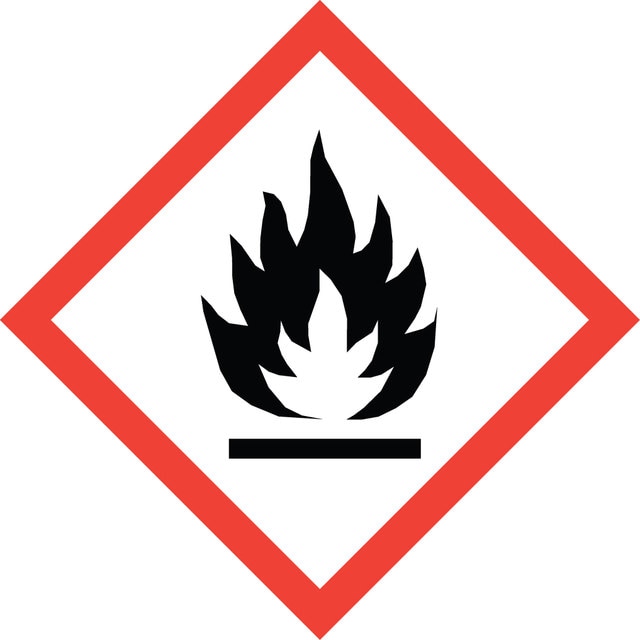
Eye Dam. 1 - Flam. Liq. 3 - Skin Irrit. 2 - STOT SE 3

target_organs

Central nervous system, Respiratory system

Clase de almacenamiento

3 - Flammable liquids

wgk

WGK 1

flash_point_f

82.4 °F - closed cup

flash_point_c

28 °C - closed cup

ppe

Eyeshields, Faceshields, Gloves, type ABEK (EN14387) respirator filter


Elija entre una de las versiones más recientes:

Certificados de análisis (COA)

Lot/Batch Number

It looks like we've run into a problem, but you can still download Certificates of Analysis from our Documentos section.

Si necesita más asistencia, póngase en contacto con Atención al cliente

¿Ya tiene este producto?

Encuentre la documentación para los productos que ha comprado recientemente en la Biblioteca de documentos.

Visite la Librería de documentos

Burdock GA
Encyclopedia of Food and Color Additives, 1, 1443-1444 (1997)
The effects of grape must fermentation conditions on volatile alcohols and esters formed by Saccharomyces cerevisiae
Mauricio JC, et al
Journal of the Science of Food and Agriculture, 75(2), 155-160 (1997)
Jeremy J Minty et al.
Proceedings of the National Academy of Sciences of the United States of America, 110(36), 14592-14597 (2013-08-21)
Synergistic microbial communities are ubiquitous in nature and exhibit appealing features, such as sophisticated metabolic capabilities and robustness. This has inspired fast-growing interest in engineering synthetic microbial consortia for biotechnology development. However, there are relatively few reports of their use
Han Li et al.
Science (New York, N.Y.), 335(6076), 1596-1596 (2012-03-31)
One of the major challenges in using electrical energy is the efficiency in its storage. Current methods, such as chemical batteries, hydraulic pumping, and water splitting, suffer from low energy density or incompatibility with current transportation infrastructure. Here, we report
D Norbäck et al.
Occupational and environmental medicine, 52(6), 388-395 (1995-06-01)
As a part of the worldwide European Community respiratory health survey, possible relations between symptoms of asthma, building characteristics, and indoor concentration of volatile organic compounds (VOCs) in dwellings were studied. The study comprised 88 subjects, aged 20-45 years, from

Nuestro equipo de científicos tiene experiencia en todas las áreas de investigación: Ciencias de la vida, Ciencia de los materiales, Síntesis química, Cromatografía, Analítica y muchas otras.

Póngase en contacto con el Servicio técnico