Iniciar sesión para ver los precios por organización y contrato.
Seleccione un Tamaño
Acerca de este artículo
Fórmula empírica (notación de Hill):
Br2
Número CAS:
Peso molecular:
159.81
PubChem Substance ID:
UNSPSC Code:
41116105
MDL number:
Servicio técnico
¿Necesita ayuda? Nuestro equipo de científicos experimentados está aquí para ayudarle.
Permítanos ayudarleServicio técnico
¿Necesita ayuda? Nuestro equipo de científicos experimentados está aquí para ayudarle.
Permítanos ayudarleInChI
1S/Br2/c1-2
InChI key
GDTBXPJZTBHREO-UHFFFAOYSA-N
grade
CP
form
liquid
availability
available only in Japan
density
1.307 g/mL at 25 °C (lit.)
storage temp.
15-25°C
¿Está buscando productos similares? Visita Guía de comparación de productos
signalword
Danger
hcodes
Hazard Classifications
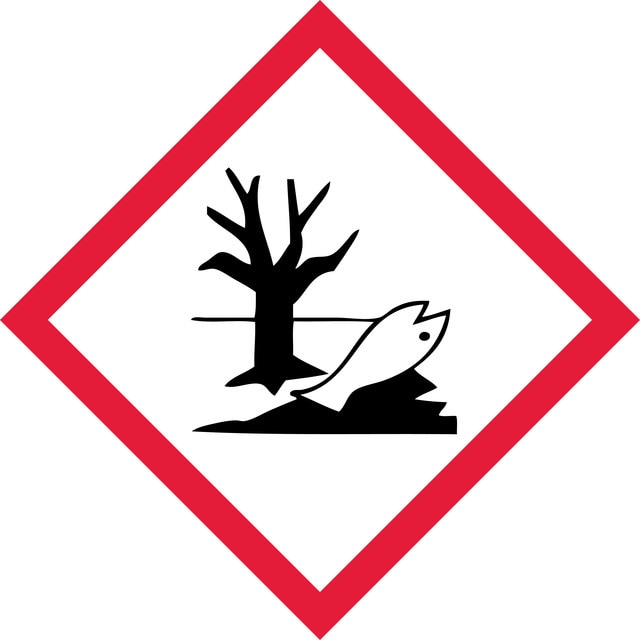
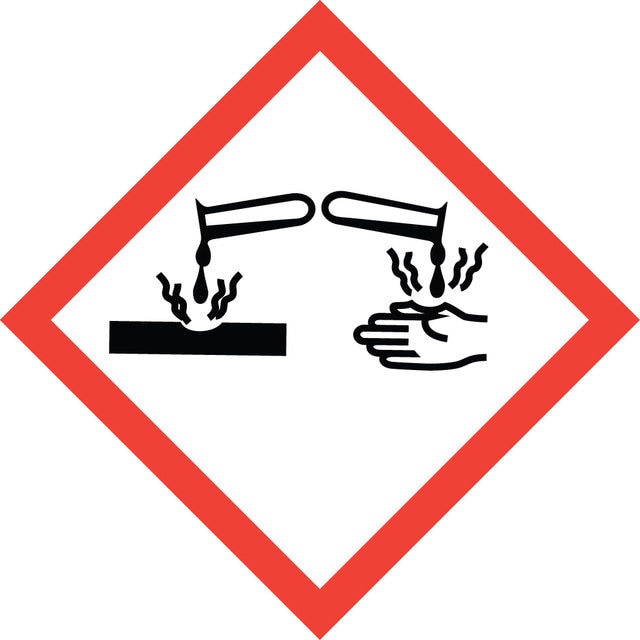
Acute Tox. 4 Inhalation - Aquatic Acute 1 - Eye Dam. 1 - Skin Irrit. 2
Clase de almacenamiento
6.1A - Combustible acute toxic Cat. 1 and 2 / very toxic hazardous materials
wgk
WGK 2
flash_point_f
Not applicable
flash_point_c
Not applicable
Elija entre una de las versiones más recientes:
¿Ya tiene este producto?
Encuentre la documentación para los productos que ha comprado recientemente en la Biblioteca de documentos.
Vitalij V Levin et al.
Organic letters, 15(4), 917-919 (2013-02-02)
Reactions of difluorocarbene with benzyl and alkylzinc halides leading to fluorinated organozinc species have been described. The generated α-difluorinated organozinc reagents are reasonably stable in solution and can be quenched with external electrophiles (iodine, bromine, proton), affording compounds containing the
Kimberly T Barrett et al.
Journal of the American Chemical Society, 135(8), 2963-2966 (2013-02-16)
We report the enantioselective synthesis of atropisomeric benzamides employing catalytic electrophilic aromatic substitution reactions involving bromination. The catalyst is a simple tetrapeptide bearing a tertiary amine that may function as a Brønsted base. A series of tri- and dibrominations were
Mohammad Navid Soltani Rad et al.
Molecular diversity, 17(1), 9-18 (2012-11-08)
A facile and highly convenient base-free protocol for the chemoselective preparation of 1,2-diol mono-esters is described. In this method, the regioselective ring opening of epoxides with carboxylic acids in the presence of [bmim]Br furnishes the corresponding 1,2-diol mono-esters in excellent
John D Sivey et al.
Environmental science & technology, 47(3), 1330-1338 (2013-01-18)
HOBr, formed via oxidation of bromide by free available chlorine (FAC), is frequently assumed to be the sole species responsible for generating brominated disinfection byproducts (DBPs). Our studies reveal that BrCl, Br(2), BrOCl, and Br(2)O can also serve as brominating
P Zhu et al.
Waste management (New York, N.Y.), 33(2), 484-488 (2012-11-28)
Separation of waste printed circuit boards (WPCBs) has been a bottleneck in WPCBs resource processing. In this study, the separation of WPCBs was performed using dimethyl sulfoxide (DMSO) as a solvent. Various parameters, which included solid to liquid ratio, temperature
Nuestro equipo de científicos tiene experiencia en todas las áreas de investigación: Ciencias de la vida, Ciencia de los materiales, Síntesis química, Cromatografía, Analítica y muchas otras.
Póngase en contacto con el Servicio técnico