Saltar al contenido
Merck

39405

4-(Dimethylamino)pyridine

purum, ≥98.0% (NT)

Sinónimos:

N,N-Dimethylpyridin-4-amine, DMAP

Iniciar sesión para ver los precios por organización y contrato.

Seleccione un Tamaño


Acerca de este artículo

Fórmula empírica (notación de Hill):
C7H10N2
Número CAS:
Peso molecular:
122.17
UNSPSC Code:
12352005
NACRES:
NA.22
PubChem Substance ID:
EC Number:
214-353-5
Beilstein/REAXYS Number:
110354
MDL number:
Assay:
≥98.0% (NT)
Form:
crystals
pellets
Servicio técnico
¿Necesita ayuda? Nuestro equipo de científicos experimentados está aquí para ayudarle.
Permítanos ayudarle
Servicio técnico
¿Necesita ayuda? Nuestro equipo de científicos experimentados está aquí para ayudarle.
Permítanos ayudarle

Nombre del producto

4-(Dimethylamino)pyridine, purum, ≥98.0% (NT)

InChI key

VHYFNPMBLIVWCW-UHFFFAOYSA-N

InChI

1S/C7H10N2/c1-9(2)7-3-5-8-6-4-7/h3-6H,1-2H3

SMILES string

CN(C)c1ccncc1

grade

purum

assay

≥98.0% (NT)

form

crystals
pellets

mp

108-110 °C (lit.)
111-114 °C

solubility

methanol: 0.1 g/mL, clear, colorless to almost colorless

functional group

amine

Quality Level

¿Está buscando productos similares? Visita Guía de comparación de productos

Application

4-(Dimethylamino)pyridine can be used:
  • As a capping agent in the preparation of water-soluble gold nanoparticles.
  • As an initiator in the polymerization of epoxy monomers.
  • As an auxiliary reagent in the electroless preparation of gold nanotubes applicable in catalysis.
  • As a catalyst in the preparation of γ- and δ-lactones via iodolactonization of γ,δ-unsaturated carboxylic acids.

A highly efficient catalyst for acylation reactions

General description

4-(Dimethylamino)pyridine is generally employed as a catalyst in the acylation of amines, alcohols, enolates, and phenols. It can also be used in the esterification of carboxylic acids. It is known to exhibit good catalytic activity in non-polar solvents.

Other Notes

Hypernucleophilic acylation catalyst.

signalword

Danger

Hazard Classifications

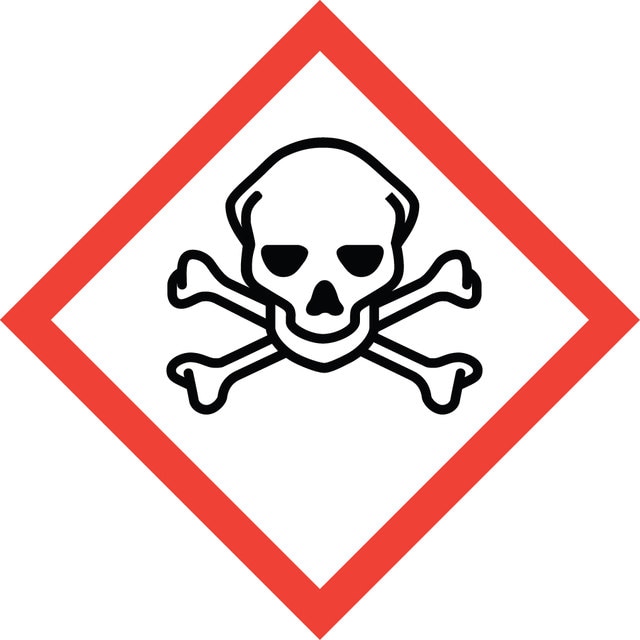
Acute Tox. 2 Dermal - Acute Tox. 3 Inhalation - Acute Tox. 3 Oral - Aquatic Chronic 2 - Eye Dam. 1 - Skin Irrit. 2 - STOT SE 1

target_organs

Nervous system

Clase de almacenamiento

6.1A - Combustible acute toxic Cat. 1 and 2 / very toxic hazardous materials

wgk

WGK 3

flash_point_f

255.2 °F

flash_point_c

124 °C

ppe

Eyeshields, Faceshields, Gloves, type P3 (EN 143) respirator cartridges


Elija entre una de las versiones más recientes:

Certificados de análisis (COA)

Lot/Batch Number

¿No ve la versión correcta?

Si necesita una versión concreta, puede buscar un certificado específico por el número de lote.

¿Ya tiene este producto?

Encuentre la documentación para los productos que ha comprado recientemente en la Biblioteca de documentos.

Visite la Librería de documentos

A. Hassner
Tetrahedron, 34, 2069-2069 (1978)
E.F. Scriben
Chemical Society Reviews, 13, 129-129 (1983)
Hoefle, G., et al.
Angewandte Chemie (International Edition in English), 90, 602-602 (1978)
Giovanna Cutrone et al.
Carbohydrate polymers, 223, 115085-115085 (2019-08-21)
Nanoparticles made of metal-organic frameworks (nanoMOFs) are becoming of increasing interest as drug carriers. However, engineered coatings such as poly(ethylene glycol) (PEG) based ones are required to prevent nanoMOFs recognition and clearance by the innate immune system, a prerequisite for
Yi Zhang et al.
ACS applied materials & interfaces, 11(50), 46427-46436 (2019-11-26)
A kind of specific cyclodextrin polyrotaxanes (PRs) drug delivery system was developed for an effective drug delivery and enhancing antitumor effect. In this work, we prepared the PR by using α-CD derivatives and dicarboxyl-PEG (Mn = 4200) self-assembling and end-capping

Nuestro equipo de científicos tiene experiencia en todas las áreas de investigación: Ciencias de la vida, Ciencia de los materiales, Síntesis química, Cromatografía, Analítica y muchas otras.

Póngase en contacto con el Servicio técnico