Saltar al contenido
Merck

452335

Tin(II) chloride

anhydrous, powder, ≥99.99% trace metals basis

Sinónimos:

Stannous chloride

Iniciar sesión para ver los precios por organización y contrato.

Seleccione un Tamaño


Acerca de este artículo

Fórmula lineal:
SnCl2
Número CAS:
Peso molecular:
189.62
NACRES:
NA.21
PubChem Substance ID:
UNSPSC Code:
12352302
EC Number:
231-868-0
MDL number:
Servicio técnico
¿Necesita ayuda? Nuestro equipo de científicos experimentados está aquí para ayudarle.
Permítanos ayudarle
Servicio técnico
¿Necesita ayuda? Nuestro equipo de científicos experimentados está aquí para ayudarle.
Permítanos ayudarle

Nombre del producto

Tin(II) chloride, anhydrous, powder, ≥99.99% trace metals basis

InChI key

AXZWODMDQAVCJE-UHFFFAOYSA-L

InChI

1S/2ClH.Sn/h2*1H;/q;;+2/p-2

SMILES string

Cl[SnH2]Cl

grade

anhydrous

vapor pressure

33 hPa (~429 °C)

assay

≥99.99% trace metals basis

form

powder

reaction suitability

reagent type: catalyst
core: tin

pH

2.18 (20 °C)

bp

606 °C
652 °C (lit.)

mp

246 °C (lit.)

solubility

water: soluble 1780 g/L at 10 °C

Quality Level

¿Está buscando productos similares? Visita Guía de comparación de productos

Categorías relacionadas

Application

Synthesis of tin(IV) octaethylcorroles was accomplished with this reagent. These new compounds exhibit reversible oxidation only at the conjugated ring system, not at the metal center.
Tin(II) chloride (SnCl2) has been used to label compounds with 99mtechnetium (99mTc).

General description

Tin(II) chloride (SnCl2), also known as stannous chloride, is commonly used as a reducing agent.

signalword

Danger

Hazard Classifications

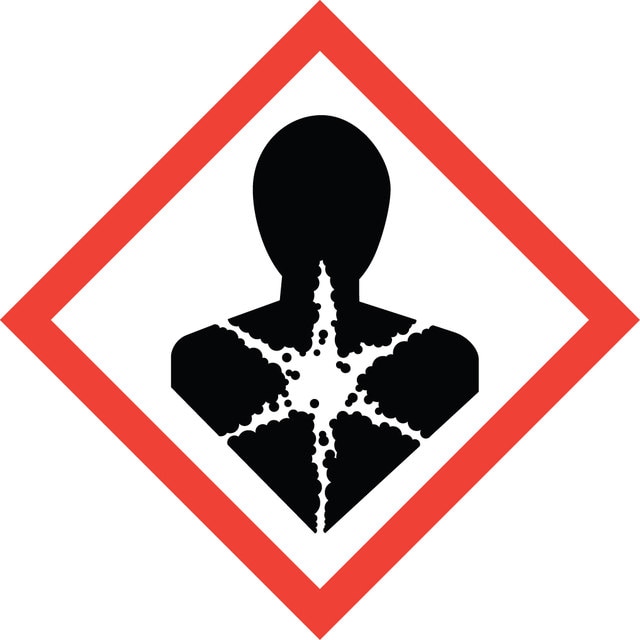
Acute Tox. 4 Inhalation - Acute Tox. 4 Oral - Aquatic Chronic 3 - Eye Dam. 1 - Met. Corr. 1 - Skin Corr. 1B - Skin Sens. 1 - STOT RE 2 Oral - STOT SE 3

target_organs

Cardio-vascular system, Respiratory system

Clase de almacenamiento

8B - Non-combustible corrosive hazardous materials

wgk

WGK 3

flash_point_f

Not applicable

flash_point_c

Not applicable

ppe

Eyeshields, Faceshields, Gloves, type P3 (EN 143) respirator cartridges


Elija entre una de las versiones más recientes:

Certificados de análisis (COA)

Lot/Batch Number

¿No ve la versión correcta?

Si necesita una versión concreta, puede buscar un certificado específico por el número de lote.

¿Ya tiene este producto?

Encuentre la documentación para los productos que ha comprado recientemente en la Biblioteca de documentos.

Visite la Librería de documentos

Seung Il Lee et al.
Scientific reports, 9(1), 2411-2411 (2019-02-23)
Blue phosphorescent organic light-emitting diodes (PHOLEDs) were fabricated with tin oxide (SnOx) nano-particles (NPs) deposited at the ITO anode to improve their electrical and optical performances. SnOx NPs helped ITO to increase the work function enhancing hole injection capability. Charge
Jae-Ho Lee et al.
Journal of liposome research, 23(4), 336-342 (2013-07-25)
The radiolabeling of the liposome surface can be a useful tool for in vivo tracking of therapeutic drug loaded liposomes. We investigated radiolabeling therapeutic drug (i.e. an antibiotic, amikacin) loaded liposomes with (99m)Tc, nebulization properties of (99m)Tc-labeled liposomal amikacin for
Karl M. Kadish et al.
Inorganic chemistry, 37(18), 4573-4577 (2001-10-24)
Two Sn(IV) corroles were synthesized and electrochemically examined. The investigated compounds are represented as (OEC)Sn(C(6)H(5)) and (OEC)SnCl, where OEC = trianion of 2,3,7,8,12,13,17,18-octaethylcorrole. (OEC)Sn(C(6)H(5)) represents the first example of a sigma-bonded metallocorrole which does not undergo a metal-centered electrode reaction.
Jae-Ho Lee et al.
Journal of liposome research, 25(2), 101-106 (2014-06-26)
Porphyrin-lipid nanovesicles (PLN) have been developed with intrinsic capabilities as activatable multimodal photonic contrast agents. Radiolabeling of PLN encapsulating drugs could eventually be able to provide quantitative in vivo information for diagnosing and treating diseases. In this study, we developed
Filippo Galli et al.
Thyroid : official journal of the American Thyroid Association, 24(8), 1297-1308 (2014-05-08)
Differentiated thyroid carcinomas originating from thyroid follicular cells are frequent tumors of the thyroid with relatively good prognosis due to improved surgical techniques and follow-up procedures. Poorly differentiated thyroid cancers, which lose iodine uptake ability, in most cases still express

Nuestro equipo de científicos tiene experiencia en todas las áreas de investigación: Ciencias de la vida, Ciencia de los materiales, Síntesis química, Cromatografía, Analítica y muchas otras.

Póngase en contacto con el Servicio técnico