Saltar al contenido
Merck

50621

terc-Butanol

analytical standard

Sinónimos:

2-Metil-2-propanol, Alcohol terc-butilo, Trimetil carbinol

Iniciar sesión para ver los precios por organización y contrato.

Seleccione un Tamaño

Cambiar Vistas

Acerca de este artículo

Fórmula lineal:
(CH3)3COH
Número CAS:
Peso molecular:
74.12
UNSPSC Code:
41116107
NACRES:
NA.24
PubChem Substance ID:
EC Number:
200-889-7
Beilstein/REAXYS Number:
906698
MDL number:
Servicio técnico
¿Necesita ayuda? Nuestro equipo de científicos experimentados está aquí para ayudarle.
Permítanos ayudarle


grade

analytical standard

Quality Level

vapor density

2.5 (vs air)

vapor pressure

31 mmHg ( 20 °C), 44 mmHg ( 26 °C)

assay

≥99.8% (GC)

autoignition temp.

896 °F

shelf life

limited shelf life, expiry date on the label

expl. lim.

8 %

technique(s)

HPLC: suitable, gas chromatography (GC): suitable

refractive index

n20/D 1.387

bp

83 °C (lit.)

mp

23-26 °C (lit.)

density

0.775 g/mL at 25 °C (lit.)

application(s)

cleaning products
cosmetics
environmental
flavors and fragrances
food and beverages
personal care

format

neat

SMILES string

CC(C)(C)O

InChI

1S/C4H10O/c1-4(2,3)5/h5H,1-3H3

InChI key

DKGAVHZHDRPRBM-UHFFFAOYSA-N

General description

tert-Butanol is a tertiary alcohol and an isomer of butanol. It is commercially produced from isobutane and is used as a solvent, ethanol denaturant, etc.

Application

The analytical standard can also be used as follows:
  • Detection and quantification of butanol and its isomers in paint samples by a rapid fast gas chromatography-proton transfer reaction-mass spectrometer (FastGC-PTR-MS) method
  • Simultaneous assessment of 121 VOCs emitted from 41 cellulose acetate movie films by proton transfer reaction-time-of-flight-mass spectrometry (PTR-ToF-MS)
  • As an internal standard in the determination of n-butane and its metabolites in the blood, heart, and tissue samples of three autopsy cases that died due to sniffling n-butane and isobutane from portable gas cartridges
  • Headspace-single drop microextraction (HS-SDME) of VOCs from different types of tomato samples for their quantification by gas chromatography-flame ionization detection (GC-FID)

Other Notes

Find a digital Reference Material for this product available on our online platform ChemisTwin® for NMR. You can use this digital equivalent on ChemisTwin® for your sample identity confirmation and compound quantification (with digital external standard). An NMR spectrum of this substance can be viewed and an online comparison against your sample can be performed with a few mouseclicks. Learn more here and start your free trial.
Refer to the product′s Certificate of Analysis for more information on a suitable instrument technique. Contact Technical Service for further support.


Still not finding the right product?

Explore all of our products under terc-Butanol
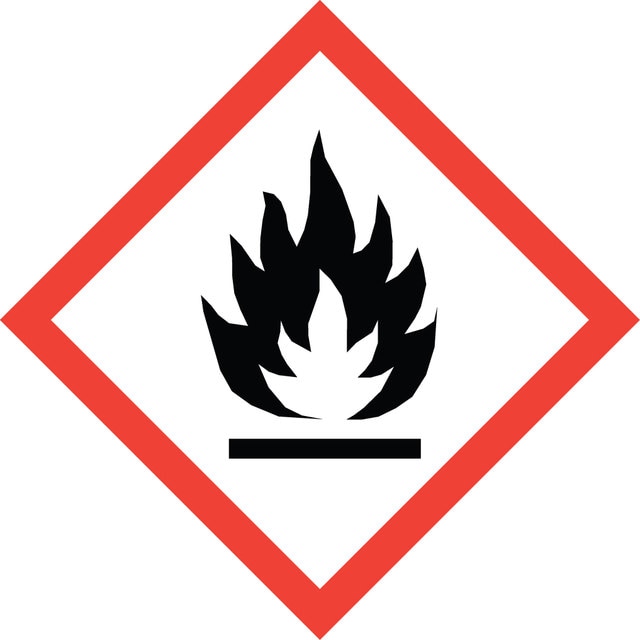

pictograms

FlameExclamation mark

signalword

Danger

Hazard Classifications

Acute Tox. 4 Inhalation - Eye Irrit. 2 - Flam. Liq. 2 - STOT SE 3

target_organs

Central nervous system, Respiratory system

Clase de almacenamiento

3 - Flammable liquids

wgk

WGK 1

flash_point_f

59.0 °F - closed cup

flash_point_c

15 °C - closed cup

ppe

Eyeshields, Faceshields, Gloves, type ABEK (EN14387) respirator filter


Elija entre una de las versiones más recientes:

Certificados de análisis (COA)

Lot/Batch Number

It looks like we've run into a problem, but you can still download Certificates of Analysis from our Documentos section.

Si necesita más asistencia, póngase en contacto con Atención al cliente

¿Ya tiene este producto?

Encuentre la documentación para los productos que ha comprado recientemente en la Biblioteca de documentos.

Visite la Librería de documentos


Alkylation of p-cresol with tert-butanol catalyzed by heteropoly acid supported on zirconia catalyst
Devassy.MB, et al.
J. Mol. Catal. A: Chem., 210, 125-130 (2004)
Lipase-catalyzed biodiesel production from soybean oil deodorizer distillate with absorbent present in tert-butanol system
Wang L, et al.
Journal of Molecular Catalysis. B, Enzymatic, 43, 29-32 (2006)
Arnau Bassegoda et al.
Applied microbiology and biotechnology, 97(19), 8559-8568 (2013-01-22)
Rhodococci are highly adaptable bacteria, capable to degrade or transform a large number of organic compounds, including recalcitrant or toxic products. However, little information is available on the lipases of the genus Rhodococcus, except for LipR, the first lipase isolated
