Saltar al contenido
Merck

81910

Propionic acid

≥99.5% (GC), liquid, puriss. p.a.

Sinónimos:

Acid C3, Propanoic acid, Propanyl acid

Iniciar sesión para ver los precios por organización y contrato.

Seleccione un Tamaño


Acerca de este artículo

Fórmula lineal:
CH3CH2COOH
Número CAS:
Peso molecular:
74.08
NACRES:
NA.21
PubChem Substance ID:
eCl@ss:
39021305
UNSPSC Code:
12352100
EC Number:
201-176-3
MDL number:
Beilstein/REAXYS Number:
506071
Assay:
≥99.5% (GC)
Form:
liquid
Servicio técnico
¿Necesita ayuda? Nuestro equipo de científicos experimentados está aquí para ayudarle.
Permítanos ayudarle
Servicio técnico
¿Necesita ayuda? Nuestro equipo de científicos experimentados está aquí para ayudarle.
Permítanos ayudarle

Nombre del producto

Propionic acid, puriss. p.a., ≥99.5% (GC)

InChI key

XBDQKXXYIPTUBI-UHFFFAOYSA-N

InChI

1S/C3H6O2/c1-2-3(4)5/h2H2,1H3,(H,4,5)

SMILES string

CCC(O)=O

vapor density

2.55 (vs air)

vapor pressure

2.4 mmHg ( 20 °C)

grade

puriss. p.a.

assay

≥99.5% (GC)

form

liquid

autoignition temp.

955 °F

expl. lim.

12.1 %

refractive index

n20/D 1.386 (lit.), n20/D 1.386

bp

141 °C (lit.)

mp

−24-−23 °C (lit.)

solubility

organic solvents: soluble(lit.), water: soluble(lit.)

density

0.993 g/mL at 25 °C (lit.)

cation traces

Al: ≤0.5 mg/kg, Ba: ≤0.1 mg/kg, Bi: ≤0.1 mg/kg, Ca: ≤0.5 mg/kg, Cd: ≤0.05 mg/kg, Co: ≤0.02 mg/kg, Cr: ≤0.1 mg/kg, Cu: ≤0.02 mg/kg, Fe: ≤0.5 mg/kg, K: ≤0.5 mg/kg, Li: ≤0.1 mg/kg, Mg: ≤0.1 mg/kg, Mn: ≤0.02 mg/kg, Mo: ≤0.1 mg/kg, Na: ≤1 mg/kg, Ni: ≤0.1 mg/kg, Pb: ≤0.1 mg/kg, Sr: ≤0.1 mg/kg, Zn: ≤0.1 mg/kg

functional group

carboxylic acid

Quality Level

¿Está buscando productos similares? Visita Guía de comparación de productos

Categorías relacionadas

Application

Propionic acid may be used in the synthesis of cellulose propionate (cellulose ester).

General description

Propionic acid is a linear monocarboxylic acid. It affords esters on reaction with alcohols or alkenes. It can be synthesized by reacting ethane, carbon monoxide and water. It participates as a precursor in the preparation of smallest azolium homoenolate intermediate.

signalword

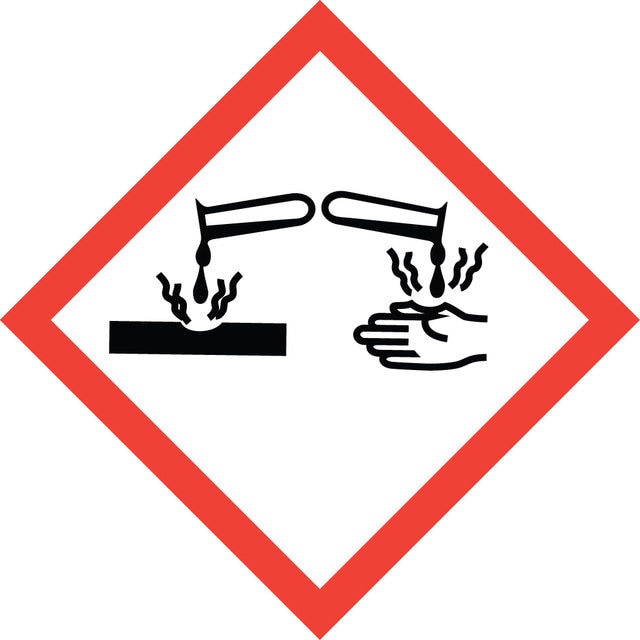
Danger

Hazard Classifications

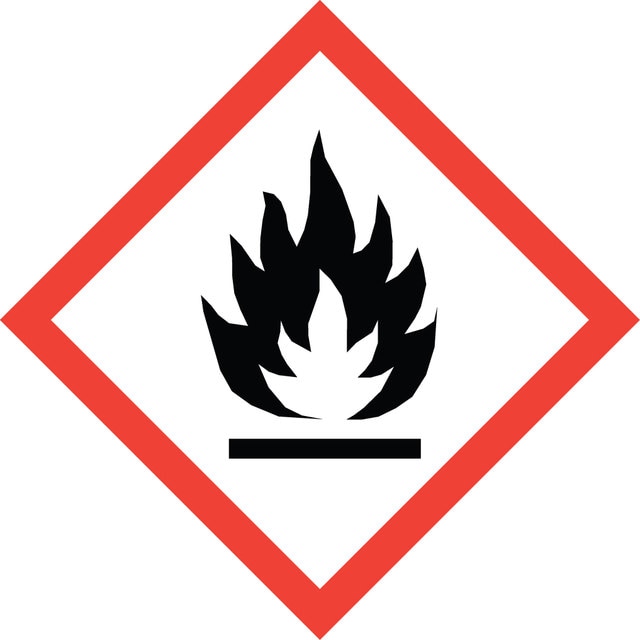
Eye Dam. 1 - Flam. Liq. 3 - Skin Corr. 1B - STOT SE 3

target_organs

Respiratory system

Clase de almacenamiento

3 - Flammable liquids

wgk

WGK 1

flash_point_f

129.2 °F - closed cup

flash_point_c

54 °C - closed cup

ppe

Faceshields, Gloves, Goggles, type ABEK (EN14387) respirator filter


Elija entre una de las versiones más recientes:

Certificados de análisis (COA)

Lot/Batch Number

¿No ve la versión correcta?

Si necesita una versión concreta, puede buscar un certificado específico por el número de lote.

¿Ya tiene este producto?

Encuentre la documentación para los productos que ha comprado recientemente en la Biblioteca de documentos.

Visite la Librería de documentos

Eagleson M.
Concise Encyclopedia Chemistry, 194-194 (1994)
Zhichao Jin et al.
Chemistry (Weinheim an der Bergstrasse, Germany), 21(26), 9360-9363 (2015-05-28)
Direct β-carbon activation of propionic acid (C2H5CO2H) by carbene organocatalysis has been developed. This activation affords the smallest azolium homoenolate intermediate (without any substituent) as a 3-carbon nucleophile for enantioselective reactions. Propionic acid is an excellent raw material because it
Eagleson M.
Concise Encyclopedia Chemistry, 898-898 (1994)
Sa'ad H Al-Lahham et al.
Biochimica et biophysica acta, 1801(11), 1175-1183 (2010-08-10)
Undigested food is fermented in the colon by the microbiota and gives rise to various microbial metabolites. Short-chain fatty acids (SCFA), including acetic, propionic and butyric acid, are the principal metabolites produced. However, most of the literature focuses on butyrate
Eddy J Smid et al.
Current opinion in biotechnology, 24(2), 148-154 (2012-12-12)
Most known natural and industrial food fermentation processes are driven by either simple or complex communities of microorganisms. Obviously, these fermenting microbes will not only interact with the fermentable substrate but also with each other. These microbe-microbe interactions are complex

Nuestro equipo de científicos tiene experiencia en todas las áreas de investigación: Ciencias de la vida, Ciencia de los materiales, Síntesis química, Cromatografía, Analítica y muchas otras.

Póngase en contacto con el Servicio técnico