Saltar al contenido
Merck

87920

Tetramethylsilane

analytical standard, suitable for NMR (spectroscopy), ACS reagent

Iniciar sesión para ver los precios por organización y contrato.

Seleccione un Tamaño


Acerca de este artículo

Fórmula lineal:
Si(CH3)4
Número CAS:
Peso molecular:
88.22
UNSPSC Code:
12142201
NACRES:
NA.24
PubChem Substance ID:
EC Number:
200-899-1
Beilstein/REAXYS Number:
1696908
MDL number:
Servicio técnico
¿Necesita ayuda? Nuestro equipo de científicos experimentados está aquí para ayudarle.
Permítanos ayudarle
Servicio técnico
¿Necesita ayuda? Nuestro equipo de científicos experimentados está aquí para ayudarle.
Permítanos ayudarle

Quality Level

grade

ACS reagent, analytical standard

vapor pressure

11.66 psi ( 20 °C)

assay

≥99.5% (GC)

form

liquid

autoignition temp.

842 °F

refractive index

n20/D 1.358 (lit.), n20/D 1.359

bp

26-28 °C (lit.)

mp

−99 °C (lit.)

density

0.648 g/mL at 25 °C (lit.)

suitability

suitable for NMR (spectroscopy)

application(s)

environmental

format

neat

storage temp.

2-8°C

SMILES string

C[Si](C)(C)C

InChI

1S/C4H12Si/c1-5(2,3)4/h1-4H3

InChI key

CZDYPVPMEAXLPK-UHFFFAOYSA-N

¿Está buscando productos similares? Visita Guía de comparación de productos

General description

Tetramethylsilane has been recommended by the International Union of Pure and Applied Chemistry (IUPAC) as a universal reference for all nuclides. It is commonly used as a reference standard in nuclear magnetic resonance (NMR) for measuring proton chemical shifts and the temperature dependence of the 1H chemical shift of TMS in solvents such as chloroform, methanol, and dimethylsulfoxide is studied.

Application

Tetramethylsilane may be used as an internal standard for the quantitative analysis of medicinal plant extracts and herbal products using the quantitative NMR (qNMR) method. It may also be used as an internal standard to investigate peroxide-based chemical systems for the crosslinking reactions carried on isotactic polypropylene using FT-IR spectrometry and proton nuclear magnetic resonance (1H NMR) techniques.

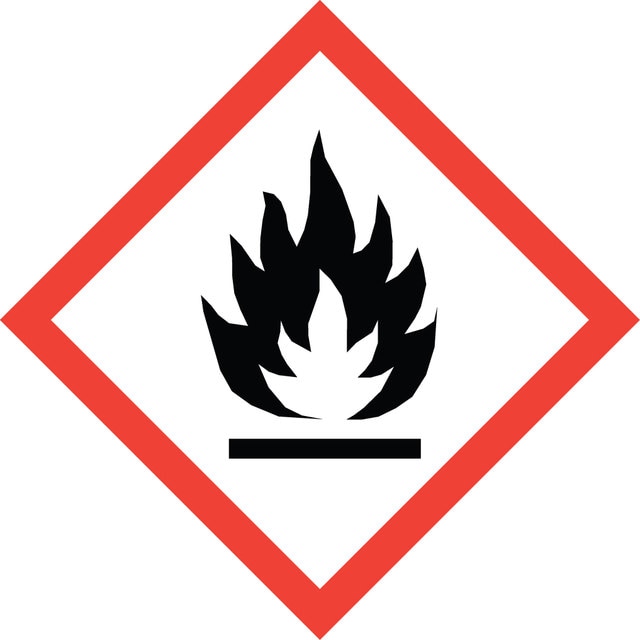
pictograms

Flame

signalword

Danger

hcodes

Hazard Classifications

Flam. Liq. 1

Clase de almacenamiento

3 - Flammable liquids

wgk

WGK 3

flash_point_f

-16.6 °F - closed cup

flash_point_c

-27 °C - closed cup

ppe

Eyeshields, Faceshields, Gloves


Elija entre una de las versiones más recientes:

Certificados de análisis (COA)

Lot/Batch Number

It looks like we've run into a problem, but you can still download Certificates of Analysis from our Documentos section.

Si necesita más asistencia, póngase en contacto con Atención al cliente

¿Ya tiene este producto?

Encuentre la documentación para los productos que ha comprado recientemente en la Biblioteca de documentos.

Visite la Librería de documentos

Ramesh C Sharma et al.
Spectrochimica acta. Part A, Molecular and biomolecular spectroscopy, 65(3-4), 787-791 (2006-03-15)
The decomposition of trimethylsilane and tetramethylsilane has been investigated for the first time, using hot wire (catalytic) at various temperatures. Trimethylsilane is catalytic-dissociated in these species SiH(2), CH(3)SiH, CH(3), CH(2)Si. Time of flight mass spectroscopy signal of these species are
K Eberle et al.
Physics in medicine and biology, 48(21), 3555-3564 (2003-12-05)
First measurements with a prototype ionization chamber are described to be applied in online monitoring of modulated fields in radiation therapy. The liquids isooctane, isononane (TMP) and tetramethylsilane (TMS) are used in a high purity grade in order to realize
Robin K Harris et al.
Magnetic resonance in chemistry : MRC, 45 Suppl 1, S174-S186 (2007-12-25)
Computations for chemical shifts of molecular organic compounds using the gauge-including projector augmented wave method and the NMR-CASTEP code are reviewed. The methods are briefly introduced, and some general aspects involving the sources of uncertainty in the results are explored.
Roy E Hoffman
Journal of magnetic resonance (San Diego, Calif. : 1997), 163(2), 325-331 (2003-08-14)
The chemical shift of TMS is commonly assumed to be zero. However, it varies by over 1 ppm for 1H and 4 ppm for 13C and shows a correlation with the physical properties of the solvent. Using the commonly accepted
Maria T Proetto et al.
ChemMedChem, 9(6), 1176-1187 (2014-05-23)
A series of methoxy- and fluorine-substituted [salophene]platinum(II) complexes (salophene=N,N'-bis(salicylidene)-1,2-phenylenediamine) were synthesized and characterized by (1) H NMR spectroscopy and mass spectrometry. The structure was confirmed on the example of [5-OCH3 -salophene]platinum(II) (4-Pt) by crystal structure analysis. The cytotoxicity of all

Nuestro equipo de científicos tiene experiencia en todas las áreas de investigación: Ciencias de la vida, Ciencia de los materiales, Síntesis química, Cromatografía, Analítica y muchas otras.

Póngase en contacto con el Servicio técnico