Saltar al contenido
Merck

E1271

N-Ethylmaleimide

BioXtra, ≥98% (HPLC)

Sinónimos:

NEM

Iniciar sesión para ver los precios por organización y contrato.

Seleccione un Tamaño


Acerca de este artículo

Fórmula empírica (notación de Hill):
C6H7NO2
Número CAS:
Peso molecular:
125.13
UNSPSC Code:
12352106
NACRES:
NA.21
PubChem Substance ID:
EC Number:
204-892-4
Beilstein/REAXYS Number:
112448
MDL number:
Servicio técnico
¿Necesita ayuda? Nuestro equipo de científicos experimentados está aquí para ayudarle.
Permítanos ayudarle
Servicio técnico
¿Necesita ayuda? Nuestro equipo de científicos experimentados está aquí para ayudarle.
Permítanos ayudarle

InChI

1S/C6H7NO2/c1-2-7-5(8)3-4-6(7)9/h3-4H,2H2,1H3

InChI key

HDFGOPSGAURCEO-UHFFFAOYSA-N

product line

BioXtra

assay

≥98% (HPLC)

impurities

≤0.001% Phosphorus (P), ≤0.1% Insoluble matter

ign. residue

≤0.1%

bp

210 °C (lit.)

Quality Level

Gene Information

solubility

95% ethanol: 50 mg/mL, clear to slightly hazy (colorless to faint yellow)

anion traces

chloride (Cl-): ≤0.05%, sulfate (SO42-): ≤0.05%

cation traces

Al: ≤0.0005%, Ca: ≤0.0005%, Cu: ≤0.0005%, Fe: ≤0.0005%, K: ≤0.005%, Mg: ≤0.0005%, Na: ≤0.005%, Pb: ≤0.001%, Zn: ≤0.0005%

storage temp.

2-8°C

SMILES string

CCN1C(=O)C=CC1=O

¿Está buscando productos similares? Visita Guía de comparación de productos

Application

Reagent for the covalent modification of cysteine residues in proteins.

Biochem/physiol Actions

Augments currents from native M-channels in sympathetic neurons and acts as an opener for KCNQ2, KCNQ4 and KCNQ5 channels.
Sulfhydryl alkylating agent that inactivates NADP-dependent isocitrate dehydrogenase and many endonucleases.

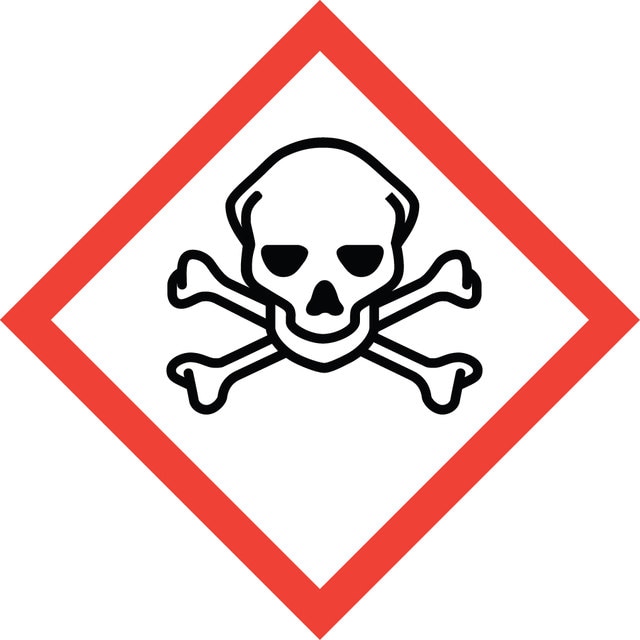
pictograms

Skull and crossbonesCorrosion

signalword

Danger

Hazard Classifications

Acute Tox. 2 Oral - Acute Tox. 3 Dermal - Eye Dam. 1 - Skin Corr. 1B - Skin Sens. 1

Clase de almacenamiento

6.1A - Combustible acute toxic Cat. 1 and 2 / very toxic hazardous materials

wgk

WGK 3

flash_point_f

163.2 °F - closed cup

flash_point_c

72.9 °C - closed cup

ppe

Eyeshields, Faceshields, Gloves, type P3 (EN 143) respirator cartridges


Elija entre una de las versiones más recientes:

Certificados de análisis (COA)

Lot/Batch Number

¿No ve la versión correcta?

Si necesita una versión concreta, puede buscar un certificado específico por el número de lote.

¿Ya tiene este producto?

Encuentre la documentación para los productos que ha comprado recientemente en la Biblioteca de documentos.

Visite la Librería de documentos

Koichi Tan-No et al.
International review of neurobiology, 85, 191-205 (2009-07-18)
Dynorphins, the endogenous opioid peptides derived from prodynorphin may participate not only in the inhibition, but also in facilitation of spinal nociceptive transmission. However, the mechanism of pronociceptive dynorphin actions, and the comparative potential of prodynorphin processing products to induce
Tatsuki Kurokawa et al.
Biochimica et biophysica acta, 1838(1 Pt B), 382-387 (2013-10-22)
Hv1 (also named, voltage-sensor only protein, VSOP) lacks an authentic pore domain, and its voltage sensor domain plays both roles in voltage sensing and proton permeation. The activities of a proton channel are intrinsic to protomers of Hv1, while Hv1
Dar'ya S Redka et al.
Biochemistry, 52(42), 7405-7427 (2013-09-21)
Muscarinic and other G protein-coupled receptors exhibit an agonist-specific heterogeneity that tracks efficacy and commonly is attributed to an effect of the G protein on an otherwise homogeneous population of sites. To examine this notion, M2 muscarinic receptors were purified
Nicolas Matuszak et al.
Journal of medicinal chemistry, 52(23), 7410-7420 (2009-07-09)
The endocannabinoid 2-arachidonoylglycerol (2-AG) plays a major role in many physiological processes, and its action is quickly terminated via enzymatic hydrolysis catalyzed by monoglyceride lipase (MGL). Regulating its endogenous level could offer therapeutic opportunities; however, few selective MGL inhibitors have
Helen R Stagg et al.
The Journal of cell biology, 186(5), 685-692 (2009-09-02)
The US2 and US11 gene products of human cytomegalovirus promote viral evasion by hijacking the endoplasmic reticulum (ER)-associated degradation (ERAD) pathway. US2 and US11 initiate dislocation of newly translocated major histocompatibility complex class I (MHC I) from the ER to

Nuestro equipo de científicos tiene experiencia en todas las áreas de investigación: Ciencias de la vida, Ciencia de los materiales, Síntesis química, Cromatografía, Analítica y muchas otras.

Póngase en contacto con el Servicio técnico