Saltar al contenido
Merck

D221104

Dodecane

ReagentPlus®, ≥99%

Iniciar sesión para ver los precios por organización y contrato.

Seleccione un Tamaño


Acerca de este artículo

Fórmula lineal:
CH3(CH2)10CH3
Número CAS:
Peso molecular:
170.33
UNSPSC Code:
12352001
NACRES:
NA.21
PubChem Substance ID:
EC Number:
203-967-9
Beilstein/REAXYS Number:
1697175
MDL number:
Assay:
≥99%
Technique(s):
microbiological culture: suitable
Bp:
215-217 °C (lit.)
Vapor pressure:
1 mmHg ( 47.8 °C)
Servicio técnico
¿Necesita ayuda? Nuestro equipo de científicos experimentados está aquí para ayudarle.
Permítanos ayudarle
Servicio técnico
¿Necesita ayuda? Nuestro equipo de científicos experimentados está aquí para ayudarle.
Permítanos ayudarle

InChI key

SNRUBQQJIBEYMU-UHFFFAOYSA-N

InChI

1S/C12H26/c1-3-5-7-9-11-12-10-8-6-4-2/h3-12H2,1-2H3

SMILES string

CCCCCCCCCCCC

vapor density

5.96 (vs air)

vapor pressure

1 mmHg ( 47.8 °C)

product line

ReagentPlus®

assay

≥99%

form

liquid

autoignition temp.

401 °F

expl. lim.

8 %

technique(s)

microbiological culture: suitable

refractive index

n20/D 1.421 (lit.)

bp

215-217 °C (lit.)

mp

−9.6 °C (lit.)

density

0.75 g/mL at 25 °C (lit.)

Quality Level

¿Está buscando productos similares? Visita Guía de comparación de productos

Application

Dodecane can be used as a solvent in the:
  • Extraction of hydrocarbons from Botryococcus braunii.
  • Pd/C catalyzed deoxygenation of stearic acid to synthesize biodiesel.
  • Oxidativede sulfurization of dibenzothiophenes.

General description

Dodecane is a long-chain linear alkane that is commonly used as a solvent and the major constituent of kerosene. Also, it is employed as an organic phase in solvent extraction.

Legal Information

ReagentPlus is a registered trademark of Merck KGaA, Darmstadt, Germany

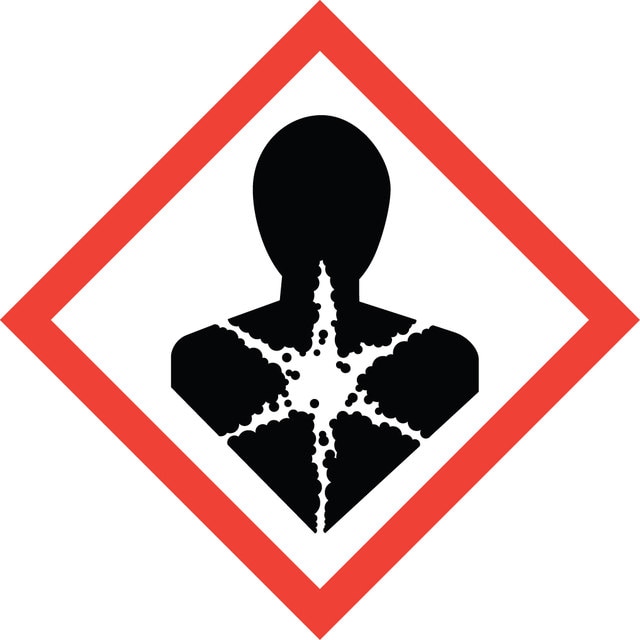
pictograms

Health hazard

signalword

Danger

hcodes

Hazard Classifications

Asp. Tox. 1

supp_hazards

Clase de almacenamiento

10 - Combustible liquids

wgk

WGK 1

flash_point_f

158.0 °F - Pensky-Martens closed cup

flash_point_c

70 °C - Pensky-Martens closed cup


Elija entre una de las versiones más recientes:

Certificados de análisis (COA)

Lot/Batch Number

¿No ve la versión correcta?

Si necesita una versión concreta, puede buscar un certificado específico por el número de lote.

¿Ya tiene este producto?

Encuentre la documentación para los productos que ha comprado recientemente en la Biblioteca de documentos.

Visite la Librería de documentos

Masoumeh Karvar et al.
Langmuir : the ACS journal of surfaces and colloids, 27(17), 10386-10391 (2011-07-07)
Surfactants such as Aerosol OT (AOT) are commonly used to stabilize and electrically charge nonpolar colloids in devices such as electronic ink displays. The electrical behavior of such devices is strongly influenced by the presence of charged inverse micelles, formed
Raquel Silva et al.
Advances in experimental medicine and biology, 733, 155-164 (2011-11-22)
In this work, we report a novel approach using proteinaceous microspheres of bovine serum albumin (BSA), human serum albumin (HSA) and silk fibroin (SF) containing different organic solvents, namely n-dodecane, mineral oil and vegetable oil, to reduce the activity of
Mahnaz Ghambarian et al.
Journal of chromatography. A, 1222, 5-12 (2011-12-27)
The aim of this research was to compare the extraction efficiencies of two modes of three-phase hollow fiber microextraction (HF-LLLME) based on aqueous and organic acceptor phases for analysis of tricyclic antidepressant (TCA) drugs. High-performance liquid chromatography with photodiode array
Dorinde M M Kleinegris et al.
Enzyme and microbial technology, 48(3), 253-259 (2011-11-25)
During the in situ extraction of β-carotene from Dunaliella salina, the causal relationship between carotenoid extraction and cell death indicated that cell growth and cell death should be at equilibrium for a continuous in situ extraction process. In a flat-panel
I Solè et al.
Journal of colloid and interface science, 376(1), 133-139 (2012-04-07)
The influence of different dilution procedures on the properties of oil-in-water (O/W) nano-emulsions obtained by dilution of oil-in-water (O/W) and water-in-oil (W/O) microemulsions has been studied. The system water/SDS/cosurfactant/dodecane with either hexanol or pentanol as cosurfactant was chosen as model

Nuestro equipo de científicos tiene experiencia en todas las áreas de investigación: Ciencias de la vida, Ciencia de los materiales, Síntesis química, Cromatografía, Analítica y muchas otras.

Póngase en contacto con el Servicio técnico