
H13303

1-Hexanol
reagent grade, 98%
Sinónimos:
Alcohol hexílico
Iniciar sesión para ver los precios por organización y contrato.
Seleccione un Tamaño
Cambiar Vistas
Acerca de este artículo
Fórmula lineal:
CH3(CH2)5OH
Número CAS:
Peso molecular:
102.17
UNSPSC Code:
12352104
NACRES:
NA.21
PubChem Substance ID:
EC Number:
203-852-3
Beilstein/REAXYS Number:
969167
MDL number:
Assay:
98%
Grade:
reagent grade
Bp:
156-157 °C (lit.)
Vapor pressure:
1 mmHg ( 25.6 °C)
Servicio técnico
¿Necesita ayuda? Nuestro equipo de científicos experimentados está aquí para ayudarle.
Permítanos ayudarlegrade
reagent grade
Quality Level
vapor density
4.5 (vs air)
vapor pressure
1 mmHg ( 25.6 °C)
assay
98%
form
liquid
autoignition temp.
559 °F
expl. lim.
0.34-6.3 %
dilution
(for analytical testing)
refractive index
n20/D 1.418 (lit.)
bp
156-157 °C (lit.)
mp
−52 °C (lit.)
density
0.814 g/mL at 25 °C (lit.)
SMILES string
CCCCCCO
InChI
1S/C6H14O/c1-2-3-4-5-6-7/h7H,2-6H2,1H3
InChI key
ZSIAUFGUXNUGDI-UHFFFAOYSA-N
General description
1-Hexanol is a linear primary alcohol, made up of six carbon atoms and is produced by the oligomerization of ethylene. There is a wide range of uses for 1-hexanol, including plasticizers, antiseptics, fragrances, pharmaceuticals, textiles, and leather finishing agents.
Application
1-Hexanol is used:
- As an oil phase in the preparation of manganese zinc ferrite nanoparticles by precipitation in reverse microemulsion system.
- As a solvent in the separation of carboxylic acids and tetrahydrofurfuryl alcohol from water.
- As a solvent in the synthesis of ZnO (zinc oxide) quantum particles from zinc acetate by precipitation method.
Features and Benefits
1-Hexanol or Hexyl alcohol exhibits high reactivity at a lower temperature due to the alkane-like reaction pathways that begin at a secondary carbon site.
Still not finding the right product?
Explore all of our products under 1-Hexanol
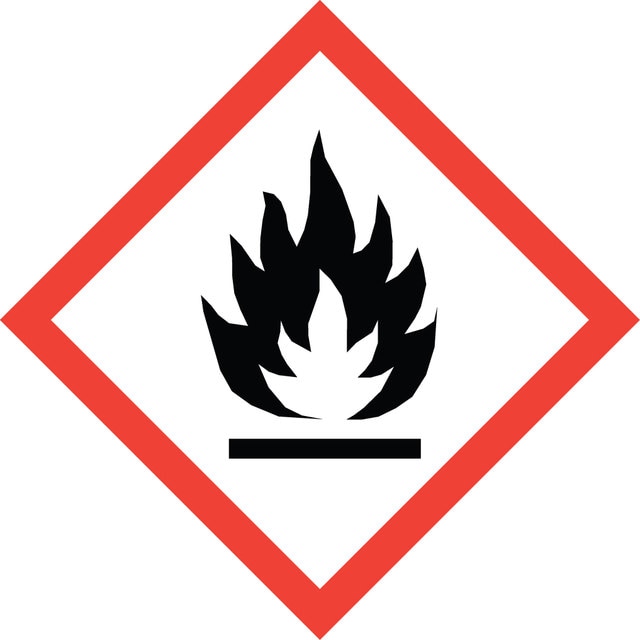

signalword
Warning
hcodes
Hazard Classifications
Acute Tox. 4 Dermal - Acute Tox. 4 Oral - Eye Irrit. 2 - Flam. Liq. 3
Clase de almacenamiento
3 - Flammable liquids
wgk
WGK 1
flash_point_f
140.0 °F - closed cup
flash_point_c
60 °C - closed cup
Elija entre una de las versiones más recientes:
¿Ya tiene este producto?
Encuentre la documentación para los productos que ha comprado recientemente en la Biblioteca de documentos.
Sandra Muschiol et al.
The Journal of biological chemistry, 292(34), 14134-14146 (2017-07-01)
Type IV pili are important virulence factors on the surface of many pathogenic bacteria and have been implicated in a wide range of diverse functions, including attachment, twitching motility, biofilm formation, and horizontal gene transfer. The respiratory pathogen Streptococcus pneumoniae
Annie Handler et al.
Cell, 178(1), 60-75 (2019-06-25)
Animals rely on the relative timing of events in their environment to form and update predictive associations, but the molecular and circuit mechanisms for this temporal sensitivity remain incompletely understood. Here, we show that olfactory associations in Drosophila can be
Maria Eugenia Villar et al.
Cell reports, 30(8), 2603-2613 (2020-02-27)
Research on honeybee memory has led to a widely accepted model in which a single pairing of an odor stimulus with sucrose induces memories that are independent of protein synthesis but is unable to form protein-synthesis-dependent long-term memory (LTM). The