Saltar al contenido
Merck

M32658

3-Methyl-1-butanol

reagent grade, 98%

Sinónimos:

Isoamyl alcohol, Isopentyl alcohol

Iniciar sesión para ver los precios por organización y contrato.

Seleccione un Tamaño


Acerca de este artículo

Fórmula lineal:
(CH3)2CHCH2CH2OH
Número CAS:
Peso molecular:
88.15
UNSPSC Code:
12352001
NACRES:
NA.21
PubChem Substance ID:
EC Number:
204-633-5
Beilstein/REAXYS Number:
1718835
MDL number:
Assay:
98%
Grade:
reagent grade
Bp:
130 °C (lit.)
Vapor pressure:
2 mmHg ( 20 °C)
Servicio técnico
¿Necesita ayuda? Nuestro equipo de científicos experimentados está aquí para ayudarle.
Permítanos ayudarle
Servicio técnico
¿Necesita ayuda? Nuestro equipo de científicos experimentados está aquí para ayudarle.
Permítanos ayudarle

SMILES string

CC(C)CCO

InChI

1S/C5H12O/c1-5(2)3-4-6/h5-6H,3-4H2,1-2H3

InChI key

PHTQWCKDNZKARW-UHFFFAOYSA-N

grade

reagent grade

vapor density

3 (vs air)

vapor pressure

2 mmHg ( 20 °C)

assay

98%

form

liquid

autoignition temp.

644 °F

expl. lim.

1.2-9 %, 100 °F

dilution

(for analytical testing)

refractive index

n20/D 1.406 (lit.)

pH

5.6 (20 °C, 25 g/L)

bp

130 °C (lit.)

mp

−117 °C (lit.)

density

0.809 g/mL at 25 °C (lit.)

Quality Level

¿Está buscando productos similares? Visita Guía de comparación de productos

Application

3-Methyl-1-butanol has been used in the preparation of bioactive beads (BABs) with uniform size for transformation.

Biochem/physiol Actions

3-Methyl-1-butanol is a pentanol isomer useful in biofuels. It is used as a starting material for the production of isoamyl acetate, a flavoring agent applicable in the food industry. 3-Methyl-1-butanol shows anti-fungal action by inhibiting the hyphal formation and reducing biofilm formation in Candida albicans. It is also used in DNA extraction protocols.

signalword

Danger

Hazard Classifications

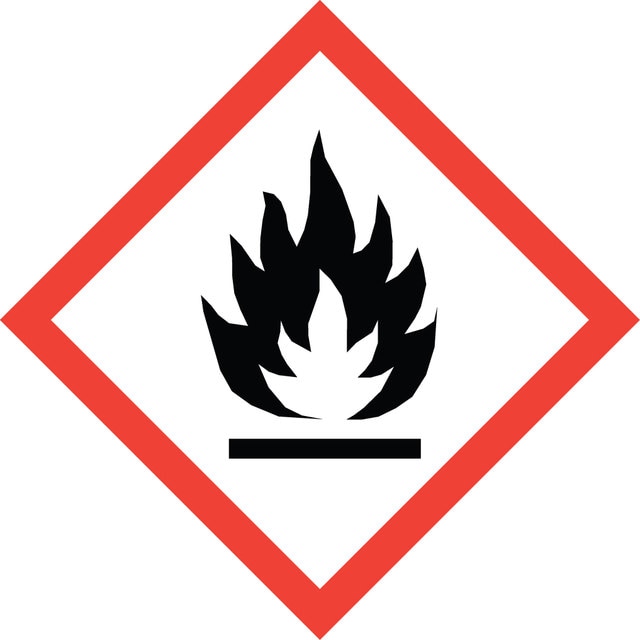
Acute Tox. 4 Inhalation - Eye Dam. 1 - Flam. Liq. 3 - Skin Irrit. 2 - STOT SE 3

target_organs

Respiratory system

Clase de almacenamiento

3 - Flammable liquids

wgk

WGK 1

flash_point_f

110.3 °F - closed cup

flash_point_c

43.5 °C - closed cup


Elija entre una de las versiones más recientes:

Certificados de análisis (COA)

Lot/Batch Number

¿No ve la versión correcta?

Si necesita una versión concreta, puede buscar un certificado específico por el número de lote.

¿Ya tiene este producto?

Encuentre la documentación para los productos que ha comprado recientemente en la Biblioteca de documentos.

Visite la Librería de documentos

Vicente Pérez-Brocal et al.
Scientific reports, 10(1), 17377-17377 (2020-10-17)
Human lungs harbor a scarce microbial community, requiring to develop methods to enhance the recovery of nucleic acids from bacteria and fungi, leading to a more efficient analysis of the lung tissue microbiota. Here we describe five extraction protocols including
Mary J Dunlop et al.
Molecular systems biology, 7, 487-487 (2011-05-11)
Many compounds being considered as candidates for advanced biofuels are toxic to microorganisms. This introduces an undesirable trade-off when engineering metabolic pathways for biofuel production because the engineered microbes must balance production against survival. Cellular export systems, such as efflux
Kazushi Yoshida et al.
Nature communications, 3, 739-739 (2012-03-15)
The same odorant can induce attractive or repulsive responses depending on its concentration in various animals including humans. However, little is understood about the neuronal basis of this behavioural phenomenon. Here we show that Caenorhabditis elegans avoids high concentrations of
Frédéric Ravyts et al.
Food microbiology, 27(7), 945-954 (2010-08-07)
Differences in the production of bacterial metabolites with potential impact on fermented sausage flavour were found in meat simulation medium when comparing different strains of Staphylococcus xylosus and Staphylococcus carnosus as starter cultures. Overall, higher levels of 3-methyl-1-butanol and acetoin
Niels O Verhulst et al.
Malaria journal, 10, 28-28 (2011-02-10)
Anopheles gambiae sensu stricto is considered to be highly anthropophilic and volatiles of human origin provide essential cues during its host-seeking behaviour. A synthetic blend of three human-derived volatiles, ammonia, lactic acid and tetradecanoic acid, attracts A. gambiae. In addition

Nuestro equipo de científicos tiene experiencia en todas las áreas de investigación: Ciencias de la vida, Ciencia de los materiales, Síntesis química, Cromatografía, Analítica y muchas otras.

Póngase en contacto con el Servicio técnico