
S2252

Sodium nitrite
ReagentPlus®, ≥99.0%
Iniciar sesión para ver los precios por organización y contrato.
Seleccione un Tamaño
Acerca de este artículo
Fórmula lineal:
NaNO2
Número CAS:
Peso molecular:
69.00
NACRES:
NA.21
PubChem Substance ID:
UNSPSC Code:
12352302
EC Number:
231-555-9
MDL number:
Assay:
≥99.0%
Form:
powder or crystals
Servicio técnico
¿Necesita ayuda? Nuestro equipo de científicos experimentados está aquí para ayudarle.
Permítanos ayudarleServicio técnico
¿Necesita ayuda? Nuestro equipo de científicos experimentados está aquí para ayudarle.
Permítanos ayudarleQuality Level
product line
ReagentPlus®
assay
≥99.0%
form
powder or crystals
autoignition temp.
914 °F
pH
9 (20 °C, 100 g/L)
mp
271 °C (lit.)
SMILES string
[Na+].[O-]N=O
InChI
1S/HNO2.Na/c2-1-3;/h(H,2,3);/q;+1/p-1
InChI key
LPXPTNMVRIOKMN-UHFFFAOYSA-M
¿Está buscando productos similares? Visita Guía de comparación de productos
Categorías relacionadas
General description
Sodium nitrite is an air-sensitive and hygroscopic solid with both reducing and oxidizing properties. It is commonly used as a reagent and catalyst in synthetic organic chemistry. It is decomposed by acids (even weak acids) with the evolution of a brown mixture of nitrogen oxides (NOx).
Application
Sodium nitrite can be used as a reagent in:
It can also be used as a nitrating agent in organic synthesis.
It is used in direct C-H nitration, ipso-nitration, and nitration via transition metal-catalyzed cross-coupling reaction. NaNO2 is also used as a co-catalyst for catalytic oxidation of alcohols under aerobic, solvent-free conditions.
- In the conversion of amines into diazo compounds, which are used as key precursors to many dyes, such as diazo dyes.
- Nef reaction and Abidi transformations.
- The C–C bond cleavage reaction in the presence of TFA under aerobic conditions.
- The oxidative carbonitration of alkenes in the presence of K2S2O8.
It can also be used as a nitrating agent in organic synthesis.
It is used in direct C-H nitration, ipso-nitration, and nitration via transition metal-catalyzed cross-coupling reaction. NaNO2 is also used as a co-catalyst for catalytic oxidation of alcohols under aerobic, solvent-free conditions.
Legal Information
ReagentPlus is a registered trademark of Merck KGaA, Darmstadt, Germany
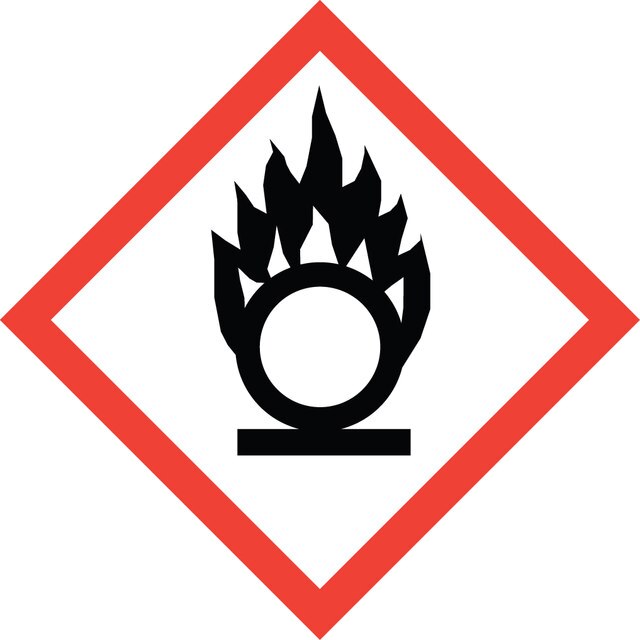


signalword
Danger
hcodes
Hazard Classifications
Acute Tox. 3 Oral - Aquatic Acute 1 - Eye Irrit. 2 - Ox. Sol. 3
Clase de almacenamiento
5.1B - Oxidizing hazardous materials
wgk
WGK 3
flash_point_f
Not applicable
flash_point_c
Not applicable
Elija entre una de las versiones más recientes:
¿Ya tiene este producto?
Encuentre la documentación para los productos que ha comprado recientemente en la Biblioteca de documentos.
Arda Gülay et al.
mBio, 10(6) (2019-11-07)
Nitrification, the oxidative process converting ammonia to nitrite and nitrate, is driven by microbes and plays a central role in the global nitrogen cycle. Our earlier investigations based on 16S rRNA and amoA amplicon analysis, amoA quantitative PCR and metagenomics
Anne C Rios et al.
Cancer cell, 35(4), 618-632 (2019-04-02)
Breast tumors are inherently heterogeneous, but the evolving cellular organization through neoplastic progression is poorly understood. Here we report a rapid, large-scale single-cell resolution 3D imaging protocol based on a one-step clearing agent that allows visualization of normal tissue architecture
Lucas C Pinheiro et al.
Free radical biology & medicine, 53(4), 701-709 (2012-06-23)
The new pathway nitrate-nitrite-nitric oxide (NO) has emerged as a physiological alternative to the classical enzymatic pathway for NO formation from l-arginine. Nitrate is converted to nitrite by commensal bacteria in the oral cavity and the nitrite formed is then
Edward H Oldfield et al.
Journal of neurosurgery, 119(3), 634-641 (2013-05-28)
Intravenous sodium nitrite has been shown to prevent and reverse cerebral vasospasm in a primate model of subarachnoid hemorrhage (SAH). The present Phase IIA dose-escalation study of sodium nitrite was conducted to determine the compound's safety in humans with aneurysmal
Paul J Shami et al.
Journal of medicinal chemistry, 49(14), 4356-4366 (2006-07-11)
The literature provides evidence that metabolic nitric oxide (NO) release mediates the cytotoxic activities (against human leukemia and prostate cancer xenografts in mice) of JS-K, a compound of structure R(2)N-N(O)=NO-Ar for which R(2)N is 4-(ethoxycarbonyl)piperazin-1-yl and Ar is 2,4-dinitrophenyl. Here
Nuestro equipo de científicos tiene experiencia en todas las áreas de investigación: Ciencias de la vida, Ciencia de los materiales, Síntesis química, Cromatografía, Analítica y muchas otras.
Póngase en contacto con el Servicio técnico