Iniciar sesión para ver los precios por organización y contrato.
Seleccione un Tamaño
Cambiar Vistas
Acerca de este artículo
Fórmula lineal:
OHC(CH2)3CHO
Número CAS:
Peso molecular:
100.12
PubChem Substance ID:
UNSPSC Code:
12352114
Beilstein/REAXYS Number:
605390
MDL number:
Servicio técnico
¿Necesita ayuda? Nuestro equipo de científicos experimentados está aquí para ayudarle.
Permítanos ayudarleconcentration
~25% in H2O
technique(s)
electron microscopy: suitable
impurities
≤0.05% free carboxylic acid
refractive index
n20/D 1.373
storage temp.
2-8°C
SMILES string
[H]C(CCCC([H])=O)=O
InChI
1S/C5H8O2/c6-4-2-1-3-5-7/h4-5H,1-3H2
InChI key
SXRSQZLOMIGNAQ-UHFFFAOYSA-N
Still not finding the right product?
Explore all of our products under Glutaraldehyde solution
signalword
Danger
Hazard Classifications
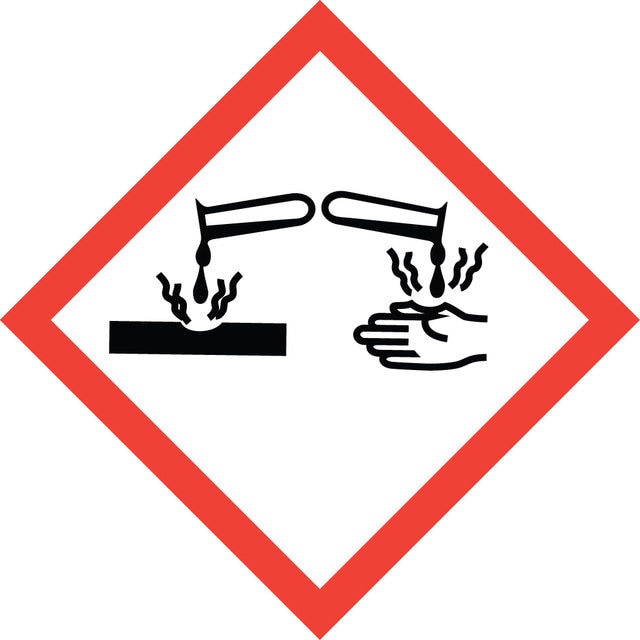
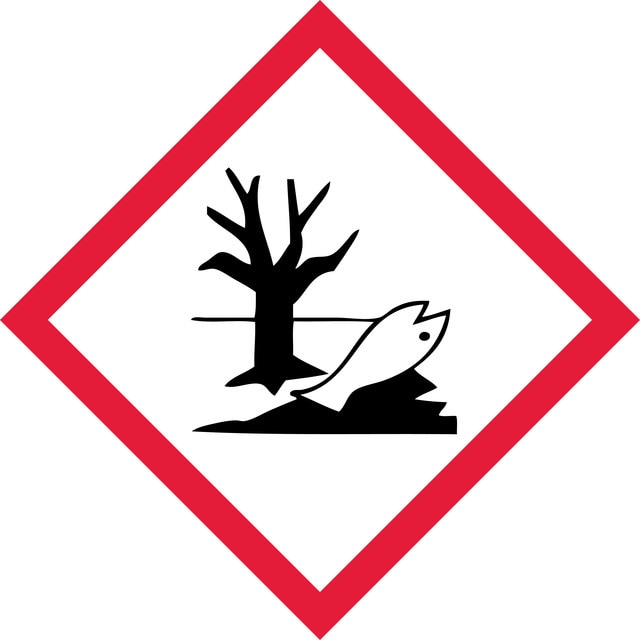
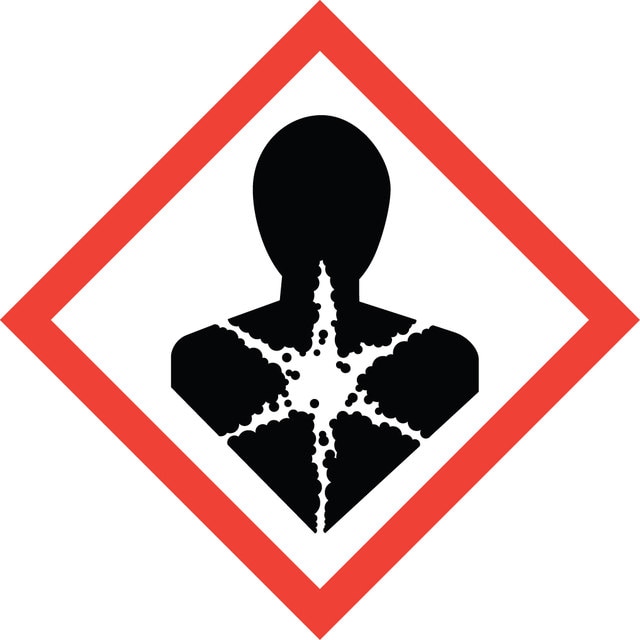
Acute Tox. 4 Inhalation - Acute Tox. 4 Oral - Aquatic Acute 1 - Aquatic Chronic 2 - Eye Dam. 1 - Resp. Sens. 1 - Skin Corr. 1B - Skin Sens. 1 - STOT SE 3
target_organs
Respiratory system
supp_hazards
Clase de almacenamiento
8A - Combustible corrosive hazardous materials
wgk
WGK 3
flash_point_f
Not applicable
flash_point_c
Not applicable
ppe
Faceshields, Gloves, Goggles, type ABEK (EN14387) respirator filter
Elija entre una de las versiones más recientes:
¿Ya tiene este producto?
Encuentre la documentación para los productos que ha comprado recientemente en la Biblioteca de documentos.
Irene Costantini et al.
Scientific reports, 5, 9808-9808 (2015-05-08)
Extensive mapping of neuronal connections in the central nervous system requires high-throughput µm-scale imaging of large volumes. In recent years, different approaches have been developed to overcome the limitations due to tissue light scattering. These methods are generally developed to
Stéphane Jauréguiberry et al.
Blood, 124(2), 167-175 (2014-05-27)
Patients with severe malaria treated with artesunate sometimes experience a delayed hemolytic episode. Artesunate (AS) induces pitting, a splenic process whereby dead parasites are expelled from their host erythrocytes. These once-infected erythrocytes then return to the circulation. We analyzed hematologic
Andri K Riau et al.
Investigative ophthalmology & visual science, 55(5), 3186-3194 (2014-04-26)
To compare flap adhesion strength, stromal bed quality, and tissue responses after flap preparation using nJ- and μJ-energy level femtosecond lasers. All corneal flaps were created by either VisuMax laser (μJ-energy level) or femto-LDV (nJ-energy level). Flap adhesion strength in