Saltar al contenido
Merck

58448

2-Methyl-1-propanol

BioUltra, Molecular Biology, ≥99.5% (GC)

Sinónimos:

Isobutanol, Isobutyl alcohol

Iniciar sesión para ver los precios por organización y contrato.

Seleccione un Tamaño


Acerca de este artículo

Fórmula lineal:
(CH3)2CHCH2OH
Número CAS:
Peso molecular:
74.12
UNSPSC Code:
12352005
NACRES:
NA.26
PubChem Substance ID:
EC Number:
201-148-0
Beilstein/REAXYS Number:
1730878
MDL number:
Assay:
≥99.5% (GC)
Grade:
Molecular Biology
Technique(s):
GC/GC: suitable
Vapor pressure:
8 mmHg ( 20 °C), 8.8 mmHg ( 0 °C)
Servicio técnico
¿Necesita ayuda? Nuestro equipo de científicos experimentados está aquí para ayudarle.
Permítanos ayudarle
Servicio técnico
¿Necesita ayuda? Nuestro equipo de científicos experimentados está aquí para ayudarle.
Permítanos ayudarle

InChI key

ZXEKIIBDNHEJCQ-UHFFFAOYSA-N

InChI

1S/C4H10O/c1-4(2)3-5/h4-5H,3H2,1-2H3

SMILES string

CC(C)CO

grade

Molecular Biology

vapor density

2.55 (vs air)

vapor pressure

8 mmHg ( 20 °C), 8.8 mmHg ( 0 °C)

product line

BioUltra

assay

≥99.5% (GC)

form

liquid

autoignition temp.

801 °F

expl. lim.

10.6 %

technique(s)

GC/GC: suitable

impurities

DNases, none detected, RNases, none detected, insoluble matter, passes filter test, phosphatases, none detected, proteases, none detected, ≤0.001% peroxides (as H2O2), ≤0.005% free acid (as C3H7CHO), ≤0.01% aldehyde (as C3H7CHO), ≤0.01% ketone (as CH3COCH3), ≤0.1% water

evapn. residue

≤0.001%

Quality Level

mp

−108 °C (lit.)

density

0.803 g/mL at 25 °C (lit.)

cation traces

Al: ≤0.5 mg/kg, Ba: ≤0.1 mg/kg, Bi: ≤0.1 mg/kg, Ca: ≤0.5 mg/kg, Cd: ≤0.05 mg/kg, Co: ≤0.02 mg/kg, Cr: ≤0.02 mg/kg, Cu: ≤0.02 mg/kg, Fe: ≤0.1 mg/kg, K: ≤0.5 mg/kg, Li: ≤0.1 mg/kg, Mg: ≤0.1 mg/kg, Mn: ≤0.02 mg/kg, Mo: ≤0.1 mg/kg, Na: ≤1.0 mg/kg, Ni: ≤0.02 mg/kg, Pb: ≤0.1 mg/kg, Sr: ≤0.1 mg/kg, Zn: ≤0.1 mg/kg

λ

neat

UV absorption

λ: 260 nm Amax: 0.10, λ: 280 nm Amax: 0.06

¿Está buscando productos similares? Visita Guía de comparación de productos

Other Notes

Butanol concentration of DNA

signalword

Danger

Hazard Classifications

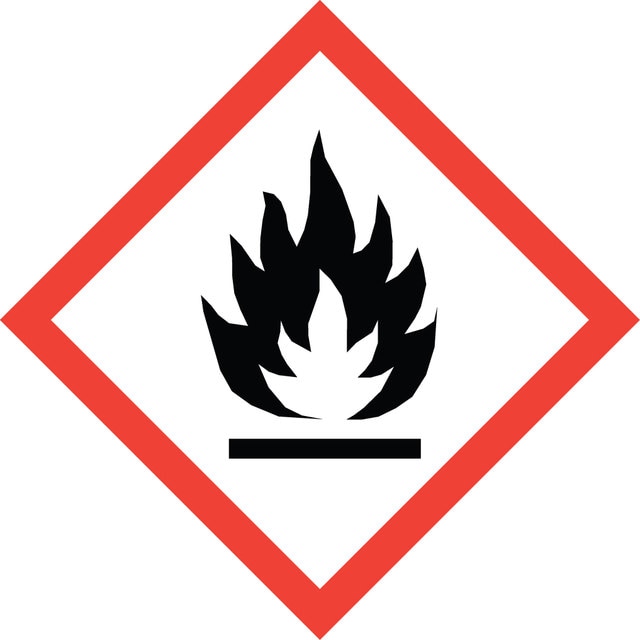
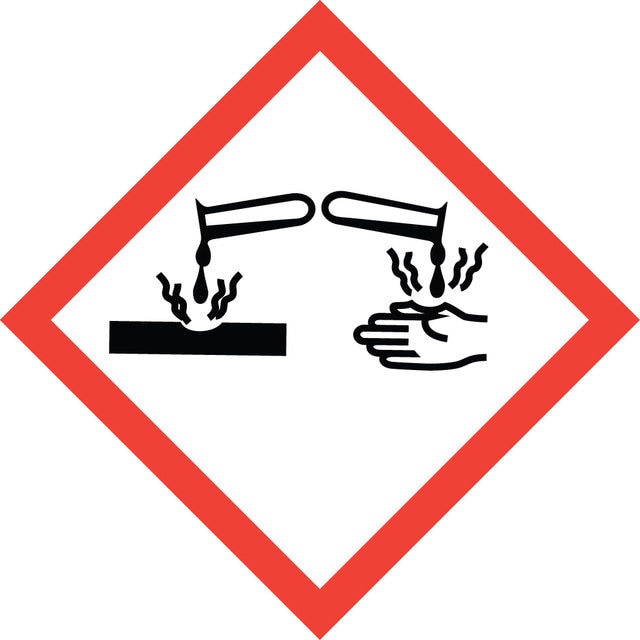
Eye Dam. 1 - Flam. Liq. 3 - Skin Irrit. 2 - STOT SE 3

target_organs

Central nervous system, Respiratory system

Clase de almacenamiento

3 - Flammable liquids

wgk

WGK 1

flash_point_f

82.4 °F - closed cup

flash_point_c

28 °C - closed cup

ppe

Eyeshields, Faceshields, Gloves, type ABEK (EN14387) respirator filter


Elija entre una de las versiones más recientes:

Certificados de análisis (COA)

Lot/Batch Number

¿No ve la versión correcta?

Si necesita una versión concreta, puede buscar un certificado específico por el número de lote.

¿Ya tiene este producto?

Encuentre la documentación para los productos que ha comprado recientemente en la Biblioteca de documentos.

Visite la Librería de documentos

D.M. Wallace
Methods in Enzymology, 152, 47-47 (1987)
R.C. Ogden et al.
Methods in Enzymology, 152, 68-68 (1987)
Jeremy J Minty et al.
Proceedings of the National Academy of Sciences of the United States of America, 110(36), 14592-14597 (2013-08-21)
Synergistic microbial communities are ubiquitous in nature and exhibit appealing features, such as sophisticated metabolic capabilities and robustness. This has inspired fast-growing interest in engineering synthetic microbial consortia for biotechnology development. However, there are relatively few reports of their use
Han Li et al.
Science (New York, N.Y.), 335(6076), 1596-1596 (2012-03-31)
One of the major challenges in using electrical energy is the efficiency in its storage. Current methods, such as chemical batteries, hydraulic pumping, and water splitting, suffer from low energy density or incompatibility with current transportation infrastructure. Here, we report
D Norbäck et al.
Occupational and environmental medicine, 52(6), 388-395 (1995-06-01)
As a part of the worldwide European Community respiratory health survey, possible relations between symptoms of asthma, building characteristics, and indoor concentration of volatile organic compounds (VOCs) in dwellings were studied. The study comprised 88 subjects, aged 20-45 years, from

Nuestro equipo de científicos tiene experiencia en todas las áreas de investigación: Ciencias de la vida, Ciencia de los materiales, Síntesis química, Cromatografía, Analítica y muchas otras.

Póngase en contacto con el Servicio técnico