Saltar al contenido
Merck

C4261

Coumarin

≥99% (HPLC)

Sinónimos:

1,2-Benzopyrone, 1-Benzopyran-2-one, 2H-Chromen-2-one

Iniciar sesión para ver los precios por organización y contrato.

Seleccione un Tamaño


Acerca de este artículo

Fórmula empírica (notación de Hill):
C9H6O2
Número CAS:
Peso molecular:
146.14
UNSPSC Code:
12352205
NACRES:
NA.25
PubChem Substance ID:
EC Number:
202-086-7
Beilstein/REAXYS Number:
383644
MDL number:
Servicio técnico
¿Necesita ayuda? Nuestro equipo de científicos experimentados está aquí para ayudarle.
Permítanos ayudarle
Servicio técnico
¿Necesita ayuda? Nuestro equipo de científicos experimentados está aquí para ayudarle.
Permítanos ayudarle

Nombre del producto

Coumarin, ≥99% (HPLC)

InChI key

ZYGHJZDHTFUPRJ-UHFFFAOYSA-N

InChI

1S/C9H6O2/c10-9-6-5-7-3-1-2-4-8(7)11-9/h1-6H

SMILES string

O=C1Oc2ccccc2C=C1

vapor pressure

0.01 mmHg ( 47 °C)

assay

≥99% (HPLC)

form

powder

bp

298 °C (lit.)

mp

68-73 °C (lit.)

Quality Level

Gene Information

¿Está buscando productos similares? Visita Guía de comparación de productos

Categorías relacionadas

Application

Coumarin is useful as a precursor molecule for the preparation or synthesis of coumarin-based anticoagulates, antiiflammatory agents and antioxidation superoxide scavengers.

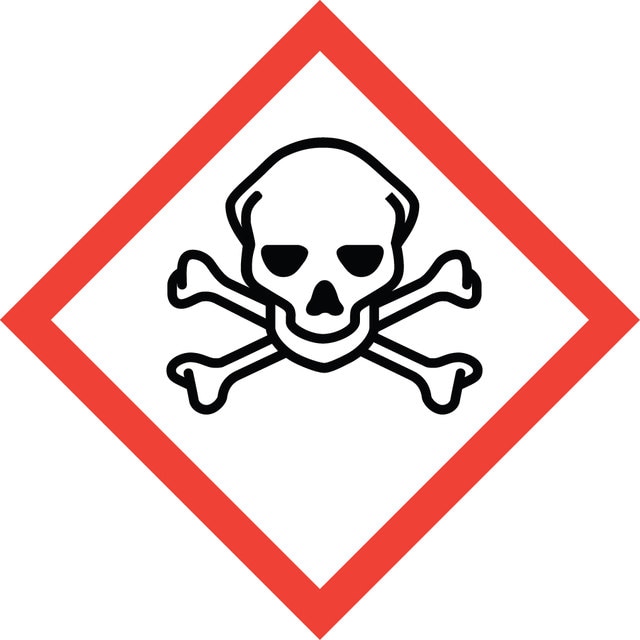
pictograms

Skull and crossbones

signalword

Danger

Hazard Classifications

Acute Tox. 3 Dermal - Acute Tox. 3 Oral - Skin Sens. 1

Clase de almacenamiento

6.1C - Combustible acute toxic Cat.3 / toxic compounds or compounds which causing chronic effects

wgk

WGK 1

flash_point_f

323.6 °F - closed cup

flash_point_c

162 °C - closed cup

ppe

dust mask type N95 (US), Eyeshields, Faceshields, Gloves


Elija entre una de las versiones más recientes:

Certificados de análisis (COA)

Lot/Batch Number

¿No ve la versión correcta?

Si necesita una versión concreta, puede buscar un certificado específico por el número de lote.

¿Ya tiene este producto?

Encuentre la documentación para los productos que ha comprado recientemente en la Biblioteca de documentos.

Visite la Librería de documentos

Klaus Abraham et al.
Molecular nutrition & food research, 54(2), 228-239 (2009-12-22)
Coumarin is a secondary phytochemical with hepatotoxic and carcinogenic properties. For the carcinogenic effect, a genotoxic mechanism was considered possible, but was discounted by the European Food Safety Authority in 2004 based on new evidence. This allowed the derivation of
Donglei Yu et al.
Medicinal research reviews, 23(3), 322-345 (2003-03-21)
Numerous plant-derived compounds have been evaluated for inhibitory effects against HIV replication, and some coumarins have been found to inhibit different stages in the HIV replication cycle. This review article describes recent progress in the discovery, structure modification, and structure-activity
Shota Morimoto et al.
Chemical communications (Cambridge, England), 49(18), 1811-1813 (2013-01-26)
A photo-switchable fluorescent flagging approach has been developed to identify photoaffinity-labeled peptides in target protein. Upon photochemical release of the ligand, the protein was newly modified with a coumarin in place of the previously attached biotin. It allowed us to
María E Riveiro et al.
Bioorganic & medicinal chemistry, 17(18), 6547-6559 (2009-09-01)
The presumption that some coumarins might be lead compounds in the search for new differentiation agents against leukemia is based on the fact that natural coumarins, 5-(3-methyl-2-butenyloxy)-6,7-methylenedioxycoumarin (C-2) and 5-methoxy-6,7-methylenedioxycoumarin (C-1) inhibit proliferation and induce differentiation in U-937 cells [Riveiro
A Marjolein Schrijver et al.
Journal of endovascular therapy : an official journal of the International Society of Endovascular Specialists, 22(1), 87-95 (2015-03-17)
To report the results of the Dutch randomized trial comparing standard catheter-directed and ultrasound-accelerated thrombolysis (UST) for the treatment of arterial thromboembolic occlusions. The DUET study ( controlled-trials.com ; identifier ISRCTN72676102) was designed to assess whether UST can reduce therapy

Contenido relacionado

Nuestro equipo de científicos tiene experiencia en todas las áreas de investigación: Ciencias de la vida, Ciencia de los materiales, Síntesis química, Cromatografía, Analítica y muchas otras.

Póngase en contacto con el Servicio técnico