
HT60

Amyloid Stain, Congo Red
Sinónimos:
Puchtler’s Modification for Amyloid
Iniciar sesión para ver los precios por organización y contrato.
Seleccione un Tamaño
Acerca de este artículo
NACRES:
NA.47
UNSPSC Code:
41116121
Servicio técnico
¿Necesita ayuda? Nuestro equipo de científicos experimentados está aquí para ayudarle.
Permítanos ayudarleServicio técnico
¿Necesita ayuda? Nuestro equipo de científicos experimentados está aquí para ayudarle.
Permítanos ayudarleshelf life
Expiry date on the label.
IVD
for in vitro diagnostic use
dilution
(for histology)
application(s)
hematology
histology
storage temp.
room temp
Quality Level
Categorías relacionadas
Biochem/physiol Actions
Amyloid protein is detected in tissue with Congo red, a metachromatic stain. Staining is intensified by pretreatment of tissue with alkaline sodium chloride.
Solo componentes del kit
Referencia del producto
Descripción
- Congo Red Solution (kit only) 500 mL
- Sodium Chloride Solution, Alcoholic (kit only) 500 mL
- Sodium Hydroxide Solution (kit only) 2 x 12

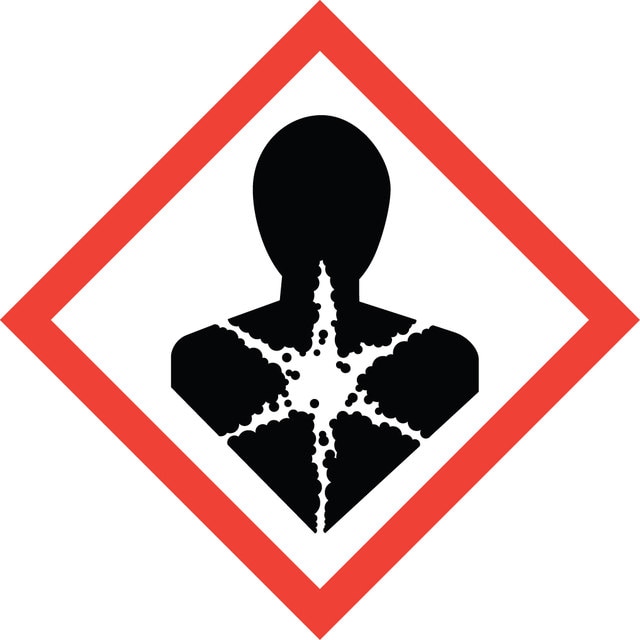

signalword
Danger
hcodes
Hazard Classifications
Carc. 1B - Eye Irrit. 2 - Flam. Liq. 2 - Met. Corr. 1 - Skin Irrit. 2
Clase de almacenamiento
3 - Flammable liquids
flash_point_f
57.2 °F - closed cup
flash_point_c
14.0 °C - closed cup
Elija entre una de las versiones más recientes:
¿Ya tiene este producto?
Encuentre la documentación para los productos que ha comprado recientemente en la Biblioteca de documentos.
J Grayson Richards et al.
The Journal of neuroscience : the official journal of the Society for Neuroscience, 23(26), 8989-9003 (2003-10-03)
Transgenic mice, expressing mutant beta-amyloid precursor proteins (betaAPPs), have lead to a better understanding of the pathophysiological processes in Alzheimer's disease (AD). In many of these models, however, the temporal development of cognitive decline and the relationship to Abeta deposition
Lei Wang et al.
PLoS biology, 6(8), e195-e195 (2008-08-08)
Protein aggregation is a process in which identical proteins self-associate into imperfectly ordered macroscopic entities. Such aggregates are generally classified as amorphous, lacking any long-range order, or highly ordered fibrils. Protein fibrils can be composed of native globular molecules, such
Samir K Maji et al.
PLoS biology, 6(2), e17-e17 (2008-02-08)
Amyloids are highly organized protein aggregates that are associated with both neurodegenerative diseases such as Alzheimer disease and benign functions like skin pigmentation. Amyloids self-polymerize in a nucleation-dependent manner by recruiting their soluble protein/peptide counterpart and are stable against harsh
Tsung-Ting Tsai et al.
Journal of orthopaedic surgery and research, 12(1), 194-194 (2017-12-23)
Dialysis-related destructive spondyloarthropathy caused by beta-2 microglobulin (β2M) amyloid deposits in intervertebral discs is a major burden for patients undergoing long-term dialysis. This study aimed to quantify the presence of β2M amyloid deposits in the intervertebral disc tissue of such
Antje Willuweit et al.
Frontiers in neuroscience, 15, 699926-699926 (2021-10-22)
Alzheimer's disease (AD) is characterized by formation of amyloid plaques and neurofibrillary tangles in the brain, which can be mimicked by transgenic mouse models. Here, we report on the characterization of amyloid load in the brains of two transgenic amyloidosis
Contenido relacionado
Nuestro equipo de científicos tiene experiencia en todas las áreas de investigación: Ciencias de la vida, Ciencia de los materiales, Síntesis química, Cromatografía, Analítica y muchas otras.
Póngase en contacto con el Servicio técnico