Saltar al contenido
Merck

L5125

N-Lauroilsarcosina sodium salt

≥94%

Sinónimos:

N-Dodecanoil-N-metilglicina sodium salt, Sarkosyl NL

Iniciar sesión para ver los precios por organización y contrato.

Seleccione un Tamaño


Acerca de este artículo

Fórmula lineal:
CH3(CH2)10CON(CH3)CH2COONa
Número CAS:
Peso molecular:
293.38
UNSPSC Code:
12352107
NACRES:
NA.32
PubChem Substance ID:
EC Number:
205-281-5
Beilstein/REAXYS Number:
5322974
MDL number:
Servicio técnico
¿Necesita ayuda? Nuestro equipo de científicos experimentados está aquí para ayudarle.
Permítanos ayudarle
Servicio técnico
¿Necesita ayuda? Nuestro equipo de científicos experimentados está aquí para ayudarle.
Permítanos ayudarle

Nombre del producto

N-Lauroilsarcosina sodium salt, ≥94%

InChI key

KSAVQLQVUXSOCR-UHFFFAOYSA-M

InChI

1S/C15H29NO3.Na/c1-3-4-5-6-7-8-9-10-11-12-14(17)16(2)13-15(18)19;/h3-13H2,1-2H3,(H,18,19);/q;+1/p-1

SMILES string

[Na+].CCCCCCCCCCCC(=O)N(C)CC([O-])=O

description

anionic

assay

≥94%

form

powder

mol wt

micellar avg mol wt 600
average mol wt 600

aggregation number

2

technique(s)

oligo synthesis: suitable

CMC

14.6 mM (20-25°C)

solubility

H2O: 100 mg/mL, clear to slightly hazy, colorless to faintly yellow

density

1,14 g/cm3 at 20 °C (1,14 g/cm3 at 20 °C)

Quality Level

¿Está buscando productos similares? Visita Guía de comparación de productos

Other Notes

Tensioactivo aniónico.

Application

N-Lauroylsarcosine sodium salt has been used as one of the components of the lysing solution in the cornet assay. It has been used for lysing protoplasts in the process of chromosomal DNA isolation form Streptococcus mutans.

Biochem/physiol Actions

N-Lauroylsarcosine is an anionic surfactant which also has protein denaturant potency. In addition, it has been shown as a microbicide for sexually transmitted diseases.

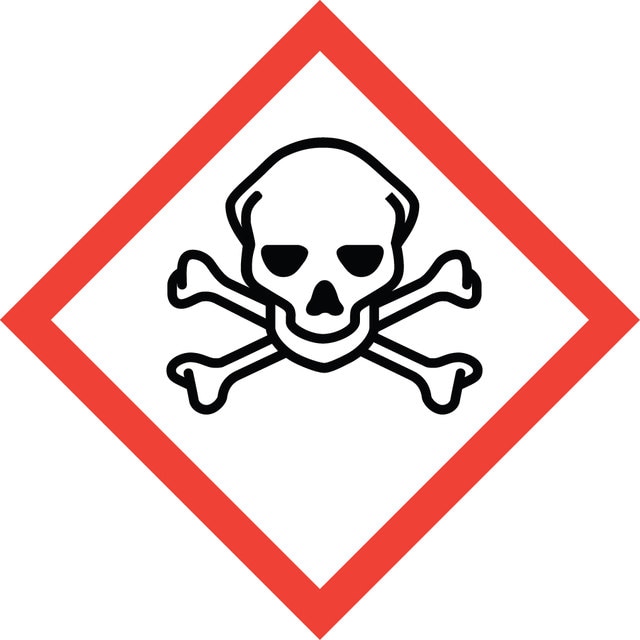
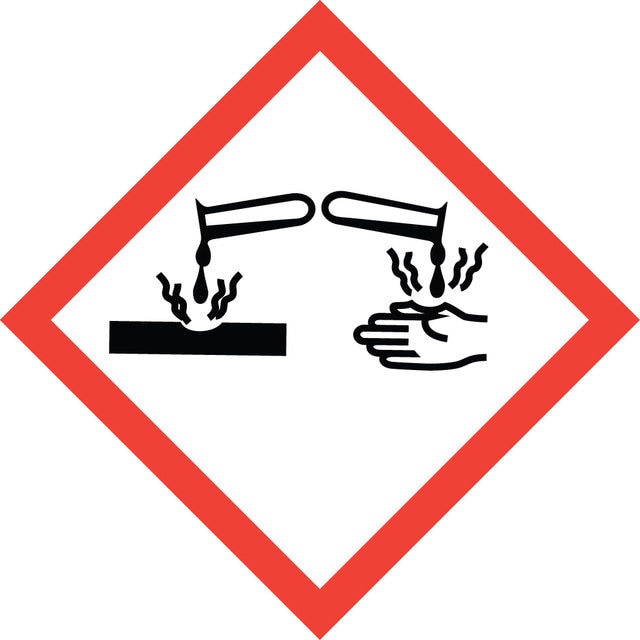
pictograms

Skull and crossbonesCorrosion

signalword

Danger

Hazard Classifications

Acute Tox. 2 Inhalation - Eye Dam. 1 - Skin Irrit. 2

Clase de almacenamiento

6.1B - Non-combustible acute toxic Cat. 1 and 2 / very toxic hazardous materials

wgk

WGK 1

ppe

Eyeshields, Gloves, type N95 (US)


Elija entre una de las versiones más recientes:

Certificados de análisis (COA)

Lot/Batch Number

¿No ve la versión correcta?

Si necesita una versión concreta, puede buscar un certificado específico por el número de lote.

¿Ya tiene este producto?

Encuentre la documentación para los productos que ha comprado recientemente en la Biblioteca de documentos.

Visite la Librería de documentos

N S Andrade et al.
Genetics and molecular research : GMR, 7(4), 1414-1421 (2009-02-19)
Baccharis dracunculifolia De Candole (DC) (Asteraceae) is indigenous throughout southeastern Latin America and is used by local people in traditional medicine. This plant is known to be the source of resin for the highly valued Brazilian green propolis. As no
P W Caufield et al.
Journal of clinical microbiology, 27(2), 274-278 (1989-02-01)
Attempts to study the acquisition, transmission, and other aspects of the natural history of Streptococcus mutans infections in humans have been hampered by limitations and inconsistencies in methods by which phenotypic characteristics of individual isolates are examined. Because most mutans
M J Stack et al.
Journal of comparative pathology, 116(2), 181-189 (1997-02-01)
Standardized samples of tissue from the central nervous system of four sheep naturally affected with scrapie and from four healthy control sheep were subjected to a centrifugal extraction technique used to obtain scrapie-associated fibrils; the latter were then demonstrated by
Jocelyne Piret et al.
Antimicrobial agents and chemotherapy, 46(9), 2933-2942 (2002-08-17)
The mechanisms of herpes simplex virus (HSV) inactivation by sodium lauryl sulfate (SLS) and n-lauroylsarcosine (LS), two anionic surfactants with protein denaturant potency, have been evaluated in cultured cells. Results showed that pretreatment of HSV type 1 (HSV-1) strain F
S Roy et al.
Antimicrobial agents and chemotherapy, 45(6), 1671-1681 (2001-05-17)
The microbicidal efficacies of two anionic surfactants, sodium lauryl sulfate (SLS) and n-lauroylsarcosine (LS), were evaluated in cultured cells and in a murine model of herpes simplex type 2 (HSV-2) intravaginal infection. In vitro studies showed that SLS and LS

Nuestro equipo de científicos tiene experiencia en todas las áreas de investigación: Ciencias de la vida, Ciencia de los materiales, Síntesis química, Cromatografía, Analítica y muchas otras.

Póngase en contacto con el Servicio técnico