Saltar al contenido
Merck

S8753

Strychnine hydrochloride

glycine receptor antagonist

Iniciar sesión para ver los precios por organización y contrato.

Seleccione un Tamaño


Acerca de este artículo

Fórmula empírica (notación de Hill):
C21H22N2O2 · HCl
Número CAS:
Peso molecular:
370.87
NACRES:
NA.32
PubChem Substance ID:
UNSPSC Code:
12352210
EC Number:
215-826-9
MDL number:
Servicio técnico
¿Necesita ayuda? Nuestro equipo de científicos experimentados está aquí para ayudarle.
Permítanos ayudarle
Servicio técnico
¿Necesita ayuda? Nuestro equipo de científicos experimentados está aquí para ayudarle.
Permítanos ayudarle

Nombre del producto

Strychnine hydrochloride,

InChI key

VLXYTKMPCOQKEM-ZEYGOCRCSA-N

InChI

1S/C21H22N2O2.ClH/c24-18-10-16-19-13-9-17-21(6-7-22(17)11-12(13)5-8-25-16)14-3-1-2-4-15(14)23(18)20(19)21;/h1-5,13,16-17,19-20H,6-11H2;1H/t13-,16-,17-,19-,20-,21+;/m0./s1

SMILES string

Cl.[H][C@@]12CC(=O)N3c4ccccc4[C@]56CCN7CC(=CCO1)[C@]([H])(C[C@@]57[H])[C@]2([H])[C@]36[H]

Quality Level

¿Está buscando productos similares? Visita Guía de comparación de productos

Application

Strychnine hydrochloride has been used as a glycine receptor antagonist in the retina for biophysiological functions. It has also been used to block glutamatergic, GABAergic and glycinergic receptors and gap junctions.

Biochem/physiol Actions

Convulsant; glycine receptor antagonist not associated with the NMDA receptor.
Strychnine is a potent convulsant, which is extracted from Strychnos nux vomica seeds. At high doses, the compound causes convulsions and ultimately death due to respiratory paralysis. Strychnine acts as a respiratory, circulatory and digestive stimulant.

pictograms

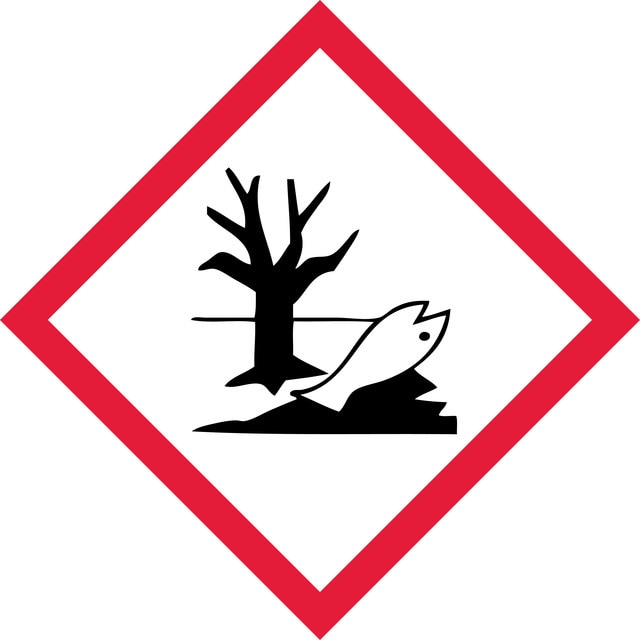
Skull and crossbonesEnvironment

signalword

Danger

Hazard Classifications

Acute Tox. 2 Inhalation - Acute Tox. 2 Oral - Aquatic Acute 1 - Aquatic Chronic 1

Clase de almacenamiento

6.1A - Combustible acute toxic Cat. 1 and 2 / very toxic hazardous materials

wgk

WGK 3

flash_point_f

Not applicable

flash_point_c

Not applicable

ppe

Eyeshields, Faceshields, Gloves, type P3 (EN 143) respirator cartridges


Elija entre una de las versiones más recientes:

Certificados de análisis (COA)

Lot/Batch Number

¿No ve la versión correcta?

Si necesita una versión concreta, puede buscar un certificado específico por el número de lote.

¿Ya tiene este producto?

Encuentre la documentación para los productos que ha comprado recientemente en la Biblioteca de documentos.

Visite la Librería de documentos

Biomarkers in Toxicology null
Joanna D Crook et al.
The Journal of neuroscience : the official journal of the Society for Neuroscience, 28(44), 11277-11291 (2008-10-31)
The distinctive parasol ganglion cell of the primate retina transmits a transient, spectrally nonopponent signal to the magnocellular layers of the lateral geniculate nucleus. Parasol cells show well-recognized parallels with the alpha-Y cell of other mammals, yet two key alpha-Y
Horizontal cell feedback without cone type-selective inhibition mediates red?green color opponency in midget ganglion cells of the primate retina
Crook JD, et al.
The Journal of Neuroscience, 31(5), 1762-1772 (2011)
Direct activation of the Mauthner cell by electric field pulses drives ultrarapid escape responses
Tabor KM, et al.
Journal of Neurophysiology, 112(4), 834-844 (2014)
Y-cell receptive field and collicular projection of parasol ganglion cells in macaque monkey retina
Crook JD, et al.
The Journal of Neuroscience, 28(44), 11277-11291 (2008)

Nuestro equipo de científicos tiene experiencia en todas las áreas de investigación: Ciencias de la vida, Ciencia de los materiales, Síntesis química, Cromatografía, Analítica y muchas otras.

Póngase en contacto con el Servicio técnico