
Saltar al contenido
Merck

SML0289

Bromfenac sodium

≥98% (HPLC), COX1 and COX2 inhibitor, powder

Sinónimos:

2-Amino-3-(4-bromobenzoyl)benzeneacetic acid sodium salt

Iniciar sesión para ver los precios por organización y contrato.

Seleccione un Tamaño


Acerca de este artículo

Fórmula empírica (notación de Hill):
C15H11BrNNaO3
Número CAS:
Peso molecular:
356.15
UNSPSC Code:
12352200
PubChem Substance ID:
NACRES:
NA.77
MDL number:
Assay:
≥98% (HPLC)
Form:
powder
Quality level:
Storage condition:
desiccated
Servicio técnico
¿Necesita ayuda? Nuestro equipo de científicos experimentados está aquí para ayudarle.
Permítanos ayudarle
Servicio técnico
¿Necesita ayuda? Nuestro equipo de científicos experimentados está aquí para ayudarle.
Permítanos ayudarle

Nombre del producto

Bromfenac sodium, ≥98% (HPLC)

SMILES string

[Na+].Nc1c(CC([O-])=O)cccc1C(=O)c2ccc(Br)cc2

InChI

1S/C15H12BrNO3.Na/c16-11-6-4-9(5-7-11)15(20)12-3-1-2-10(14(12)17)8-13(18)19;/h1-7H,8,17H2,(H,18,19);/q;+1/p-1

InChI key

HZFGMQJYAFHESD-UHFFFAOYSA-M

assay

≥98% (HPLC)

form

powder

storage condition

desiccated

color

faintly yellow to dark yellow

solubility

H2O: ≥5 mg/mL

storage temp.

2-8°C

Quality Level

Gene Information

Application

Bromfenac sodium has been used:
  • to study its ability to bind to melanin
  • in the synthesis of bromfenac indolinone standard
  • to analyze its permeability in porcine conjunctiva

Biochem/physiol Actions
Bromfenac exhibits antipyretic and prostaglandin synthetase inhibiting properties. It has therapeutic properties against the reduction of ocular pain and inflammation in postoperative cataract patients. Bromfenac acts as an effective agent against allergic conjunctivitis. It has the potential to treat acute muscle pain, osteoarthritis, and rheumatoid arthritis.
Bromfenac is a nonsteroidal anti inflammatory drug (NSAID) that inhibits both COX1 and COX2. It is used as an opthalmic analgesic.
Bromfenac is a nonsteroidal anti inflammatory drug (NSAID); COX1 and COX2 inhibitor; opthalmic analgesic.

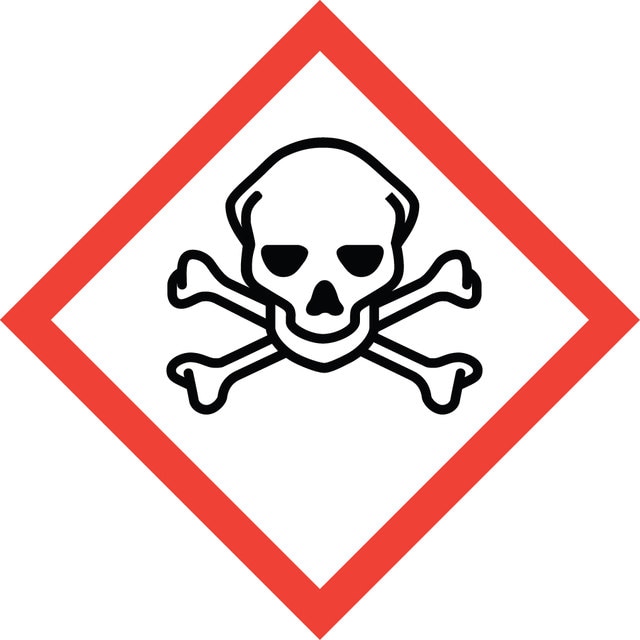
pictograms

Skull and crossbones

signalword

Danger

hcodes

Hazard Classifications

Acute Tox. 3 Oral

Clase de almacenamiento

6.1C - Combustible acute toxic Cat.3 / toxic compounds or compounds which causing chronic effects

wgk

WGK 3

flash_point_f

Not applicable

flash_point_c

Not applicable


Elija entre una de las versiones más recientes:

Certificados de análisis (COA)

Lot/Batch Number

¿No ve la versión correcta?

Si necesita una versión concreta, puede buscar un certificado específico por el número de lote.

¿Ya tiene este producto?

Encuentre la documentación para los productos que ha comprado recientemente en la Biblioteca de documentos.

Visite la Librería de documentos

Christina Flaxel et al.
Retina (Philadelphia, Pa.), 32(3), 417-423 (2011-08-25)
To evaluate whether bromfenac eyedrops and ranibizumab intravitreal injections would provide added efficacy over ranibizumab alone. This was a single-site, multiinvestigator, prospective, open-label, interventional, Phase II study of patients with new or recurrent exudative/neovascular age-related macular degeneration. Thirty eyes were
Jeffrey S Heier et al.
Retina (Philadelphia, Pa.), 29(9), 1310-1313 (2009-11-26)
To assess vitreous concentrations of nonsteroidal antiinflammatory drugs (NSAIDs) and prostaglandin E(2) in patients treated with NSAIDs before vitrectomy. This was an investigator-masked, randomized, multicenter study. Patients received ketorolac 0.4% 4 times a day, bromfenac 0.09% 2 times a day
Frank A Bucci et al.
Advances in therapy, 28(12), 1089-1095 (2011-11-23)
We compared the prostaglandin E(2) (PGE(2)) inhibition of three topical nonsteroidal antiinflammatory drugs (NSAIDs): ketorolac 0.45%, bromfenac 0.09%, and nepafenac 0.1% at peak dosing levels in patients previously scheduled to undergo phacoemulsification. This was a single-center, double-masked observational study of
Frank A Bucci et al.
Current medical research and opinion, 27(12), 2235-2239 (2011-10-14)
To compare the peak to-aqueous penetration of three nonsteroidal anti-inflammatory drugs: ketorolac tromethamine 0.45%, bromfenac 0.09%, nepafenac 0.1%, and amfenac (the active metabolite of nepafenac) in patients undergoing phacoemulsification. A single center, double-masked study randomized 122 patients to receive one
Koichiro Mukai et al.
Journal of cataract and refractive surgery, 35(9), 1614-1618 (2009-08-18)
To evaluate the efficacy of ophthalmic nonsteroidal and steroidal antiinflammatory drugs in preventing anterior capsule contraction and secondary posterior capsule opacification (PCO) using an experimental cataract model. Department of Ophthalmology, Dokkyo Medical University, Tochigi, Japan. Eight-week-old albino rabbits weighing about

Nuestro equipo de científicos tiene experiencia en todas las áreas de investigación: Ciencias de la vida, Ciencia de los materiales, Síntesis química, Cromatografía, Analítica y muchas otras.

Póngase en contacto con el Servicio técnico