Saltar al contenido
Merck

V4877

Verrucarin A

from Myrothecium sp., ≥85.0% (HPLC), CCRCC inhibitor

Sinónimos:

Muconomycin A

Iniciar sesión para ver los precios por organización y contrato.

Seleccione un Tamaño


Acerca de este artículo

Fórmula empírica (notación de Hill):
C27H34O9
Número CAS:
Peso molecular:
502.55
UNSPSC Code:
12352200
PubChem Substance ID:
NACRES:
NA.77
MDL number:
Assay:
≥85.0% (HPLC)
Quality level:
Servicio técnico
¿Necesita ayuda? Nuestro equipo de científicos experimentados está aquí para ayudarle.
Permítanos ayudarle
Servicio técnico
¿Necesita ayuda? Nuestro equipo de científicos experimentados está aquí para ayudarle.
Permítanos ayudarle

Nombre del producto

Verrucarin A from Myrothecium sp., ≥85.0% (HPLC)

SMILES string

CC1CCOC(=O)\C=C\C=C\C(=O)OC2CC3OC4C=C(C)CCC4(COC(=O)C1O)C2(C)C35CO5

InChI key

NLUGUZJQJYVUHS-YDFGWWAZSA-N

InChI

1S/C27H34O9/c1-16-8-10-26-14-33-24(31)23(30)17(2)9-11-32-21(28)6-4-5-7-22(29)36-18-13-20(35-19(26)12-16)27(15-34-27)25(18,26)3/h4-7,12,17-20,23,30H,8-11,13-15H2,1-3H3/b6-4+,7-5+

assay

≥85.0% (HPLC)

storage temp.

−20°C

Quality Level

Categorías relacionadas

Application

Verrucarin A from Myrothecium sp has been used:
  • as a translation initiation inhibitor in P. falciparum W2 strain
  • as a peptidyl transfer inhibitor to test sensitivity in methyltransferase knock-out S. cerevisiae cells
  • to test its cytotoxicity in renal cell carcinoma cells

Biochem/physiol Actions

Verrucarin A binds to the P and A sites in ribosomes and blocks peptide-bond and translation initiation. It inhibits the clear cell renal cell carcinoma (CCRCC) proliferation. Verrucarin A blocks the peptidyl transferase activity and favors apoptosis induction in cancer cells
Verrucarin A is phytotoxic to plantlet cultures and cytotoxic to cultured mammalian cell lines.

General description

Verrucarin derived from the Myrothecium verrucari, a fungal plant pathogen is a macrocyclic trichothecene compound.

Other Notes

Macrocyclic trichothecene mycotoxin.

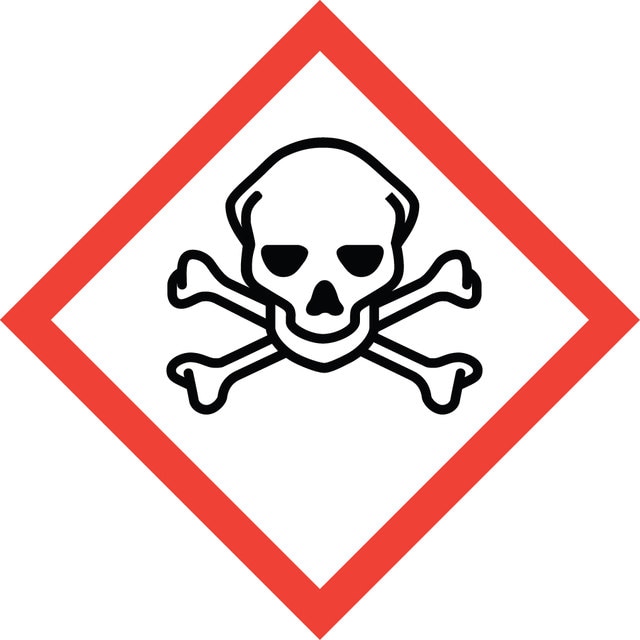
pictograms

Skull and crossbones

signalword

Danger

Hazard Classifications

Acute Tox. 1 Inhalation - Acute Tox. 2 Dermal - Acute Tox. 2 Oral

Clase de almacenamiento

6.1A - Combustible acute toxic Cat. 1 and 2 / very toxic hazardous materials

wgk

WGK 3

ppe

Eyeshields, Faceshields, Gloves, type P3 (EN 143) respirator cartridges


Elija entre una de las versiones más recientes:

Certificados de análisis (COA)

Lot/Batch Number

¿No ve la versión correcta?

Si necesita una versión concreta, puede buscar un certificado específico por el número de lote.

¿Ya tiene este producto?

Encuentre la documentación para los productos que ha comprado recientemente en la Biblioteca de documentos.

Visite la Librería de documentos

Chien-Shan Cheng et al.
Cancer cell international, 19, 92-92 (2019-04-24)
In the past decade, increasing research attention investigated the novel therapeutic potential of steroidal cardiac glycosides in cancer treatment. Huachansu and its main active constituent Bufalin have been studied in vitro, in vivo and clinical studies. This review aims to
Antonio L Amelio et al.
Proceedings of the National Academy of Sciences of the United States of America, 104(51), 20314-20319 (2007-12-14)
Signal transduction pathways often use a transcriptional component to mediate adaptive cellular responses. Coactivator proteins function prominently in these pathways as the conduit to the basic transcriptional machinery. Here we present a high-throughput cell-based screening strategy, termed the "coactivator trap,"
Charles S Bond et al.
The Journal of cell biology, 186(5), 637-644 (2009-09-02)
Paraspeckles are ribonucleoprotein bodies found in the interchromatin space of mammalian cell nuclei. These structures play a role in regulating the expression of certain genes in differentiated cells by nuclear retention of RNA. The core paraspeckle proteins (PSF/SFPQ, P54NRB/NONO, and
Mukhtar Jaderson et al.
Safety and health at work, 10(2), 196-204 (2019-07-13)
Liquid chromatography-tandem mass spectrometry (LC-MSMS) for simultaneous analysis of multiple microbial secondary metabolites (MSMs) is potentially subject to interference by matrix components. We examined potential matrix effects (MEs) in analyses of 31 MSMs using ultraperformance LC-MSMS. Twenty-one dust aliquots from three

Nuestro equipo de científicos tiene experiencia en todas las áreas de investigación: Ciencias de la vida, Ciencia de los materiales, Síntesis química, Cromatografía, Analítica y muchas otras.

Póngase en contacto con el Servicio técnico