
コンテンツへスキップ
Merck

28-3030

水酸化ナトリウム 溶液

0.2 M

ログインで組織・契約価格をご覧ください。

サイズを選択してください

表示を変更する

この商品について

化学式:
NaOH
CAS番号:
分子量:
40.00
UNSPSC Code:
12352106
PubChem Substance ID:
MDL number:
Concentration:
0.2 M, 1/5 N
Form:
liquid
テクニカルサービス
お困りのことがあれば、経験豊富なテクニカルサービスチームがお客様をサポートします。
お手伝いします


vapor pressure

3 mmHg ( 37 °C)

form

liquid

availability

available only in Japan

concentration

0.2 M, 1/5 N

density

1 g/cm3 at 20 °C

SMILES string

[OH-].[Na+]

InChI

1S/Na.H2O/h;1H2/q+1;/p-1

InChI key

HEMHJVSKTPXQMS-UHFFFAOYSA-M


Still not finding the right product?

Explore all of our products under 水酸化ナトリウム 溶液
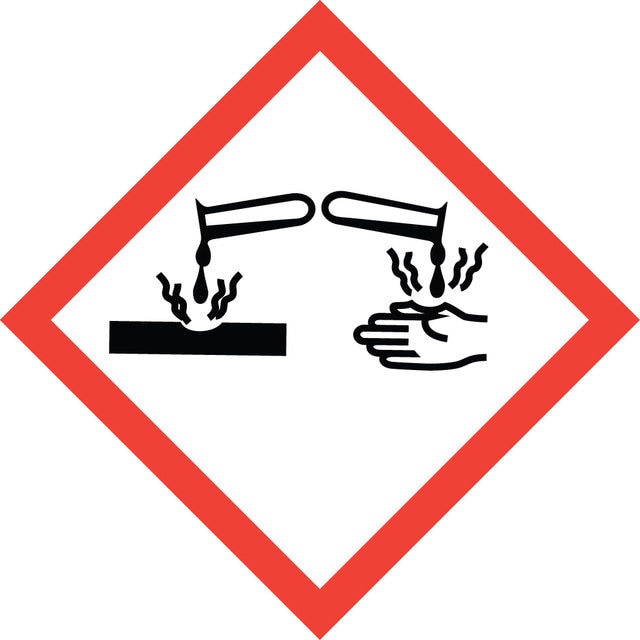

pictograms

Corrosion

signalword

Warning

Hazard Classifications

Eye Irrit. 2 - Met. Corr. 1 - Skin Irrit. 2

flash_point_f

Not applicable

flash_point_c

Not applicable

保管分類

12 - Non Combustible Liquids


適用法令

試験研究用途を考慮した関連法令を主に挙げております。化学物質以外については、一部の情報のみ提供しています。 製品を安全かつ合法的に使用することは、使用者の義務です。最新情報により修正される場合があります。WEBの反映には時間を要することがあるため、適宜SDSをご参照ください。

28-3030-5-500ML-J:4.548173016825E12

jan


最新バージョンのいずれかを選択してください:

試験成績書(COA)

Lot/Batch Number

適切なバージョンが見つかりませんか。

特定のバージョンが必要な場合は、ロット番号またはバッチ番号で特定の証明書を検索できます。

以前この製品を購入いただいたことがある場合

文書ライブラリで、最近購入した製品の文書を検索できます。

文書ライブラリにアクセスする


Olof Idevall-Hagren et al.
The EMBO journal, 34(17), 2291-2305 (2015-07-24)
The extended synaptotagmins (E-Syts) are ER proteins that act as Ca(2+)-regulated tethers between the ER and the plasma membrane (PM) and have a putative role in lipid transport between the two membranes. Ca(2+) regulation of their tethering function, as well
Miki Wada et al.
Nucleic acids research, 42(12), 7851-7866 (2014-06-11)
During termination of translation in eukaryotes, a GTP-binding protein, eRF3, functions within a complex with the tRNA-mimicking protein, eRF1, to decode stop codons. It remains unclear how the tRNA-mimicking protein co-operates with the GTPase and with the functional sites on
Yuki Itakura et al.
PloS one, 10(9), e0136660-e0136660 (2015-09-04)
Rhythmic motor patterns underlying many types of locomotion are thought to be produced by central pattern generators (CPGs). Our knowledge of how CPG networks generate motor patterns in complex nervous systems remains incomplete, despite decades of work in a variety