
A6756

Sodium arsenate dibasic heptahydrate
≥98.0%
동의어(들):
Disodium hydrogen arsenate heptahydrate, di-Sodium hydrogen arsenate heptahydrate
조직 및 계약 가격을 보려면 로그인를 클릭합니다.
크기 선택
보기 변경
제품정보 (DICE 배송 시 비용 별도)
Linear Formula:
Na2HAsO4 · 7H2O
CAS 번호:
Molecular Weight:
312.01
NACRES:
NA.21
PubChem Substance ID:
UNSPSC Code:
12352302
MDL number:
Assay:
≥98.0%
Form:
powder
Quality Level
assay
≥98.0%
form
powder
reaction suitability
reagent type: catalyst
core: arsenic
pH
8.5-9.0 (25 °C, 50 g/L)
SMILES string
O.O.O.O.O.O.O.[Na+].[Na+].O[As]([O-])([O-])=O
InChI
1S/AsH3O4.2Na.7H2O/c2-1(3,4)5;;;;;;;;;/h(H3,2,3,4,5);;;7*1H2/q;2*+1;;;;;;;/p-2
InChI key
KOLXPEJIBITWIQ-UHFFFAOYSA-L
General description
Sodium arsenate dibasic heptahydrate (As(V)) is an arsenic compound.
Application
Sodium arsenate dibasic heptahydrate may be used as a reference standard for the quantification of arsenic compounds in rice- and seafood-based samples by ion chromatography-inductively coupled plasma/ mass spectrometry. The samples for analysis were prepared by ultrasonic-assisted enzymatic extraction (UAEE).
Still not finding the right product?
Explore all of our products under Sodium arsenate dibasic heptahydrate
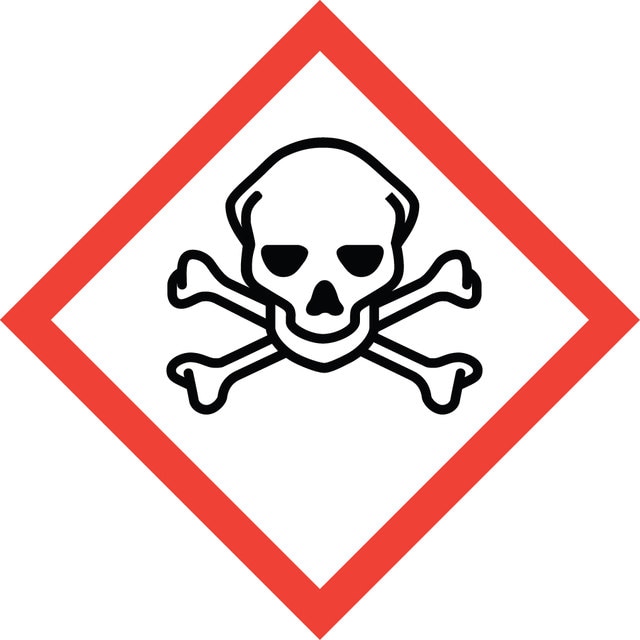

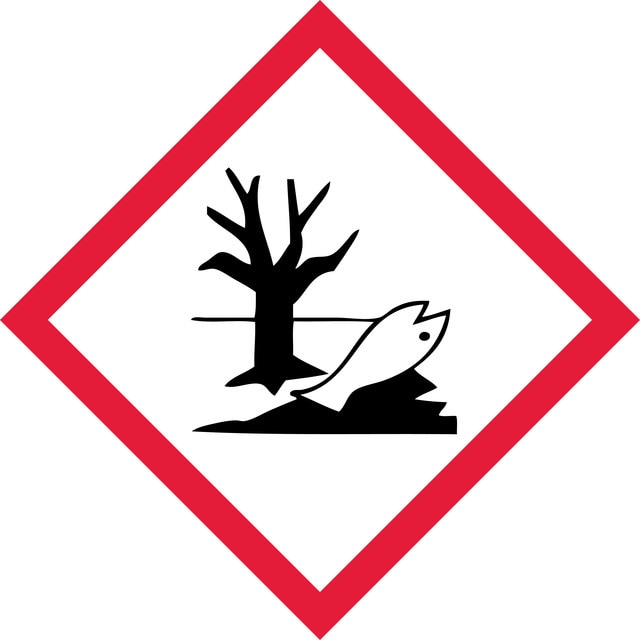
signalword
Danger
hcodes
Hazard Classifications
Acute Tox. 3 Inhalation - Acute Tox. 3 Oral - Aquatic Acute 1 - Aquatic Chronic 1 - Carc. 1A
저장 등급
6.1A - Combustible acute toxic Cat. 1 and 2 / very toxic hazardous materials
wgk
WGK 3
flash_point_f
Not applicable
flash_point_c
Not applicable
ppe
Eyeshields, Faceshields, Gloves, type P3 (EN 143) respirator cartridges
Validation of a method for arsenic speciation in food by ion chromatography-inductively coupled plasma/mass spectrometry after ultrasonic-assisted enzymatic extraction.
Dufailly V, et al.
Journal of AOAC (Association of Official Analytical Chemists) International, 94(3), 947-958 (2011)
Lauren C Radlinski et al.
Cell chemical biology, 26(10), 1355-1364 (2019-08-14)
Aminoglycoside antibiotics require proton motive force (PMF) for bacterial internalization. In non-respiring populations, PMF drops below the level required for drug influx, limiting the utility of aminoglycosides against strict and facultative anaerobes. We recently demonstrated that rhamnolipids (RLs), biosurfactant molecules
Martin P Pothier et al.
Frontiers in microbiology, 9, 2310-2310 (2018-10-20)
Despite its high toxicity and widespread occurrence in many parts of the world, arsenic (As) concentrations in decentralized water supplies such as domestic wells remain often unquantified. One limitation to effective monitoring is the high cost and lack of portability