
B7901

Boric acid
suitable for electrophoresis, ≥99.5%
조직 및 계약 가격을 보려면 로그인를 클릭합니다.
크기 선택
보기 변경
제품정보 (DICE 배송 시 비용 별도)
Linear Formula:
H3BO3
CAS 번호:
Molecular Weight:
61.83
PubChem Substance ID:
eCl@ss:
38120104
UNSPSC Code:
12161700
NACRES:
NA.25
EC Number:
233-139-2
MDL number:
Assay:
≥99.5%
Form:
powder
Grade:
electrophoresis grade
grade
electrophoresis grade
Quality Level
vapor pressure
2.6 mmHg ( 20 °C)
assay
≥99.5%
form
powder
technique(s)
electrophoresis: suitable
impurities
≤0.005% Insoluble in methanol
pH
8.2-10.1
mp
160 °C (dec.) (lit.)
solubility
H2O: 40 mg/mL, clear, colorless
density
1.43 g/cm3 at 20 °C
anion traces
chloride (Cl-): ≤0.001%, phosphate (PO43-): ≤0.001%, sulfate (SO42-): ≤0.01%
cation traces
Ca: ≤0.005%, Fe: ≤0.001%, heavy metals (as Pb): ≤0.001%
suitability
suitable for electrophoresis (as a reagent)
storage temp.
room temp
SMILES string
OB(O)O
InChI
1S/BH3O3/c2-1(3)4/h2-4H
InChI key
KGBXLFKZBHKPEV-UHFFFAOYSA-N
유사한 제품을 찾으십니까? 방문 제품 비교 안내
General description
Boric acid is a weak acid and is widely used in multi-purpose solutions (MPS) as a buffering agent. It is less toxic and non-volatile in nature.
Application
Boric acid has been used as a component of tris borate buffer:
- for native polyacrylamide gel electrophoresis (PAGE) and denaturing urea-PAGE of tRNA samples(80)
- for urea-polyacrylamide electrophoresis of RNA samples(81)
- for agarose gel electrophoresis of DNA samples(82)
Biochem/physiol Actions
Boric acid is used in the periodontal therapy as an irrigation solution as it elicits bactericidal effects in microbial biofilms in root canal. Boric acid may favor osteoblastic activity and inhibit bone loss. It inhibits Candida albicans fungal infection and has potential to treat vaginal infection.
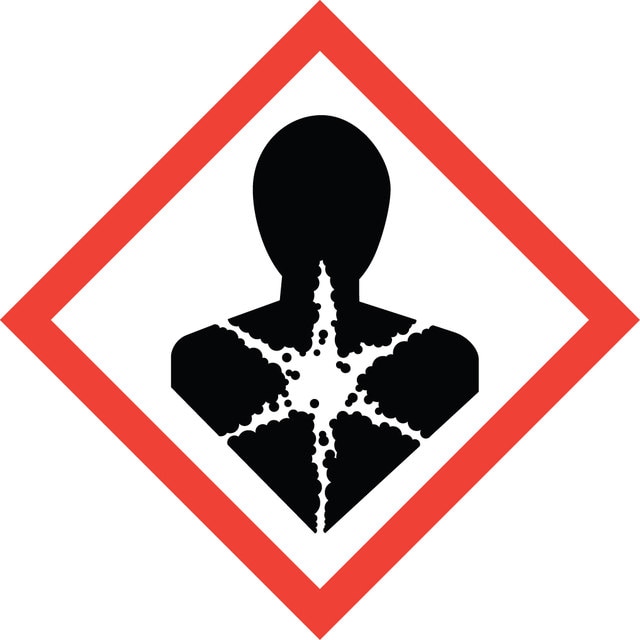
signalword
Danger
hcodes
Hazard Classifications
Repr. 1B
저장 등급
6.1C - Combustible acute toxic Cat.3 / toxic compounds or compounds which causing chronic effects
wgk
WGK 1
flash_point_f
Not applicable
flash_point_c
Not applicable
ppe
Eyeshields, Gloves, type P3 (EN 143) respirator cartridges
Antifungal mechanisms supporting boric acid therapy of Candida vaginitis
De Seta F, et al.
The Journal of Antimicrobial Chemotherapy, 63(2), 325-336 (2008)
Antibacterial effect of different concentration of boric acid against enterococcus faecalis biofilms in root canal
Zan R, et al.
Marmara Dental Journal, 2, 76-80 (2013)
Nonclinical safety evaluation of boric acid and a novel borate-buffered contact lens multi-purpose solution, Biotrue? multi-purpose solution
Lehmann DM, et al.
Contact Lens & Anterior Eye : the Journal of the British Contact Lens Association, 33, S24-S32 (2010)
Akie Shimotohno et al.
Plant & cell physiology, 56(4), 620-630 (2015-02-12)
Boron, an essential micronutrient, is transported in roots of Arabidopsis thaliana mainly by two different types of transporters, BORs and NIPs (nodulin26-like intrinsic proteins). Both are plasma membrane localized, but have distinct transport properties and patterns of cell type-specific accumulation
Jing Li et al.
American journal of physiology. Cell physiology, 306(10), C943-C960 (2014-03-22)
The human solute carrier (SLC26) family of anion transporters consists of 10 members (SLCA1-11, SLCA10 being a pseudogene) that encode membrane proteins containing ~12 transmembrane (TM) segments with putative N-glycosylation sites (-NXS/T-) in extracellular loops and a COOH-terminal cytosolic STAS
자사의 과학자팀은 생명 과학, 재료 과학, 화학 합성, 크로마토그래피, 분석 및 기타 많은 영역을 포함한 모든 과학 분야에 경험이 있습니다..
고객지원팀으로 연락바랍니다.