
155810

2-Methyltetrahydrofuran

BioRenewable, ReagentPlus®, ≥99.5%, contains 150-400 ppm BHT as stabilizer
Sinónimos:
2-MeTHF, Tetrahydro-2-methylfuran, Tetrahydrosilvan
Seleccione un Tamaño
Acerca de este artículo
Quality Level
product line
ReagentPlus®
assay
≥99.5%
form
liquid
contains
150-400 ppm BHT as stabilizer
expl. lim.
0.34-6.3 %
greener alternative product characteristics
Safer Solvents and Auxiliaries
Use of Renewable Feedstocks
Learn more about the Principles of Green Chemistry.
sustainability
Greener Alternative Product
dilution
(for general lab use)
impurities
≤1.0% water (coulometr.), ≤100 ppm peroxide (as H2O2)
refractive index
n20/D 1.406 (lit.)
bp
78-80 °C (lit.)
mp
-136 °C
density
0.86 g/mL at 25 °C (lit.)
greener alternative category
SMILES string
CC1CCCO1
InChI
1S/C5H10O/c1-5-3-2-4-6-5/h5H,2-4H2,1H3
InChI key
JWUJQDFVADABEY-UHFFFAOYSA-N
General description
2-Methyltetrahydrofuran (2-MTHF), a 2-methyl substituted tetrahydrofuran, is a biomass derived, environmentally favorable solvent alternative to tetrahydrofuran (THF), 1,4 Dioxane (Dioxane) and dichloromethane (DCM) for most industrial applications. Its polarity and Lewis base strength is intermediate between tetrahydrofuran (THF) and diethyl ether. It is a potential greener solvent alternative for organic synthesis and shows resistance to reduction by lithium making it a promising candidate as electrolytes in lithium batteries.
Application
THF in organometallic reactions
- Grignard
- Reformantsky
- Lithiation
- Hydride Reduction
- Metal-Catalyzed Coupling (Heck, Stile, Suzuki)
Dichloromethane for Biphasic Reactions:
- Alkylation
- Amidation
- Nucleophilic Substitution
Features and Benefits
- Made from Renewable Resource - furfural derived from agricultural byproducts
- High boiling point
- Clean organic-water phase separation
- Reduced energy to recover
Legal Information
Still not finding the right product?
Explore all of our products under 2-Methyltetrahydrofuran
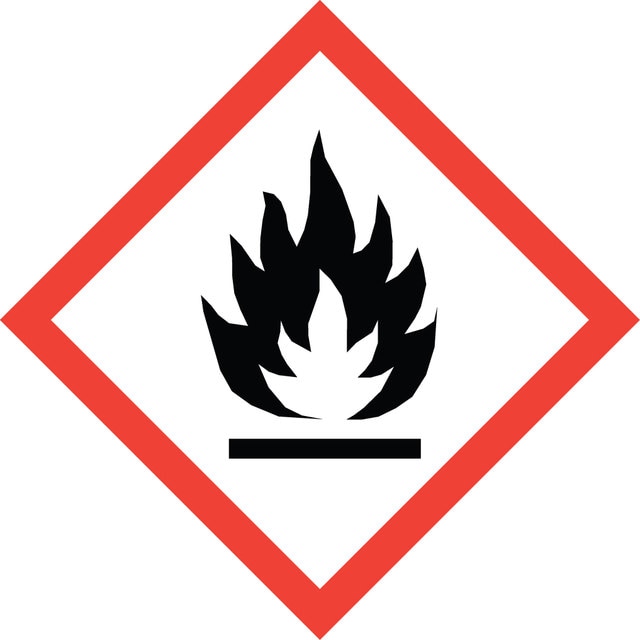


signalword
Danger
hcodes
Hazard Classifications
Acute Tox. 4 Oral - Eye Dam. 1 - Flam. Liq. 2 - Skin Irrit. 2
supp_hazards
Clase de almacenamiento
3 - Flammable liquids
flash_point_f
14.0 °F - closed cup
flash_point_c
-10.0 °C - closed cup
Elija entre una de las versiones más recientes:
¿Ya tiene este producto?
Encuentre la documentación para los productos que ha comprado recientemente en la Biblioteca de documentos.